Geodesics - Some help, please.

Click For Summary
The discussion focuses on the projection of General Relativity geodesics onto a 2-D space, specifically seeking a formula to simulate this effect based on mass input. An embedding diagram is identified as the relevant concept, illustrating the equatorial plane of a massive body in curved Schwarzschild space-time. The formula for this can be found in the discussion of Flamm's paraboloid within the Schwarzschild metric article. A follow-up question raises the interpretation of the vertical dimension in the diagram, debating whether it represents time or velocity, with the consensus being that the vertical dimension lacks physical significance and is merely a visual aid. Overall, the conversation emphasizes the importance of understanding the curvature of space in the context of General Relativity.
RCopernicus
Messages
23
Reaction score
1
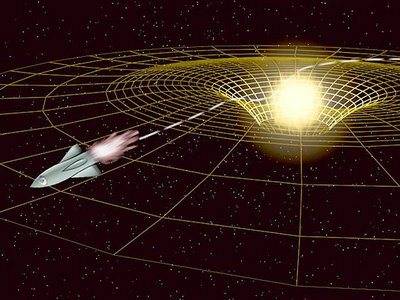
We've all seen an image similar to this one:
Gravity.jpg

This is displaying the projection of GR Geodesics onto 3-D space (well, 2D in the picture). I'm still working my way through the General Relativity texts, so I'm not yet able to do the calculation on my own. Can anyone give me a formula that I can poke into a simulation that takes the mass an input parameter and gives me the geodesic coordinate system projected onto the 2-D space? I'm basically looking to draw the concentric circles in the above picture (given a mass).
 
Physics news on Phys.org
RCopernicus said:
We've all seen an image similar to this one:

<snip>

This is displaying the projection of GR Geodesics onto 3-D space (well, 2D in the picture). I'm still working my way through the General Relativity texts, so I'm not yet able to do the calculation on my own. Can anyone give me a formula that I can poke into a simulation that takes the mass an input parameter and gives me the geodesic coordinate system projected onto the 2-D space? I'm basically looking to draw the concentric circles in the above picture (given a mass).

I think what you are looking for is called an embedding diagram, in particular the diagram you show embeds the 2 dimensional equatorial plane of a massive body in the curved Schwarzschild space-time onto a 3d surface, as a visual aid to understanding the curved spatial geometry of the equatorial (r, theta) plane.

The exact formula can be found be found in the discussion of "Flamm's paraboliod" in the wiki article about the Schwarzschild metric, i.e. http://en.wikipedia.org/w/index.php?title=Schwarzschild_metric&oldid=628392899#Flamm.27s_paraboloid
 
pervect said:
I think what you are looking for is called an embedding diagram, in particular the diagram you show embeds the 2 dimensional equatorial plane of a massive body in the curved Schwarzschild space-time onto a 3d surface, as a visual aid to understanding the curved spatial geometry of the equatorial (r, theta) plane.

The exact formula can be found be found in the discussion of "Flamm's paraboliod" in the wiki article about the Schwarzschild metric, i.e. http://en.wikipedia.org/w/index.php?title=Schwarzschild_metric&oldid=628392899#Flamm.27s_paraboloid

Thanks for the post. Very helpful.
Here's a follow up question: In the diagram above, we see a star that appears to be sitting in some sort of well. The coordinate system of space-time appears to curve into this well making it appear like the spaceship is sitting at a higher potential than the star at the bottom of the well. What isn't obvious is what dimension is pointing into the well? My first reflect was 'time', but upon more reflection, I think it's 'velocity' (inasmuch as the velocity is a projection of the geodesics on a 2-D surface). Is that a fair interpretation?
 
RCopernicus said:
Thanks for the post. Very helpful.
Here's a follow up question: In the diagram above, we see a star that appears to be sitting in some sort of well. The coordinate system of space-time appears to curve into this well making it appear like the spaceship is sitting at a higher potential than the star at the bottom of the well. What isn't obvious is what dimension is pointing into the well? My first reflect was 'time', but upon more reflection, I think it's 'velocity' (inasmuch as the velocity is a projection of the geodesics on a 2-D surface). Is that a fair interpretation?

As far as I know the vertical dimension has no physical significance, and it's a matter of convention whether it's a well or a mountain. The diagram is a visual aid, really, it illustrates a hypothetical 3d surface that gives the correct distances between pairs of points in space. Note that the diagram presupposes a particular slicing of space-time (because it suppresses the t coordinate). The diagram illustrates that given this particular slice, space is curved.
 
In an inertial frame of reference (IFR), there are two fixed points, A and B, which share an entangled state $$ \frac{1}{\sqrt{2}}(|0>_A|1>_B+|1>_A|0>_B) $$ At point A, a measurement is made. The state then collapses to $$ |a>_A|b>_B, \{a,b\}=\{0,1\} $$ We assume that A has the state ##|a>_A## and B has ##|b>_B## simultaneously, i.e., when their synchronized clocks both read time T However, in other inertial frames, due to the relativity of simultaneity, the moment when B has ##|b>_B##...

Similar threads

  • · Replies 76 ·
3
Replies
76
Views
4K
  • · Replies 31 ·
2
Replies
31
Views
2K
  • · Replies 0 ·
Replies
0
Views
1K
  • · Replies 22 ·
Replies
22
Views
3K
  • · Replies 11 ·
Replies
11
Views
2K
  • · Replies 10 ·
Replies
10
Views
5K
  • · Replies 27 ·
Replies
27
Views
7K
  • · Replies 10 ·
Replies
10
Views
2K
  • · Replies 11 ·
Replies
11
Views
3K
  • · Replies 4 ·
Replies
4
Views
1K