Ground is always considered at 0 Volt?

  • Thread starter Thread starter otomanb
  • Start date Start date
  • Tags Tags
    Ground Volt
Click For Summary

Discussion Overview

The discussion revolves around the concept of ground potential in electrical circuits, specifically whether ground is always considered at 0 volts and its implications for current flow in a circuit involving a bulb. Participants explore scenarios with different voltage sources and their effects on the operation of the bulb.

Discussion Character

  • Technical explanation
  • Debate/contested

Main Points Raised

  • Some participants assert that ground is generally considered to be at 0 volts.
  • One participant claims that a bulb will not glow if there is no potential difference to allow current to flow.
  • Another participant points out that the circuit diagram provided does not relate to the question of current flow, suggesting that the configuration shown would prevent the bulb from glowing.
  • A question is raised about the scenario where one source offers 5 volts and another offers 15 volts, leading to a potential difference.
  • Some participants agree that if there is a potential difference, the bulb will glow.
  • One participant mentions that ground can be set at any voltage, as long as other voltages are stated relative to it, although this may not be practical.
  • A participant shares an experience with a simulation software indicating that the bulb glows when there is a 10-volt difference between two batteries.

Areas of Agreement / Disagreement

Participants express differing views on the relationship between ground potential and current flow, with some agreeing that a potential difference is necessary for the bulb to glow, while others emphasize the importance of circuit configuration. The discussion remains unresolved regarding the implications of ground potential in various scenarios.

Contextual Notes

There are limitations in the clarity of the circuit diagram referenced, and assumptions about the configuration of the circuit are not fully explored. The discussion also does not resolve the practical implications of defining ground at different voltages.

otomanb
Messages
59
Reaction score
0
ground is always considered at 0 Volt?
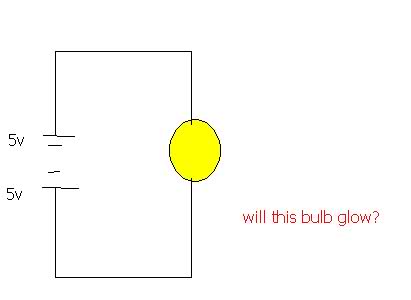
Will this bulb glow and why?

faapp3.jpg
 
Engineering news on Phys.org
No as there is no potential difference to allow current to flow.
 
hi otomanb
Welcome to PF :)

Generally yes its the 0V.

umm just trying to decypher your diagram it appears to show the 2 positive terminals connected to the lamp and the 2 negative teminals connected together.

In this case the lamp WONT glow as there can be no current flow

cheers
Dave
 
your actual subject question doesn't have anything to do with the
circuit diag you have posted and the question you asked about current flow
the 2 questions are not related :)

Dave
 
and if one source offers 5 volt and other offers 15 volt ? will bulb glow?
because now there is a potential difference as it's called voltages!
 
Last edited:
Yes, because there is a potential difference then.

Ground can be any voltage you like as long as you state all other voltages relative to ground. So you could call ground 100V and state all the other voltages relative to this if you wanted... there just isn't much point in doing so.
 
because i tested this thing with a software livewire 1.1 . the bulb glows if one battery provides 15 v and other 5v. And as there is a difference of 10 volts.
 

Similar threads

Replies
6
Views
4K
  • · Replies 7 ·
Replies
7
Views
3K
Replies
47
Views
11K
  • · Replies 2 ·
Replies
2
Views
2K
  • · Replies 3 ·
Replies
3
Views
1K
  • · Replies 13 ·
Replies
13
Views
5K
  • · Replies 5 ·
Replies
5
Views
3K
  • · Replies 28 ·
Replies
28
Views
2K
Replies
59
Views
9K
  • · Replies 15 ·
Replies
15
Views
2K