Why Does Grounding Imply Zero Electric Potential in the Method of Images?

Click For Summary

Discussion Overview

The discussion centers on the concept of grounding and its implication of zero electric potential in the context of the method of images, particularly regarding an infinite conducting plane. Participants explore the theoretical underpinnings, mathematical implications, and physical interpretations of grounding, electric potential, and the behavior of charges in relation to grounded conductors.

Discussion Character

  • Exploratory
  • Technical explanation
  • Conceptual clarification
  • Debate/contested

Main Points Raised

  • Some participants question why a grounded conducting plane is defined as having zero electric potential, suggesting it serves as a reference for potential measurements.
  • There is a discussion about the necessity of an infinite plane for mathematical convenience, as it simplifies the analysis and avoids complications from boundary effects.
  • Some argue that if the plane is conducting but not grounded, it can still have a non-zero potential and contribute to the electric field, although it remains an equipotential surface.
  • Participants explore the implications of placing a charge above the grounded plane, noting that a surface charge distribution develops to maintain the equipotential condition.
  • There is confusion regarding the potential at the location of a point charge, with some asserting that it is infinite, while others discuss the potential in relation to the surrounding space.
  • Some participants emphasize that the method of images relies on symmetry and the uniqueness of solutions to the Laplace equation, which justifies the use of a virtual charge to model the system.

Areas of Agreement / Disagreement

Participants express varying degrees of understanding and confusion regarding the implications of grounding and electric potential. There is no consensus on the nature of potential at the location of charges or the implications of grounding, indicating multiple competing views and unresolved questions.

Contextual Notes

Limitations include assumptions about the infinite nature of the conducting plane, the definition of zero potential, and the treatment of singularities in electric potential calculations. The discussion also highlights the complexity of electric fields and potentials in relation to grounded conductors.

sinus
Messages
17
Reaction score
1
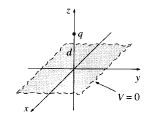
Can anyone explain to me why grounded means zero electric potential. I confuse what's the relation between infinite ground conducting plane and its electric potential (the method of images).
1675585195620-png.png


I have a several question:
1. Why the conductor plane must be infinite, while in reality there's no such one.
2. Why the electric potential must be zero to using this method?
2. If the plane isn't be grounded, does its electric potential not zero? What's exactly that making the potential in the plane zero when we grounded it? How ?
As far as I know that the electron easily run into the ground, does it mean the plane become positive charge?
 
Physics news on Phys.org
HI,

It's all mathematics. A solution of the Laplace equation is unique. The math is reasonable when good use is made of infinity. So for your #1 question: to keep the math from becoming unpleasant.

#2: If the plane is conducting and not grounded and not neutral, it contributes to the electric field and needs to be taken into account. Its surface is still an equipotential surface, though.
sinus said:
grounded means zero electric potential
That's just a conventient convention. All physics is independent of the choice of zero potential. Often infinity is chosen (but sometimes that doesn't work, for instance with the electric field of an infinitely long wire charge).

sinus said:
As far as I know that the electron easily run into the ground, does it mean the plane become positive charge?
Yes ! That's the fun of the image method. And quite useful, to boot!

##\ ##
 
  • Informative
Likes   Reactions: sinus
BvU said:
HI,

It's all mathematics. A solution of the Laplace equation is unique. The math is reasonable when good use is made of infinity. So for your #1 question: to keep the math from becoming unpleasant.

#2: If the plane is conducting and not grounded and not neutral, it contributes to the electric field and needs to be taken into account. Its surface is still an equipotential surface, though.
That's just a conventient convention. All physics is independent of the choice of zero potential. Often infinity is chosen (but sometimes that doesn't work, for instance with the electric field of an infinitely long wire charge).Yes ! That's the fun of the image method. And quite useful, to boot!

##\ ##
Thanks a lot, but I still a little bit confused, why then the plane that have positive charge has zero electric potential?
If we take a case of point charge in space at coordinat position x,y; does that mean electric potential exactly at that x,y is zero? Where the charge is, the potential right at that charge place is zero and only its surrounding that have a potential? And similiarly to a charged plate?
 
sinus said:
Thanks a lot, but I still a little bit confused, why then the plane that have positive charge has zero electric potential?
If we take a case of point charge in space at coordinat position x,y; does that mean electric potential exactly at that x,y is zero? Where the charge is, the potential right at that charge place is zero and only its surrounding that have a potential? And similiarly to a charged plate?
BvU said:
HI,

It's all mathematics. A solution of the Laplace equation is unique. The math is reasonable when good use is made of infinity. So for your #1 question: to keep the math from becoming unpleasant.

#2: If the plane is conducting and not grounded and not neutral, it contributes to the electric field and needs to be taken into account. Its surface is still an equipotential surface, though.
That's just a conventient convention. All physics is independent of the choice of zero potential. Often infinity is chosen (but sometimes that doesn't work, for instance with the electric field of an infinitely long wire charge).Yes ! That's the fun of the image method. And quite useful, to boot!

##\ ##
how it can be zero, while the plane have charge? If we look to the formula that:
V=k(q/r), at any point as long as the point is right on the plane then r =0, how "k and q" divides zero become zero?
 
sinus said:
Thanks a lot, but I still a little bit confused, why then the plane that have positive charge has zero electric potential?
A conducting grounded plane (infinitely large to keep thing simple) is an equipotential surface (otherwise charges would move until it was). If you place a charge ##q## above it at a distance ##d##, the plane still remains an equipotential surface, so things must happen:
A nonzero surface charge distribution builds up on the top surface in such a way that the plane still remains an equipotential surface. The electric field lines just above the top surface have to be perpendicular to the plate (or else the charges would move along the surface).

Since a configuration with an imaginary charge ##-q##, at ##-d## opposite the actual charge causes exactly the electric field distribution in space that satisfies these conditions (zero potential at the surface and field lines perpendicular to the surface) AND a solution to the Laplace equation is unique, this mirror method is justified.

With Gauss' theorem you can find the induced surface charge distribution. The integral of the surface charge over the entire top surface is ##-q##.

sinus said:
If we take a case of point charge in space at coordinat position x,y; does that mean electric potential exactly at that x,y is zero? Where the charge is, the potential right at that charge place is zero and only its surrounding that have a potential? And similiarly to a charged plate?
NO ! A point charge is a singularity. The electric field and the potential at its exact position are infinite (in the convention that field and potential are zero at infinite distance from the point charge.

sinus said:
how it can be zero, while the plane have charge? If we look to the formula that:
V=k(q/r), at any point as long as the point is right on the plane then r =0, how "k and q" divides zero become zero?
I don't follow. How can what be zero ? Are you mixing up an equation for the potential field caused by a single point charge in space with a potential field (*) caused by a charge distribution on a plane ?

(*) in the half-space above the plate

##\ ##
 
  • Like
  • Informative
Likes   Reactions: sinus and PhDeezNutz
sinus said:
Can anyone explain to me why grounded means zero electric potential.
All potentials are differential, measured between points. Defining a perfectly conductive plane as zero potential provides a reference for all potential measurements. What happens above the plane will be reflected by the plane like a mirror, which will invert the potential of the virtual image below the plane.

sinus said:
1. Why the conductor plane must be infinite, while in reality there's no such one.
If the plane is defined as being infinite, it becomes unnecessary to specify the boundary. That makes it easier to handle situations where an image may or may not form. It also eliminates peripheral currents along the boundary of the plane, and reflections of currents from the boundaries of the plane.

sinus said:
2. Why the electric potential must be zero to using this method?
If the potential of a point above the ground plane is +v, then the image below will appear to have a potential of -v. If the ground plane was not at zero potential, symmetry would be lost, and the analysis would rapidly become intractable.
 
  • Like
  • Love
Likes   Reactions: sinus and BvU
BvU said:
A conducting grounded plane (infinitely large to keep thing simple) is an equipotential surface (otherwise charges would move until it was). If you place a charge ##q## above it at a distance ##d##, the plane still remains an equipotential surface, so things must happen:
A nonzero surface charge distribution builds up on the top surface in such a way that the plane still remains an equipotential surface. The electric field lines just above the top surface have to be perpendicular to the plate (or else the charges would move along the surface).

Since a configuration with an imaginary charge ##-q##, at ##-d## opposite the actual charge causes exactly the electric field distribution in space that satisfies these conditions (zero potential at the surface and field lines perpendicular to the surface) AND a solution to the Laplace equation is unique, this mirror method is justified.

With Gauss' theorem you can find the induced surface charge distribution. The integral of the surface charge over the entire top surface is ##-q##.

NO ! A point charge is a singularity. The electric field and the potential at its exact position are infinite (in the convention that field and potential are zero at infinite distance from the point charge.I don't follow. How can what be zero ? Are you mixing up an equation for the potential field caused by a single point charge in space with a potential field (*) caused by a charge distribution on a plane ?

(*) in the half-space above the plate

##\ ##
Thank you so much for your explanation, I finally understand. I'm sorry for my question that make you confused and sorry for long time I didn't reponse. It's because my mind that make it look like it complicated when it wasn't :)
 
  • Like
Likes   Reactions: BvU
Baluncore said:
All potentials are differential, measured between points. Defining a perfectly conductive plane as zero potential provides a reference for all potential measurements. What happens above the plane will be reflected by the plane like a mirror, which will invert the potential of the virtual image below the plane.If the plane is defined as being infinite, it becomes unnecessary to specify the boundary. That makes it easier to handle situations where an image may or may not form. It also eliminates peripheral currents along the boundary of the plane, and reflections of currents from the boundaries of the plane.If the potential of a point above the ground plane is +v, then the image below will appear to have a potential of -v. If the ground plane was not at zero potential, symmetry would be lost, and the analysis would rapidly become intractable.
Thank you so much for your explanations:)
 

Similar threads

  • · Replies 4 ·
Replies
4
Views
3K
  • · Replies 14 ·
Replies
14
Views
3K
  • · Replies 4 ·
Replies
4
Views
2K
  • · Replies 11 ·
Replies
11
Views
2K
  • · Replies 3 ·
Replies
3
Views
1K
  • · Replies 2 ·
Replies
2
Views
2K
  • · Replies 4 ·
Replies
4
Views
2K
  • · Replies 12 ·
Replies
12
Views
2K
  • · Replies 1 ·
Replies
1
Views
1K
  • · Replies 8 ·
Replies
8
Views
2K