Discussion Overview
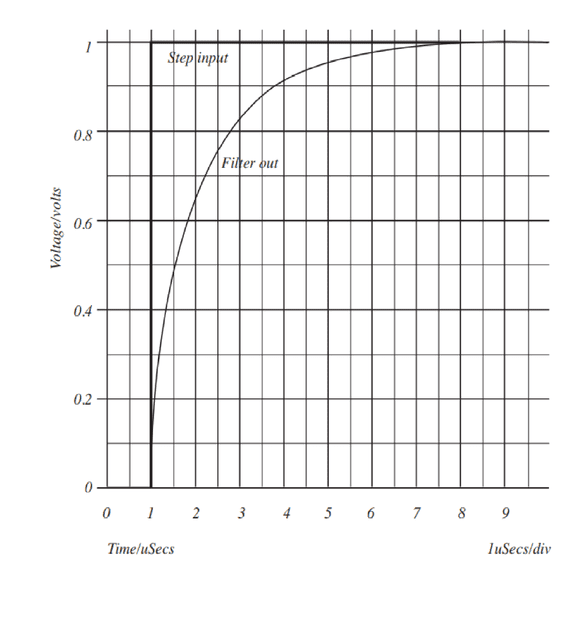
The discussion revolves around estimating the half-power cut-off frequency of a first-order filter based on its response to a step input. Participants explore how to sketch the frequency and phase response, as well as the methods for calculating the cut-off frequency and the implications of different definitions of rise time.
Discussion Character
- Exploratory
- Technical explanation
- Debate/contested
- Mathematical reasoning
Main Points Raised
- The original poster (OP) calculates the half-power cut-off frequency as 127.27 kHz but is uncertain about sketching the frequency and phase response.
- Some participants suggest that the OP should consider a simple RC lowpass filter and write its transfer function using complex impedances to plot the frequency domain response.
- There is a question about how the OP arrived at the frequency of 127.27 kHz, with some participants noting they calculated a slightly higher value based on the graph and relevant equations.
- Participants discuss the use of different methods to find the 3dB cut-off frequency from the step response, specifically mentioning the rise time (10% to 90%) and the 63% criterion.
- One participant notes that practicing electrical engineers often use the 10-90% definition of rise time, while physicists and mathematicians may use various approaches.
- There is a discussion about the origin of the rule of thumb for calculating the cut-off frequency based on rise time, with references to the step response of a single pole.
- Concerns are raised about potential artifacts in the step response that could affect the accuracy of the rise time definitions used.
Areas of Agreement / Disagreement
Participants express differing views on the appropriate methods for calculating the cut-off frequency and the implications of the step response graph. There is no consensus on which method is definitively correct, and the discussion remains unresolved regarding the accuracy of the graph provided in the problem statement.
Contextual Notes
Participants highlight that results can differ considerably depending on the method used for calculating the cut-off frequency, and they express uncertainty about the correctness of the provided graph. The discussion also touches on the influence of non-dominant poles and instrumentation issues on the step response.