Heat Capacity of a Van Der Waals' gas in an Open system

Click For Summary
SUMMARY

The discussion centers on the calculation of heat capacity for a Van der Waals gas in an open system, utilizing Wassermann's Thermal Physics as a reference. The participant initially struggled with the complexity of deriving entropy and heat capacity, specifically the isobaric heat capacity \(C_p\). Through feedback, they identified mistakes in their calculations and successfully derived the correct value of \(C_p = \frac{5}{2} Nk\) for an ideal gas, acknowledging that the Van der Waals gas presents additional complexities.

PREREQUISITES
  • Understanding of Van der Waals equation of state
  • Familiarity with thermodynamic concepts such as heat capacity and entropy
  • Knowledge of quantum concentration and its relation to ideal gas partition function
  • Ability to perform partial derivatives in thermodynamic equations
NEXT STEPS
  • Study the derivation of the Sackur-Tetrode equation for entropy
  • Learn about the implications of the Van der Waals equation on heat capacity calculations
  • Explore the relationship between \(C_p\) and \(C_v\) using Maxwell's relations
  • Investigate the effects of non-ideal gas behavior on thermodynamic properties
USEFUL FOR

Students and researchers in thermal physics, particularly those focusing on thermodynamic properties of gases, including heat capacity calculations for ideal and non-ideal gases.

Astrocyte
Messages
15
Reaction score
4
Homework Statement
Find Cp-Cv for Van Der Waals' Gas
Relevant Equations
Grand Partition Function, Grand potential.
In our class, we're using Wassermann's Thermal physics as textbook.
I always try to solve all question which included in Text book.
But sometime when I meet a problem that look like easy but actually hard, I'm so embarrassed.
This problem do also.

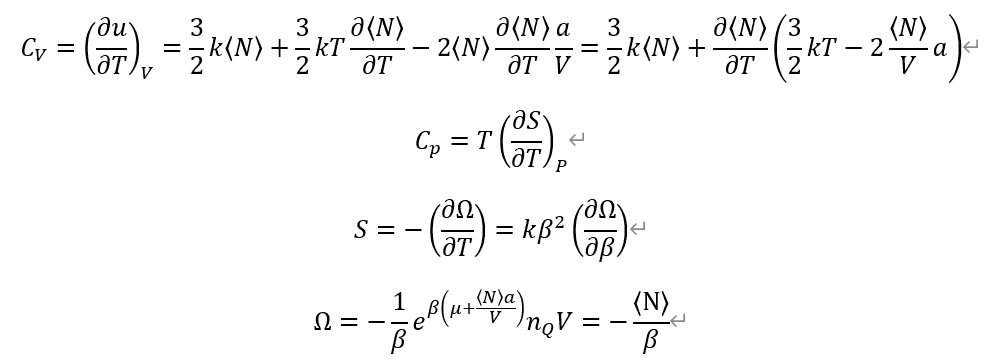
First, in the textbook grand potential for van der Waals' gas is

1603535055780.png

Next, I calculated routinely, but it's so complex.
The internal energy come from previous problem. I guess it's right.

1603535158385.png

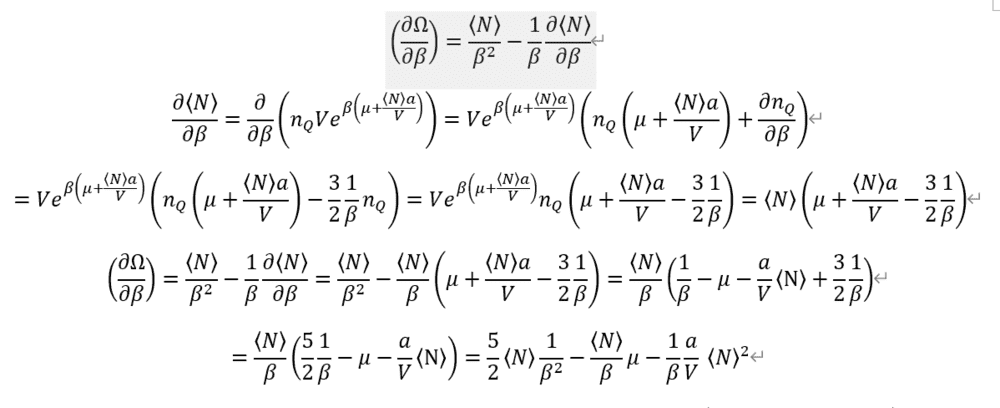
From definition of each Heat capacities. And, Entropy from Grand potential Omega.
I used previous calculation on average particle number <N>.
<N>=exp( \beta (\mu + <N>a/V))*n_Q*V
Also, n_Q is quantum concentration, which come from Ideal gas partition function, and define (m/(2*\pi*\hbar^2*\beta)^3/2
So, n_Q also depends on \beta or Temperature T.
1603535178643.png

1603535213417.png

1603535257563.png

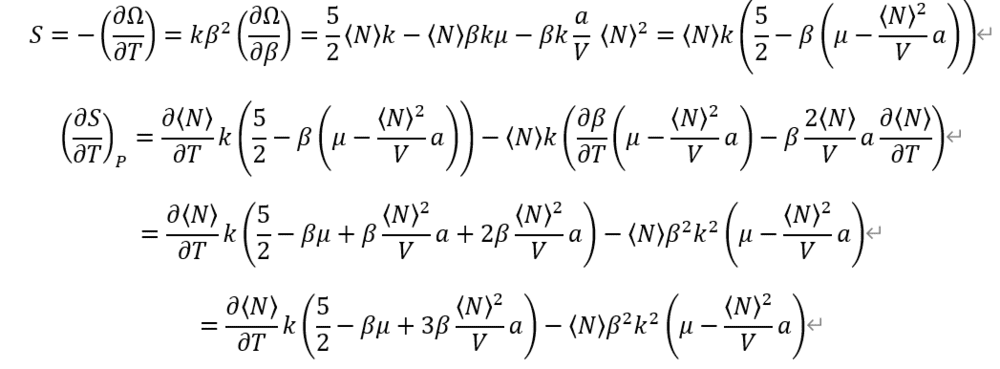
Entropy is so complex.
1603535626052.png

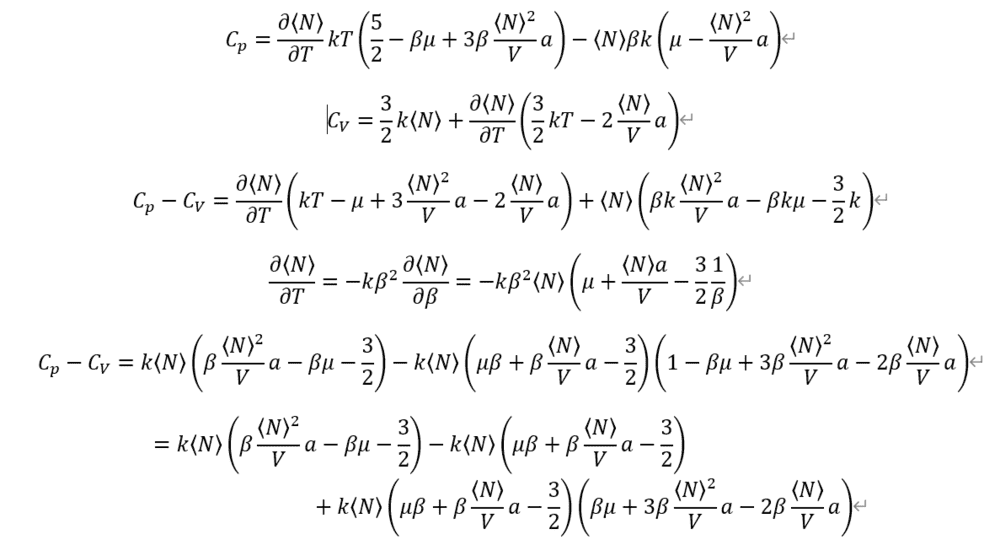
And I given up, because it's so complex for calculating by hand.
Where am I wrong?
 
Physics news on Phys.org
Well, one thing you're doing wrong is assuming N is a function of T.
 
  • Like
Likes   Reactions: Astrocyte
To find where i wrong, I tried to solve isobaric heat capacity in ideal gas.
So, I got entropy. it's the Sackur-Tetrode equation.
$$S=\braket{N} k[\frac{5}{2}-\beta\mu], when \;\mu \; is\; chemical\; potential.$$
it's same with
$$S=\braket{N}k[5/2-\ln{\frac{ \braket{N}}{(n_Q*V)} } ].$$
The definition of isobaric heat capacity is
$$C_{p}=T(\frac{\partial {S}}{\partial {T}})_{p},$$.
As we know, isobaric heat capacity in ideal gas is
$$C_{P}=\frac{5}{2} Nk.$$
But, I cannot prove it also...
I tried
$$C_{p}=T(\frac{\partial {S}}{\partial {T}})_{p,N}$$
It didn't work...
 
Are you familiar with the following equation for an arbitrary equation of state:

$$C_p-C_v=T\left(\frac{\partial V}{\partial T}\right)_P\left(\frac{\partial P}{\partial T}\right)_V$$
 
  • Like
Likes   Reactions: Astrocyte
Thanks!

I have checked all of my equation... And, I found several mistakes.

By your feedback, I tried it without derivative of N respective of T.

And I got a right Cp value. 5/2 Nk.

And also I will try the equation you gave me.

Really Really Thank you. :D
 
Astrocyte said:
Thanks!

I have checked all of my equation... And, I found several mistakes.

By your feedback, I tried it without derivative of N respective of T.

And I got a right Cp value. 5/2 Nk.

And also I will try the equation you gave me.

Really Really Thank you. :D
That Cp value is only for an ideal gas, right?
 
  • Like
Likes   Reactions: Astrocyte
Chestermiller said:
That Cp value is only for an ideal gas, right?

Yes. I only tried it about Cp value, because the van Der Waals gas's one is so complicated.
In addition, that Cp value come from
$$ \ln{\frac{⁡⟨N⟩}{nQV}} = \ln{\frac{⁡⟨N⟩βP}{nQ⟨N⟩}} = ln⁡{\frac{βP}{n_Q}} $$

in Entropy term.
And fortunately, In my midterm, my professor didn't ask about heat capacity, and Van der Waals' gas.
 

Similar threads

Replies
1
Views
2K
Replies
6
Views
3K
  • · Replies 8 ·
Replies
8
Views
3K
  • · Replies 23 ·
Replies
23
Views
11K
  • · Replies 6 ·
Replies
6
Views
4K
  • · Replies 7 ·
Replies
7
Views
3K
  • · Replies 1 ·
Replies
1
Views
3K
  • · Replies 8 ·
Replies
8
Views
2K
Replies
1
Views
2K
  • · Replies 3 ·
Replies
3
Views
8K