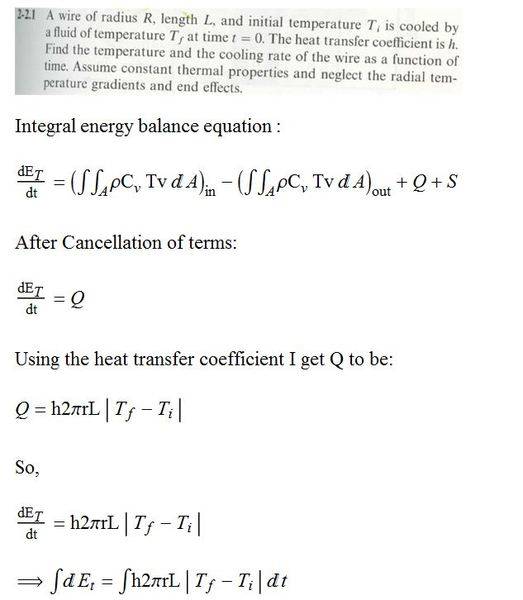
Whenever you solve an engineering-type problem, look at your result to see if it makes sense with what you perceive to be reality. You have determined the temperature as a function of time. According to your result, the temperature change over any time interval is the same because your function is linear in time. Think of a cup of hot coffee at 200 F. In 20 seconds it will have cooled somewhat. Its mean temperature will have dropped x degrees. Now think about the coffee over the time interval of 5 minutes and 5 minutes plus 20 seconds. Would you expect the temperature drop to be the same? Suppose you go 10 minutes and 10 minutes plus 20 seconds. Would you again expect the temperature drop over that interval to be the same?
The linearity of your function indicates such would be the case. But we all know it isn't. The boundary condition is what drives this problem. Its strength depends on the difference between the object's temperature and the ambient temperature (and also some constants). Therefore its strength lessens in time because the temperature difference vanishes. Your result should reflect this.