Heat transfer from a closed cylinder filled with fluid

Click For Summary
SUMMARY

The discussion focuses on the thermal management of a large uninsulated steel cylinder filled with hydraulic fluid, specifically mineral oil, to maintain a surface temperature above 40 degrees Fahrenheit during winter. The user currently employs three 1200-W heaters, which are insufficient under ambient temperatures of 25F. A calculation indicates that an additional 7.2 kW of heating capacity is required, suggesting the need for three more heaters. The consensus emphasizes the importance of insulating the cylinder to enhance heat retention, potentially reducing the need for additional heaters and improving energy efficiency.

PREREQUISITES
  • Understanding of heat transfer principles, specifically conduction and convection.
  • Familiarity with thermal insulation materials and their properties.
  • Knowledge of hydraulic systems and the behavior of fluids at varying temperatures.
  • Basic electrical engineering concepts related to heater wattage and energy calculations.
NEXT STEPS
  • Research industrial pipe insulation options and their thermal resistance ratings.
  • Investigate hydraulic fluids designed for low-temperature environments.
  • Learn about heat loss calculations for cylindrical objects to optimize heater placement.
  • Explore the use of fluid recirculation systems for temperature maintenance in hydraulic applications.
USEFUL FOR

This discussion is beneficial for mechanical engineers, maintenance technicians, and anyone involved in thermal management of hydraulic systems, particularly in cold environments.

msteves
Messages
7
Reaction score
0
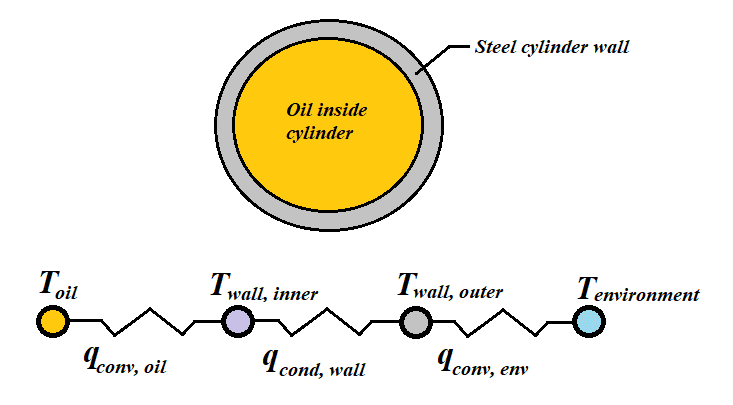
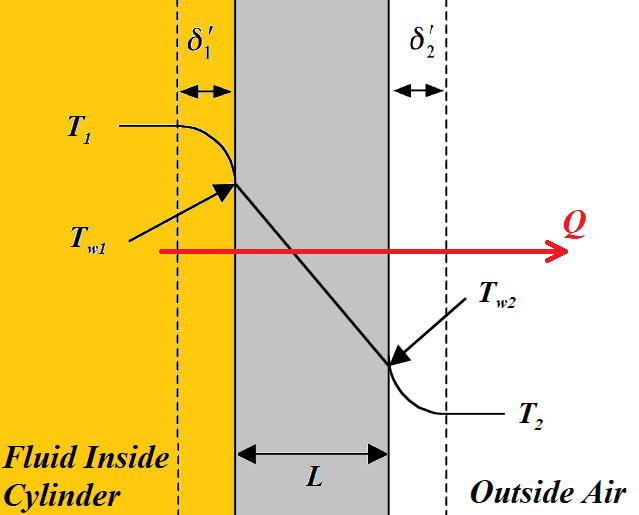
I have a long steel uninsulated cylinder filled with hydraulic fluid (let's say it's mineral oil), and I need to figure out how many barrel heaters to clamp onto it in the winter months to prevent the steel surface temperature from dropping under 40 degrees Fahrenheit. My question is, how do I set up this problem? I currently have three 1200-W heaters, and I know that under an ambient temperature of 25F, I get sensors reporting under 40F, so I know these were undersized. I've attached a couple figures I made to try to best represent the problem. The numbers I have been getting have not instilled confidence in my work. Insulating these is tricky, but I know I will need to at least insulate portions of them.

Side note: the oil is locked up, with very occasional spurts of new oil entering the system at 100F. I am just assuming the oil is isolated in the cylinder.

Thanks for any help you can provide.
Untitled.png
Untitled2.png
 

Attachments

  • Untitled.png
    Untitled.png
    9.8 KB · Views: 849
  • Untitled2.png
    Untitled2.png
    6.7 KB · Views: 839
Science news on Phys.org
Wow. Your 3.6 kW of heat can only raise the temperature 15 deg F above ambient? My own house only needs 3.8 kW to raise the temperature 90 deg F above ambient. Simple rule of thumb: the temperature rise is proportional to the amount of heat added. If your minimum ambient is 10 deg F and the required temperature is 40 deg F, then the desired temperature rise is 30 deg F. 30 / 15 X 3.6 kW = 7.2 kW = three more heaters.

You would be far better off to put some insulation on that cylinder. If you added an inch or two of industrial pipe insulation, the existing heaters would be overkill. The insulation might even cost less than the additional heaters, wiring, and controls. Add in the electricity savings, and you have a strong business case for insulation.
 
  • Like
Likes   Reactions: anorlunda
yes, my cylinder is pretty large (192 sq-ft surface area of uninsulated steel). I'm assuming your house is fairly well designed for this purpose. i really appreciate your response, but can you explain your logic of the 3x more heaters equation you used? i completely agree on the insulation part, and that i what i will push for regardless, there's just a lot of stuff on it that complicates this and makes it difficult for maintenance. just not sure where the (deltaT)/(capable heat rise)*(existing heat input)=add't heat required is coming from. though, it's also evening and I'm off work til monday...

again, appreciate the reply.
 
Are they any hydraulic fluids specifically made for very cold environments? It would be far simpler if they exist
than any heating gizmo.
 
the problem here is not that the fluid is incompatible, it's that the cylinder steel wall temperature cannot be below 40F. i mentioned the fluid because i recognized that it is one of the two ways (along with added heaters) that heat transfer would occur through this wall to keep the wall temp up.
 
If not a fluid issue, why the 40F limitation? On startup, could the fluid be recirculated through either the pump or another heating
device to warm it up?
 
The bottom line is that the cylinder failed its Charpy impact test after manufacturing, and 40F was the "passing" temperature. So anytime it's used, it needs to remain above 40F. Recirculation of the fluid, although simple in theory, adds complexity in this case. My goal is to come up with a justification for adding more heaters, and to insulate what sections that can be accessed (there are manifolds/hoses/etc. surrounding this cylinder).
 

Similar threads

  • · Replies 5 ·
Replies
5
Views
3K
Replies
7
Views
2K
  • · Replies 5 ·
Replies
5
Views
1K
  • · Replies 9 ·
Replies
9
Views
2K
  • · Replies 1 ·
Replies
1
Views
2K
  • · Replies 2 ·
Replies
2
Views
3K
  • · Replies 7 ·
Replies
7
Views
2K
  • · Replies 1 ·
Replies
1
Views
3K
  • · Replies 5 ·
Replies
5
Views
2K
  • · Replies 1 ·
Replies
1
Views
2K