Heat transfer through a MultiLayer Cylinder (find the Temperature inside)

Join the discussion
Ask a follow-up here, or get your own question answered by working scientists, mathematicians and engineers — people, not an autocomplete.
Real named experts · corrections over time · the nuance an AI answer skips
7 replies · 3K views
Jweck002
Messages
7
Reaction score
0
TL;DR
Finding interior wall Temperature through a Multi Layer Cylinder knowing only exterior temp
Hello,

I am a Mechanical Engineer a little out of practice on Heat transfer. I am trying to solve this problem. It must be solvable but i have yet to find right equations online.
I have a multi Layer Cylinder made up of C350 marraging Steel,Zinc Alloy-12 , then 6061 Aluminum T6. All that is known is the temperature of the steel and of course the parameters & material properties of each metal. The temperature is over a time also. Outside surface starts 70 F @ 0 seconds and goes 180 F @ 25 s, 200 F @ 40s, 225F @ 45s, 250F @ 50s, 280 @ 60s.
I was looking for conductive heat transfer but all formulas i found need Q (heat flux). Which i don't believe i have. Please help.
Material properties:
C350 :
denisty : 0.292 lb/in^3
conductivity: k = 25.3 W/mK @ 20C

ZA-12:
density: 0.218 lb/in3
Conductivity: k = 110 W/m-K

Al 6061 T6:
Density: 0.0975 lb/in³
Conductivity: k= 167 W/m-k
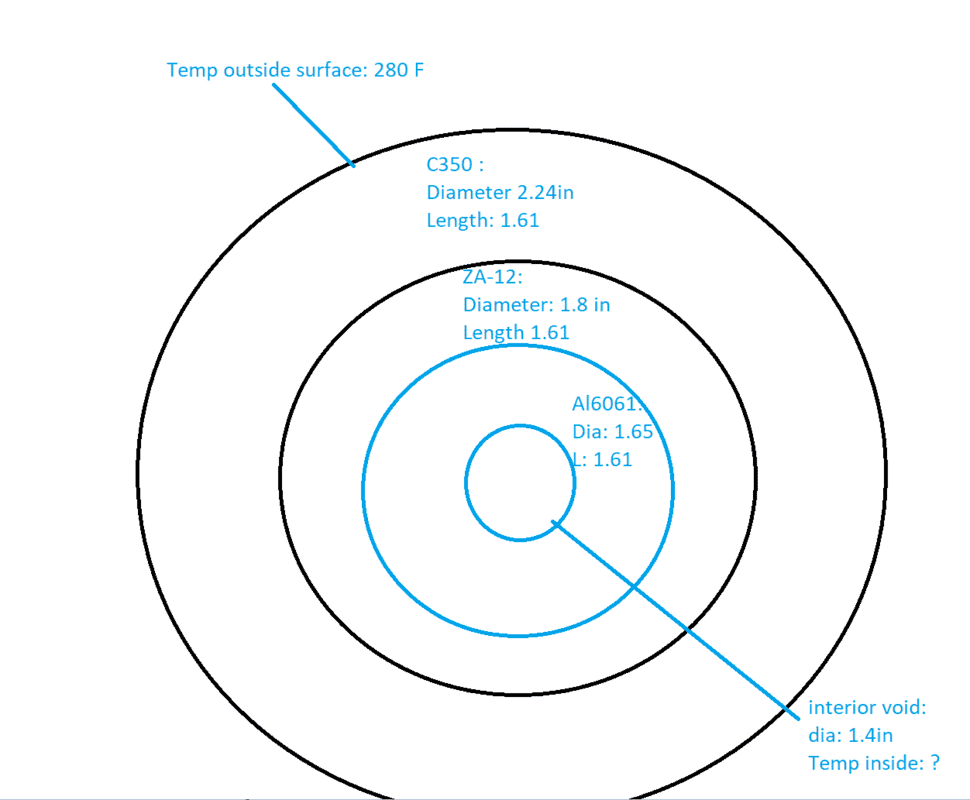
1580482630439.png
 
on Phys.org
Chestermiller said:
Are you willing to accept a numerical solution?

yes, as long as work is shown and explained so i may learn. Thanks for the help.
 
I'm not going to provide you with the numerical solution. I'm just going to explain how to formulate the equations and describe what is involved in solving the equations numerically. Are you familiar with the transient heat conduction equation in cylindrical coordinates for a circumferentially symmetric system like this (where the temperature varies only radially)? If so, please write it down.
 
Chestermiller said:
I'm not going to provide you with the numerical solution. I'm just going to explain how to formulate the equations and describe what is involved in solving the equations numerically. Are you familiar with the transient heat conduction equation in cylindrical coordinates for a circumferentially symmetric system like this (where the temperature varies only radially)? If so, please write it down.

I do not fully remember it. Is is something like this? (sorry i haven't taken heat transfer in a few years)
IMG_0389.jpg
 
Yes. That is correct. For your situation (and, assuming constant thermal properties), it reduces to
$$\rho C_p\frac{\partial T}{\partial t}=\frac{k}{r}\frac{\partial}{\partial r}\left(r\frac{\partial T}{\partial r}\right)$$This equation applies to each and every one of the layers (of course, using the properties for each layer). The boundary condition at the very outer radius is ##T(R,t)=F(t)## where F is the imposed time-dependent temperature variation. What do you think the boundary condition at the very inner radius is? What do you think the boundary conditions are at the interfaces between the layers?
 
Chestermiller said:
Yes. That is correct. For your situation (and, assuming constant thermal properties), it reduces to
$$\rho C_p\frac{\partial T}{\partial t}=\frac{k}{r}\frac{\partial}{\partial r}\left(r\frac{\partial T}{\partial r}\right)$$This equation applies to each and every one of the layers (of course, using the properties for each layer). The boundary condition at the very outer radius is ##T(R,t)=F(t)## where F is the imposed time-dependent temperature variation. What do you think the boundary condition at the very inner radius is? What do you think the boundary conditions are at the interfaces between the layers?

I have no clue. I am out of my depth here. Do not remember this at all
is it
 

Attachments

  • IMG_0393.jpg
    IMG_0393.jpg
    63.4 KB · Views: 271
Jweck002 said:
I have no clue. I am out of my depth here. Do not remember this at all
is it
No. At the very inner radius, the heat flux is zero, so ##\frac{\partial T}{\partial r}=0##

At the interfaces between layers, T is continuous and the heat flux is continuous: $$T^+=T^- $$and$$\left[k\left(\frac{\partial T}{\partial r}\right)\right]^+=\left[k\left(\frac{\partial T}{\partial r}\right)\right]^-$$ where the + and the - refer to the two abutting materials at the interface (i.e., the two sides of the interface).
 
Last edited:
  • Like
Likes   Reactions: Jweck002