Boundary conditions for convective heat and mass transfer + wall Temperature

Click For Summary

Discussion Overview

The discussion revolves around the boundary conditions for convective heat and mass transfer in a finite difference context, specifically concerning the temperatures at the wall and within the fluid in a pipe. Participants explore how to appropriately define and apply these boundary conditions in their calculations.

Discussion Character

  • Technical explanation
  • Debate/contested
  • Mathematical reasoning

Main Points Raised

  • One participant questions which temperature value to use at the boundary condition, specifically whether to use the wall temperature (Tw) or the bulk fluid temperature (T) at the wall point.
  • Another participant suggests that the boundary condition should be expressed in finite difference terms and questions the relationship between T and Tw at the wall.
  • A later reply clarifies that Tb represents the exterior imposed temperature of the surrounding medium, distinct from the wall temperature, and assumes a transient problem context.
  • Further clarification is provided regarding the role of Tb as the bulk temperature outside the wall and the fictitious temperature T5 in the boundary condition equation.

Areas of Agreement / Disagreement

Participants express differing views on the definitions and roles of T, Tw, and Tb in the boundary condition equations. The discussion remains unresolved regarding the precise application of these temperatures in the finite difference formulation.

Contextual Notes

Participants highlight potential confusion regarding the evaluation points for temperatures in the boundary condition equations, particularly in relation to spatial dimensions and the transient nature of the problem.

maistral
Messages
235
Reaction score
17
I am operating via finite differences.

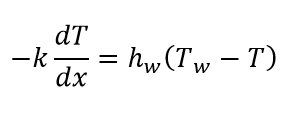
Say for example, I have this pipe that contains a fluid. I have the boundary condition at x = x1:
deriv.png

k is the effective thermal conductivity of the fluid, T is the temperature of the fluid at any point x, hw is the wall heat transfer coefficient, and Tw is the temperature at the wall.

I know how to 'plug in' such boundary conditions in finite difference formulations. My question is which value of T do I use? Is it T at x = x1? But isn't that Tw already, since x1 is the wall?

I keep on seeing that T here is supposed to be the bulk temperature. The problem is since I'm doing this by finite difference, the temperature of the fluid is not constant along the spatial dimension. In this case, which point to use exactly? Is it the point at the fluid beside the wall point?

Or is it that at the 'wall point', there are 'two operating temperatures' - the 'wall temperature' and the 'bulk fluid temperature' at the wall?

Any help is appreciated. Thank you!
 
Last edited:
Engineering news on Phys.org
EDITED; Additional info:

The first equation written below is the boundary condition I lifted directly from a book. If I express the boundary condition in terms of finite differences, I write it as the second equation, am I correct?

1574704848241.png


But if I do write it as the second equation, isn't T(r) just equal to Tw(r), since this boundary condition is applied at the wall? Or am I missing something here?

Or Tw(r) is indeed, the temperature at the wall (r = d/2)? If then, what is T in the RHS of the equation, and at which value of r do I evaluate it? Certainly it should not be r = d/2 since it would just cancel out?
 
Last edited:
This graphic should sum up my rather, annoying problem that makes me look like someone who wants to constipate. Please help.
reactor help!.png
 
You are aware that Tb is supposed to be the exterior imposed temperature of the surrounding medium, outside the thermal boundary layer at the wall. It has nothing to do with the wall temperature. I assume you are solving a transient problem, correct? Your boundary condition equation should read: $$-\lambda\frac{(T_5-T_3)}{2\Delta x}=h_w(T_b-T_4)$$This should be combined with your transient differential equation at point 4 to eliminate ##T_5##.
 
Allow me to reinforce my understanding.

In your equation, this means Tb is the bulk temperature at the right side (outside) of the wall, yes?
 
maistral said:
Allow me to reinforce my understanding.

In your equation, this means Tb is the bulk temperature at the right side (outside) of the wall, yes?
Yes. Of course, T5 is a fictitious temperature that gets eliminated by combining with the discretized transient energy balance equation at point 4.
 
Last edited:

Similar threads

  • · Replies 1 ·
Replies
1
Views
2K
  • · Replies 4 ·
Replies
4
Views
4K
  • · Replies 4 ·
Replies
4
Views
4K
  • · Replies 1 ·
Replies
1
Views
2K
Replies
13
Views
4K
  • · Replies 6 ·
Replies
6
Views
2K
Replies
2
Views
4K
  • · Replies 4 ·
Replies
4
Views
2K
Replies
18
Views
5K
  • · Replies 21 ·
Replies
21
Views
3K