Helmholtz free energy for mixing?

Click For Summary
SUMMARY

The discussion centers on the derivation of excess Helmholtz energy equations for mixing, specifically referencing the work of Wong and Sandler. Participants highlight the need for reliable resources to understand these equations, with recommendations including "Introduction to Chemical Engineering Thermodynamics" by Smith and Van Ness, which covers Gibbs free energy concepts relevant to the topic. Additionally, it is noted that Sanders derived these equations for Van der Waals gas mixtures, providing a foundational context for their application.

PREREQUISITES
  • Understanding of excess Helmholtz energy in thermodynamics
  • Familiarity with Van der Waals gas equations
  • Knowledge of Gibbs free energy principles
  • Basic concepts of chemical engineering thermodynamics
NEXT STEPS
  • Study the derivation of excess Helmholtz energy equations in thermodynamics
  • Review the Van der Waals equation of state for gas mixtures
  • Examine the Gibbs free energy concepts in "Introduction to Chemical Engineering Thermodynamics" by Smith and Van Ness
  • Explore advanced thermodynamic models for mixing rules in chemical engineering
USEFUL FOR

Chemical engineers, thermodynamics researchers, and students studying chemical engineering principles will benefit from this discussion, particularly those interested in the thermodynamic properties of gas mixtures.

maistral
Messages
235
Reaction score
17
TL;DR
Derivation of formula.
Hi, I have been reading a few literature regarding excess Helmholtz energy and I encountered this definition from the paper of Wong and Sandler (apparently, from the mixing rule used in a EOS):
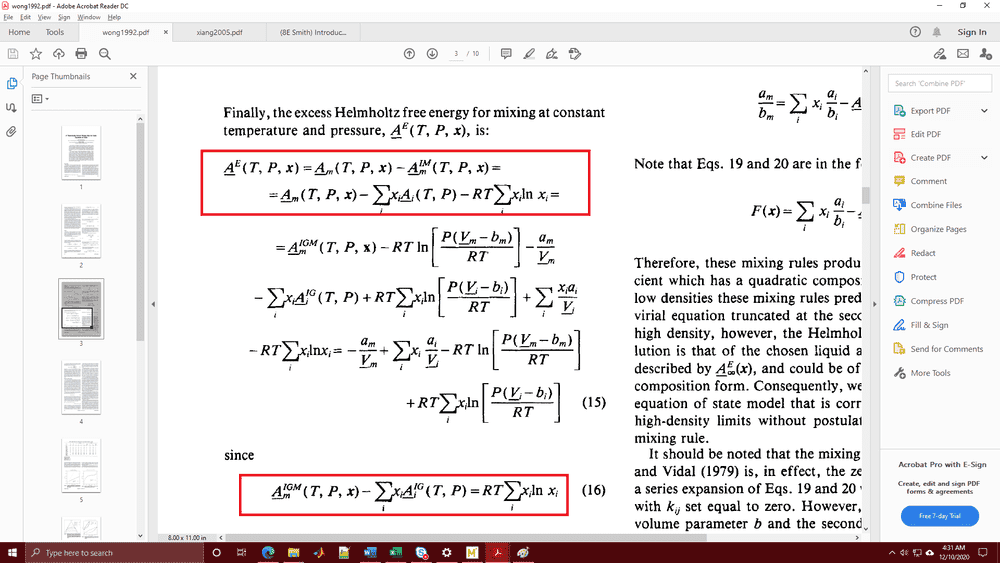
wong.png


In particular, the ones in the red boxes.

How did these equations come into being? I tried to look for it in books like Tester and SVNA and I still am unable to find where on Earth did these come from. Can someone point me to a reliable resource? Thanks.
 
  • Like
Likes   Reactions: Astronuc
Engineering news on Phys.org
Check out Smith and Van Ness, Introduction to Chemical Engineering Thermodynamics, Chapters 10 and 11. They work mainly with Gibbs free energy, but you'll get the idea.

It looks like Sanders derived these equations specifically for an Van der Waals gas mixture.
 
  • Like
Likes   Reactions: ChemAir and Astronuc

Similar threads

  • · Replies 1 ·
Replies
1
Views
3K
  • · Replies 1 ·
Replies
1
Views
2K
  • · Replies 4 ·
Replies
4
Views
2K
  • · Replies 1 ·
Replies
1
Views
15K
  • · Replies 3 ·
Replies
3
Views
3K
  • · Replies 1 ·
Replies
1
Views
3K
  • · Replies 2 ·
Replies
2
Views
2K
  • · Replies 1 ·
Replies
1
Views
3K
  • · Replies 1 ·
Replies
1
Views
2K
  • · Replies 125 ·
5
Replies
125
Views
7K