Help Applying SR to Calculate Time Dilation

Click For Summary
SUMMARY

The discussion centers on the application of the time dilation principle in special relativity (SR) involving three reference frames: a space station (A), a spaceship (B) traveling at 80% the speed of light (0.8c), and a smaller craft (C) detaching from B. The confusion arises when B calculates that C's clocks are running slower than his own, despite C being stationary in A's reference frame. The key conclusion is that the assumption of absolute simultaneity leads to contradictions; in relativity, simultaneity is relative, and different observers may measure different rates of time based on their frames of reference.

PREREQUISITES
  • Understanding of special relativity principles
  • Familiarity with time dilation calculations
  • Knowledge of inertial frames of reference
  • Concept of simultaneity in relativity
NEXT STEPS
  • Study the Lorentz transformations for time dilation
  • Explore the concept of simultaneity in different inertial frames
  • Learn about the twin paradox and its implications in special relativity
  • Investigate practical applications of time dilation in GPS technology
USEFUL FOR

Students of physics, educators teaching special relativity, and anyone interested in understanding the complexities of time dilation and simultaneity in relativistic contexts.

Palpatine
Messages
28
Reaction score
0
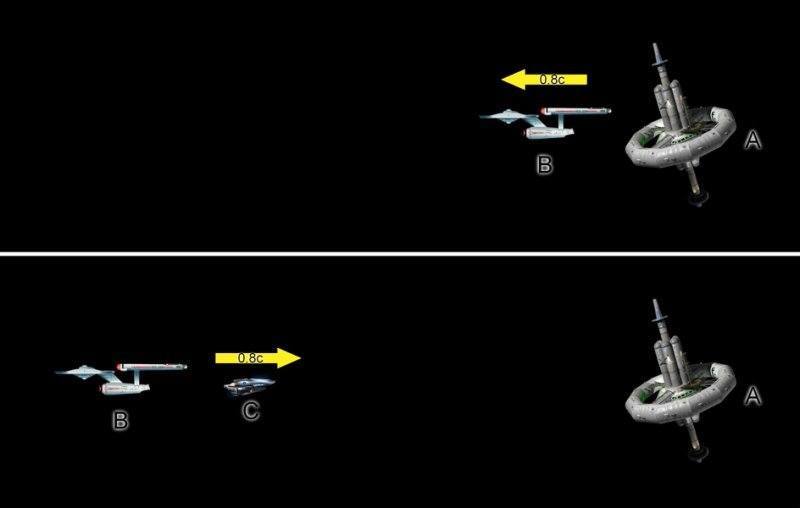
I made this pic to illustrate my problem.
paradox.jpg

A spaceship (labeled B) departs from a space station (labeled A) at 80% the speed of light (0.8c). A applies the time dilation principle and calculates that B's clocks are running slower than his.

Some time later a smaller craft (labeled C) detaches from B and travels at 80% the speed of light in the opposite direction. B applies the time dilation principle and calculates that C's clocks are running slower than his.

But this results in an illogical situation. B's clocks are slower than A's and C's clocks are slower than B's but C is stationary in A's reference frame so C's clocks are running at the same rate as A's.

What am i doing wrong?
 
Physics news on Phys.org
You are implicitly assuming the existence of an absolute simultaneity. This no longer holds in relativity. Instead, you must be aware that events that are simultaneous for one observer are not necessarily simultaneous for another. Since the rate at which clocks tick in an inertial frame is based on the notion of simultaneity in that frame, you will get different results as different frames have different definitions of simultaneity.
 

Similar threads

  • · Replies 12 ·
Replies
12
Views
3K
  • · Replies 58 ·
2
Replies
58
Views
5K
  • · Replies 2 ·
Replies
2
Views
1K
  • · Replies 26 ·
Replies
26
Views
1K
  • · Replies 9 ·
Replies
9
Views
2K
  • · Replies 6 ·
Replies
6
Views
2K
  • · Replies 8 ·
Replies
8
Views
3K
  • · Replies 4 ·
Replies
4
Views
2K
  • · Replies 115 ·
4
Replies
115
Views
9K
  • · Replies 83 ·
3
Replies
83
Views
6K