Help for interpreting Opamps on a schematic

  • Thread starter Thread starter eigenmax
  • Start date Start date
  • Tags Tags
    Op-amp Schematic
Click For Summary

Discussion Overview

The discussion centers around interpreting a schematic involving the LM358 op-amp, with participants exploring the representation of op-amps in circuit diagrams, the implications of using high-value resistors, and the challenges of measuring low currents in electronic circuits. The scope includes technical explanations, conceptual clarifications, and some debate regarding the circuit's design and components.

Discussion Character

  • Technical explanation
  • Conceptual clarification
  • Debate/contested
  • Experimental/applied

Main Points Raised

  • One participant notes that the LM358 op-amp contains two identical op-amps, which can be represented by two triangles in a schematic.
  • Another participant raises a concern about the practicality of using a 100,000 megohm resistor, sharing their difficulty in finding a 100 megohm resistor in the past.
  • A participant mentions the importance of ensuring the minimum wiper current for potentiometers used with op-amps, suggesting that insufficient current can lead to unreliable connections over time.
  • There is a discussion about the challenges of measuring picoamps and the potential need for specific circuit design considerations to avoid interference.
  • Some participants express uncertainty about the use and characteristics of high-value resistors and their applications in the circuit.
  • One participant questions the meaning of a partial arc symbol in the schematic, speculating it may relate to shielding or guarding in the circuit design.

Areas of Agreement / Disagreement

Participants express differing views on the feasibility of using high-value resistors and the design of the circuit. There is no consensus on the best practices for measuring low currents or the implications of the schematic's components.

Contextual Notes

Participants note limitations in their measuring equipment and the potential for errors in the circuit design. The discussion includes references to datasheets and the need for careful consideration of component specifications.

eigenmax
Messages
58
Reaction score
12
Hello,
I've been doing electronics for a while now, and only recently started using ICs. I have no problem with the 555 timer (I've used it in several circuits), but recently found and attempted the construction of a few circuits with the LM358 op-amp. On each there were two triangles, which I know represented the ICs. But when I saw an image of the circuit, I could only see one chip. I also noticed that none of the pins are repeated. Are both triangles one actual chip? Are the two triangles just ways to represent a single, physical chip?
Here's the circuit I was constructing.
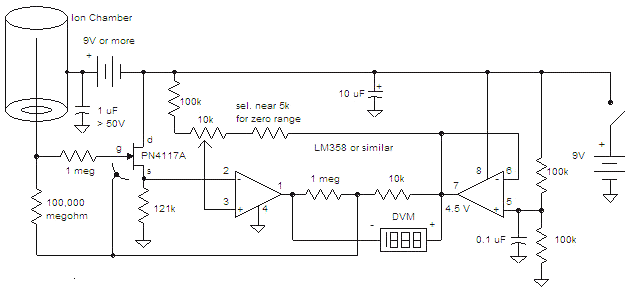
ionsens2.gif
 

Attachments

  • ionsens2.gif
    ionsens2.gif
    10.6 KB · Views: 2,148
Engineering news on Phys.org
Yes, that chip has two identical OpAmps inside.

Some chips even has four. On schematics, you have to be careful with the power pins, since sometimes they are represented by a third (fifth) triangle (one without the usual input-output pins).
 
  • Like
Likes   Reactions: jim hardy
Thank you, Rive! So that 1M, 10k resistor network is simply connected between pin 7 and 1. Thanks!
 
Be careful, this schematic is not a simple one. Was there any build instructions around where it come from?
 
  • Like
Likes   Reactions: jim hardy
I question the 100,000 megohm resistor. I once needed a 100 megohm resistor and had difficulty finding one.
 
  • Like
Likes   Reactions: berkeman
skeptic2 said:
I question the 100,000 megohm resistor. I once needed a 100 megohm resistor and had difficulty finding one.
Yeah, and there's a pretty serious error at pin 3 of the opamp external circuit. I'd make it a Quiz Question for the OP, but he's already said he is fairly new to electronics.

@eigenmax -- for potentiometers (the adjustable resistor connected to pin 3 of the opamp), there is usually a minimum wiper current specified in the datasheet to ensure reliable operation over the lifetime of the circuit that uses the potentiometer. If this minimum wiper current is not met, the wiper connection to the resistor inside can corrode over time, making the contact unreliable. So it is generally a design error to connect just the input of an opamp to the wiper of a pot. The opamp inputs generally do not have a high enough Input Current to meet the minimum wiper current spec. As an exercise, can you check the datasheet for a typical pot that might be used in this circuit, and compare that to the Input Current (not the Input Offset Current) spec for that opamp in its datasheet? Let us know what you find.
 
  • Like
Likes   Reactions: dlgoff and Asymptotic
skeptic2 said:
I question the 100,000 megohm resistor. I once needed a 100 megohm resistor and had difficulty finding one.
Google up "glass Victoreen resistor". Not an easy find...

I guess the source of the circuit is this: http://www.techlib.com/science/ionpage2.html
Should be a working model, but sure not a professional design...

Ps.: and also sure not for beginners...
 
  • Like
Likes   Reactions: Paul Colby, Asymptotic and berkeman
I stand corrected. I had no idea they existed.
 
skeptic2 said:
I stand corrected. I had no idea they existed.
I'm guessing that they can only be used inside hermetically sealed enclosures that have been evacuated or have extremely low humidity...
 
  • #10
skeptic2 said:
I stand corrected. I had no idea they existed.
Not a common stuff. That page makes a good read. Things like this:
Make sure that no epoxy touches the center lead of the transistor (base lead). The epoxy is too conductive!
The resistance there is waaaay higher than what a common fingerprint has...
 
  • #11
Sorry for the late reply. I'm using an old 100M resistor I removed from a broken piece of old electronics. I built the circuit, but realized my meter was probably not nearly sensitive enough (old analog 1-6V meter). I'll check the potentiometer thing now.
 
  • #12
The current from your ion chamber is so feeble it's easy for it to get lost.
I'd keep this junction up in the air, not touching the board.
ionization_chamber.jpg

I don't recognize that partial arc symbol - perhaps a guard if on the circuit board?
or perhaps a metal shield covering those connections to prevent pickup of line frequency 'hum'.?

Measuring picoamps is difficult at best. Here's a snip from TI electrometer amplifier datasheet
upload_2018-5-9_5-58-18.png


http://www.ti.com/lit/ds/symlink/opa128.pdfhere's a TI app note about working with high impedance circuits
http://www.ti.com/lit/an/snoa664/snoa664.pdf
upload_2018-5-9_6-4-30.png
Good Luck !

old jim
 

Attachments

  • ionization_chamber.jpg
    ionization_chamber.jpg
    16.9 KB · Views: 1,630
  • upload_2018-5-9_5-58-18.png
    upload_2018-5-9_5-58-18.png
    15.3 KB · Views: 1,248
  • upload_2018-5-9_6-4-30.png
    upload_2018-5-9_6-4-30.png
    9.1 KB · Views: 1,350
  • Like
Likes   Reactions: dlgoff, berkeman and Asymptotic
  • #13
jim hardy said:
The current from your ion chamber is so feeble it's easy for it to get lost.
I'd keep this junction up in the air, not touching the board.
View attachment 225441
I don't recognize that partial arc symbol - perhaps a guard if on the circuit board?
or perhaps a metal shield covering those connections to prevent pickup of line frequency 'hum'.?

Measuring picoamps is difficult at best. Here's a snip from TI electrometer amplifier datasheet
View attachment 225443

http://www.ti.com/lit/ds/symlink/opa128.pdfhere's a TI app note about working with high impedance circuits
http://www.ti.com/lit/an/snoa664/snoa664.pdf
View attachment 225444Good Luck !

old jim
The arc symbol is the FET casing I believe.
 
  • #14
eigenmax said:
The arc symbol is the FET casing I believe.
Good catch !

upload_2018-5-13_19-15-40.png


Thanks !
 

Attachments

  • upload_2018-5-13_19-15-40.png
    upload_2018-5-13_19-15-40.png
    11.2 KB · Views: 847
  • #15
eigenmax said:
Sorry for the late reply. I'm using an old 100M resistor I removed from a broken piece of old electronics. I built the circuit, but realized my meter was probably not nearly sensitive enough (old analog 1-6V meter). I'll check the potentiometer thing now.
The origin of this thing far predates DVMs, so unless it is some extreme insensitive meter, you should be able to see something after some fiddling.

However, I think it would be better to repeat some of the experiments on the first page first to get familiar with the requirements and results.
Also, that resistor really is 100GOhm... And you should build this thing so that 100GOhm would fit in.
 

Similar threads

  • · Replies 2 ·
Replies
2
Views
4K
  • · Replies 3 ·
Replies
3
Views
2K
Replies
10
Views
3K
  • · Replies 9 ·
Replies
9
Views
5K
  • · Replies 6 ·
Replies
6
Views
3K
  • · Replies 2 ·
Replies
2
Views
2K
  • · Replies 3 ·
Replies
3
Views
3K
  • · Replies 12 ·
Replies
12
Views
4K
Replies
5
Views
3K
  • · Replies 3 ·
Replies
3
Views
2K