Help needed to understand dispersion curve of a 1D lattice with diatomic basic

Click For Summary
SUMMARY

The discussion focuses on understanding the dispersion curve of a one-dimensional lattice with diatomic basis, specifically addressing the coexistence of optical and acoustic phonon branches and the presence of a band gap between them. It is established that both branches can exist simultaneously, with the acoustic band forming when atoms move in the same direction and the optical band when they move in opposite directions. The diatomic chain typically consists of alternating charge atoms, leading to a stronger restoring force when oppositely charged ions move apart. A recommended resource for further study is "Wave Propagation in Periodic Structures" by Brillouin.

PREREQUISITES
  • Understanding of phonon branches in solid-state physics
  • Familiarity with diatomic lattice structures
  • Knowledge of band theory and band gaps
  • Basic principles of wave propagation in periodic media
NEXT STEPS
  • Study "Wave Propagation in Periodic Structures" by Brillouin for in-depth knowledge
  • Research the concept of phonon dispersion relations in solid-state physics
  • Explore the role of restoring forces in diatomic chains
  • Learn about the implications of band gaps in electronic properties of materials
USEFUL FOR

Students and researchers in solid-state physics, materials scientists, and anyone interested in the behavior of phonons in crystal lattices.

ghegde
Messages
1
Reaction score
0
Hi there,
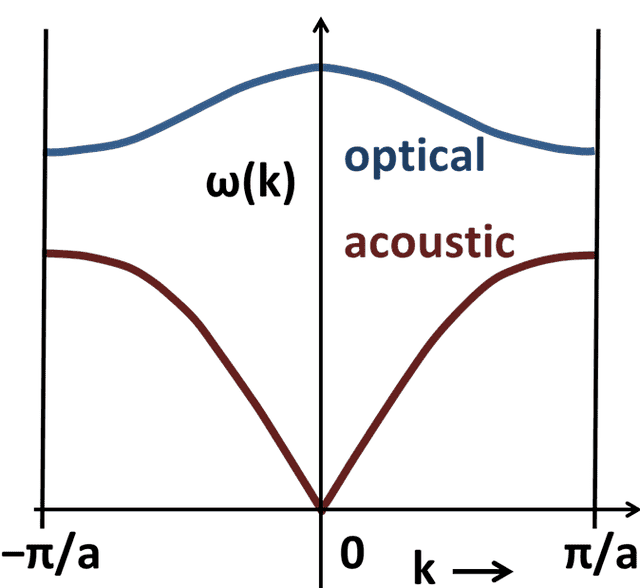
I am trying to understand the dispersion curve(as shown below) of a 1D lattice with diatomic basic.
640px-Diatomic_phonons.png

Here are my questions
1) Can both optical and acoustic branch of phonon can simultaneously exist in crystal?
2)Why there is a band gap between optical and acoustic phonon branch ?

Also please suggest a good book to better understand the crystal physics if your are aware of any.

Thanks in advance for your help,
Ganesh
 
Physics news on Phys.org
There is a good classics about the topics: Brillouin: Wave propagation in periodic structures.
In case of a chain of two different atom, both atoms of the bases can move in the same direction: that makes the acoustic band. If the different atoms of the bases move in opposite direction, you get the optical band.
The diatomic chain usually consist of atoms of alternating charge. The restoring force is higher when the opposite ions move in opposite directions, than in the case, when they move in the same direction. Try to read http://www.lcst-cn.org/Solid%20State%20Physics/Ch43.html
 
Last edited by a moderator:

Similar threads

  • · Replies 2 ·
Replies
2
Views
4K
  • · Replies 5 ·
Replies
5
Views
4K
  • · Replies 2 ·
Replies
2
Views
4K
  • · Replies 6 ·
Replies
6
Views
3K
Replies
1
Views
2K
Replies
2
Views
2K
  • · Replies 2 ·
Replies
2
Views
2K
  • · Replies 7 ·
Replies
7
Views
10K
  • · Replies 8 ·
Replies
8
Views
9K
  • · Replies 1 ·
Replies
1
Views
3K