Help Understanding Andrew Browder's Proposition 8.14

  • Context: MHB 
  • Thread starter Thread starter Math Amateur
  • Start date Start date
  • Tags Tags
    Functions Maxima
Click For Summary
SUMMARY

This discussion centers on understanding Andrew Browder's Proposition 8.14 from his book "Mathematical Analysis: An Introduction," specifically in the context of differentiable maps. The proposition states that for a differentiable function, the expression $$f(p + h) - f(p) = Lh + r(h)$$ holds, where $$L = \text{df}_p$$ and $$r(h)/|h| \to 0$$ as $$h \to 0$$. Participants clarify that defining $$r(h)$$ as $$f(p + h) - f(p) - Lh$$ leads to the conclusion that $$\lim_{h\to0}\frac{r(h)}{|h|} = 0$$, confirming Browder's definition of differentiability in Definition 8.9.

PREREQUISITES
  • Understanding of differentiable functions in mathematical analysis
  • Familiarity with limits and continuity concepts
  • Knowledge of Browder's definitions and propositions from "Mathematical Analysis: An Introduction"
  • Basic proficiency in mathematical notation and proofs
NEXT STEPS
  • Study Browder's Definition 8.9 in detail to grasp the concept of differentiability
  • Review the proof structure of Proposition 8.14 for deeper insights
  • Explore examples of differentiable maps to apply the concepts discussed
  • Investigate the implications of the limit $$\lim_{h\to0}\frac{r(h)}{|h|} = 0$$ in various contexts
USEFUL FOR

Students of mathematical analysis, educators teaching calculus and analysis, and anyone seeking a rigorous understanding of differentiability in the context of Browder's work.

Math Amateur
Gold Member
MHB
Messages
3,920
Reaction score
48
I am reading Andrew Browder's book: "Mathematical Analysis: An Introduction" ... ...

I am currently reading Chapter 8: Differentiable Maps and am specifically focused on Section 8.2 Differentials ... ...

I need some further help in fully understanding the proof of Proposition 8.14 ...

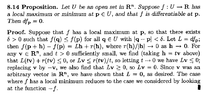
Proposition 8.14 reads as follows:
View attachment 9406

In the above proof by Browder we read the following:"... ... Let $$L = \text{df}_p$$; then $$f(p + h) - f(p) = Lh + r(h)$$ where $$r(h)/|h| \to 0$$ as $$h \to 0$$ ... .. "
My question is as follows:Can someone please formally and rigorously demonstrate how Browder's definition of differentiability (Definition 8.9) ...

... ... leads to the equation $$f(p + h) - f(p) = Lh + r(h)$$ where $$r(h)/|h| \to 0$$ as $$h \to 0$$ ... ..

Help will be much appreciated ...

Peter
====================================================================NOTE:

The above post mentions Browder's Definition 8.9 ... Definition 8.9 reads as follows:View attachment 9407

Hope that helps ...

Peter
 

Attachments

  • Browder - Proposition 8.14 ... .....png
    Browder - Proposition 8.14 ... .....png
    13.3 KB · Views: 159
  • Browder - Definition 8.9  ... Differentials ....png
    Browder - Definition 8.9 ... Differentials ....png
    21.4 KB · Views: 156
Physics news on Phys.org
Peter said:
In the above proof by Browder we read the following:"... ... Let $$L = \text{df}_p$$; then $$f(p + h) - f(p) = Lh + r(h)$$ where $$r(h)/|h| \to 0$$ as $$h \to 0$$ ... .. "
My question is as follows:Can someone please formally and rigorously demonstrate how Browder's definition of differentiability (Definition 8.9) ...

... ... leads to the equation $$f(p + h) - f(p) = Lh + r(h)$$ where $$r(h)/|h| \to 0$$ as $$h \to 0$$ ... ..
If you define $r(h)$ by $r(h) = f(p + h) - f(p) - Lh$ then Definition 8.9 says that $$\lim_{h\to0}\frac{r(h)}h = 0$$, or equivalently $$\lim_{h\to0}\frac{r(h)}{|h|} = 0$$
 
Opalg said:
If you define $r(h)$ by $r(h) = f(p + h) - f(p) - Lh$ then Definition 8.9 says that $$\lim_{h\to0}\frac{r(h)}h = 0$$, or equivalently $$\lim_{h\to0}\frac{r(h)}{|h|} = 0$$

Thanks Opalg ..

I appreciate the help ...

Peter
 

Similar threads

Replies
2
Views
2K
  • · Replies 2 ·
Replies
2
Views
2K
Replies
2
Views
2K
Replies
7
Views
2K
Replies
2
Views
2K
Replies
2
Views
2K
Replies
2
Views
2K
Replies
2
Views
2K
Replies
3
Views
2K
Replies
2
Views
2K