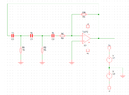
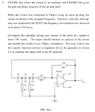
* At first, you should verify if the oscillation condition (Barkhausen) is fulfilled: Loop gain (somewhat larger than) unity with zero phase shift at the desired frequency fo.
* For this purpose, the loop gain (gain of the complete open loop) has to be analyzed (ac analysis, magnitude and phase) . You should open the loop at the node left to C3 for injecting an ac test signal.
* This analysis should be made for the ideal as well as real opamp model. You will notice a remarkable difference - caused by the unwanted (but unavoidable) reduced open-loop gain Aol as well as phase shift introduced by the real opamp model (if it is a good and realistic model).
* For this purpose, you should not use the graph as contained in the data sheet (and reproduced in your contribution). The graph shows a parasitic phase shift (at 65kHz) of zero deg which is not correct (too rough). To verify the real contribution of the opamp model you should perform a separate ac anylysis of the opamps open-loop gain Aol and phase response .