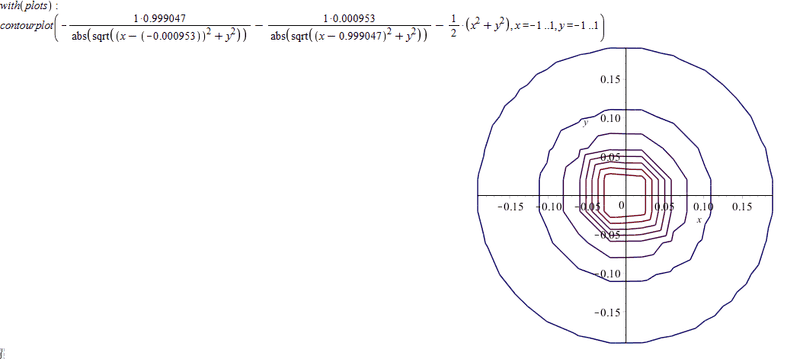
Help with contour plots of effective potential in R3BP.

Click For Summary
The discussion focuses on plotting the effective potential for the Sun-Jupiter system to visualize the Lagrangian points. The user has derived the effective potential equation but struggles to generate an accurate contour plot in Maple. Responses indicate that the mass disparity between the Sun and Jupiter makes the Lagrangian points challenging to visualize. Suggestions include zooming in on specific regions around the Lagrangian points and adjusting plotting parameters for better clarity. Hand-picking contour line values and increasing the number of plotted points can improve the representation of the Lagrangian points.
Hjortlund
Messages
1
Reaction score
0
Hello everyone! I'm currently trying to plot the effective potential for Sun-Jupiter system, to show the lagrangian points in this system. I've converted to a system of units where G=1, m_sun+m_jupiter=1 and R=1, whereby I get the following equation describing the effective potential of a third mass m in the system:

U(x,y)=-1 * 0.999047/abs(sqrt((x-(-0.000953))^2 +y^2 ))-1 * 0.000953/abs(sqrt((x-0.999047)^2 +y^2 ))

However, when I plot this in Maple, I don't get a contour plot that matches up with what I would expect
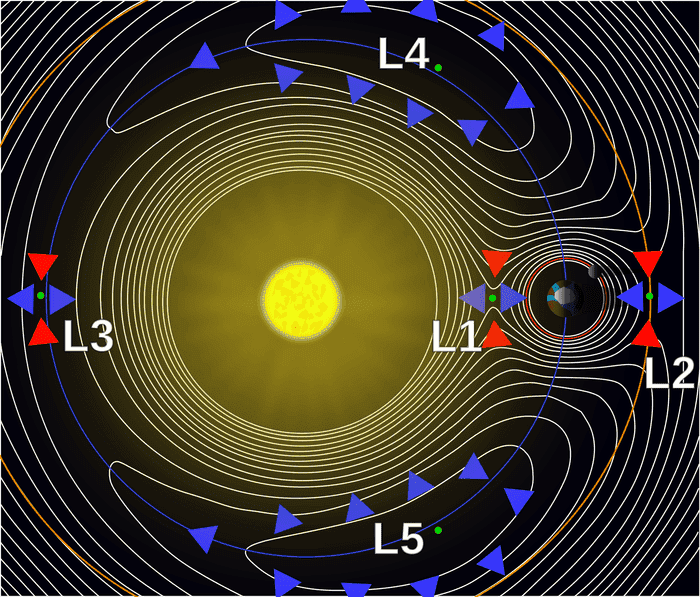
2000px-Lagrange_points2.svg.png

, but this.
oZLE3gV.png

Is there possibly anyone here who could point out a mistake I've done, or give me some advice? Thanks in advance!
 
Physics news on Phys.org
Welcome to PF!

I believe you are plotting the correct expression. But because the mass of Jupiter is much smaller than the mass of the sun, the Lagrange points are difficult to see on a contour plot. The Wikipedia site https://en.wikipedia.org/wiki/Lagrangian_point has some formulas for estimating where the points are located when one mass is much smaller than the other.

I tried a contour plot of your expression on Mathematica and I had to do quite a bit of playing around with the plotting parameters to see the contours near the Lagrange points. In particular, I had to zoom in on L3 and L4 and plot just a small region around the Lagrange points. I have not been able to get one plot that shows all the Lagrange points. Don't expect to get a plot that looks like the figure that you posted from the web site.

[EDIT: If you can "hand pick"" the value of each contour line, then you can get a pretty decent plot that shows all of the Lagrange points. Each contour line needs to be plotted with a sufficiently large number of points to get fairly smooth looking lines.]
 
Last edited:
The book claims the answer is that all the magnitudes are the same because "the gravitational force on the penguin is the same". I'm having trouble understanding this. I thought the buoyant force was equal to the weight of the fluid displaced. Weight depends on mass which depends on density. Therefore, due to the differing densities the buoyant force will be different in each case? Is this incorrect?

Similar threads

  • · Replies 10 ·
Replies
10
Views
2K
  • · Replies 13 ·
Replies
13
Views
3K
Replies
11
Views
1K
  • · Replies 1 ·
Replies
1
Views
2K
  • · Replies 1 ·
Replies
1
Views
2K
  • · Replies 1 ·
Replies
1
Views
1K
  • · Replies 1 ·
Replies
1
Views
5K
  • · Replies 9 ·
Replies
9
Views
2K
  • · Replies 4 ·
Replies
4
Views
2K
  • · Replies 7 ·
Replies
7
Views
3K