Help with deriving the formula for kinetic energy (using calculus)

Click For Summary

Discussion Overview

The discussion revolves around deriving the formula for kinetic energy using calculus. Participants explore various mathematical steps and concepts involved in the derivation, including the use of Cartesian coordinates, vector notation, and the application of the chain rule.

Discussion Character

  • Exploratory
  • Technical explanation
  • Mathematical reasoning
  • Debate/contested

Main Points Raised

  • One participant expresses confusion about switching the positions of variables in the derivation, specifically regarding the notation used for velocity and position vectors.
  • Another participant suggests expressing the derivative of velocity in terms of Cartesian components and provides a detailed breakdown using the chain rule.
  • A later reply questions the clarity of rewriting the expression in Cartesian coordinates and seeks further explanation on the process.
  • Some participants discuss the implications of using different coordinate systems (Cartesian, cylindrical, spherical) for representing position vectors and their components.
  • One participant critiques a previous statement about coordinate systems, emphasizing that the representation of position vectors differs based on the chosen basis.
  • Another participant introduces an integral approach to the derivation, discussing the relationship between work and kinetic energy through line integrals and Newton's laws.
  • One participant summarizes the derivation of the work-energy theorem, linking it to the definition of kinetic energy.

Areas of Agreement / Disagreement

Participants express differing views on the appropriate coordinate systems to use and the implications of switching variables in the derivation. The discussion remains unresolved regarding the best approach to represent the derivation accurately.

Contextual Notes

Participants highlight the importance of consistency in coordinate systems when discussing vector representations. There are also mentions of potential complications in integration due to the non-monotonic nature of variables along certain paths.

EchoRush
Messages
9
Reaction score
1
Hello, I am learning how to use calculus to derive the formula for kinetic energy

now, I understandthe majority of the steps in how to do this, however, there is one step where I get totally lost, I will post a picture of the steps and I will circle the part where I get lost. If you see the part circled in BLUE, Why can we just “re-write” those variables? Why can we just switch the positions of the “v” and the “r”?
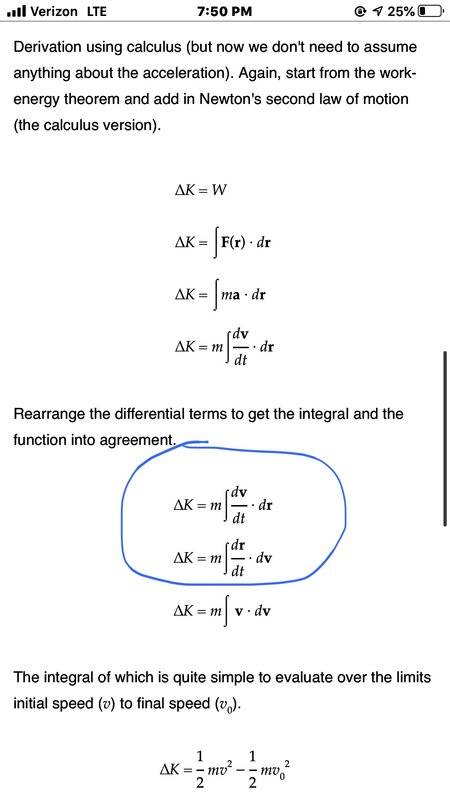
35FE6FA7-AFCC-4E58-8CE9-D4807278455E.jpeg
 
Physics news on Phys.org
It might help to write ##\frac{d \mathbf v}{dt}\cdot d\mathbf r## in terms of cartesian components as $$\frac{d v_x}{dt}dx + \frac{d v_y}{dt} dy+\frac{d v_z}{dt}dz$$

Using the chain rule, $$\frac{d v_x}{dt}dx = \left(\frac{d v_x}{dx}\frac{dx}{dt}\right)dx = \frac{dx}{dt}\left(\frac{d v_x}{dx}dx\right) $$

Note $$\frac{d v_x}{dx}dx = dv_x $$

So we end up with $$\frac{d v_x}{dt}dx = \frac{dx}{dt} dv_x = v_x \, dv_x$$

Similarly for the other cartesian components.
 
  • Like
Likes   Reactions: etotheipi, EchoRush and mpresic3
TSny said:
It might help to write ##\frac{d \mathbf v}{dt}\cdot d\mathbf r## in terms of cartesian components as $$\frac{d v_x}{dt}dx + \frac{d v_y}{dt} dy+\frac{d v_z}{dt}dz$$

Using the chain rule, $$\frac{d v_x}{dt}dx = \left(\frac{d v_x}{dx}\frac{dx}{dt}\right)dx = \frac{dx}{dt}\left(\frac{d v_x}{dx}dx\right) $$

Note $$\frac{d v_x}{dx}dx = dv_x $$

So we end up with $$\frac{d v_x}{dt}dx = \frac{dx}{dt} dv_x = v_x \, dv_x$$

Similarly for the other cartesian components.
Can you please explain what you mean when you say rewrite it in terms of Cartesian coordinates? How do you actually take (dv/dt) dr and rewrite it into Cartesian coordinates?
 
EchoRush said:
Can you please explain what you mean when you say rewrite it in terms of Cartesian coordinates? How do you actually take (dv/dt) dr and rewrite it into Cartesian coordinates?

The expression ##\large \frac{d \mathbf{v}}{dt} \cdot \normalsize d\mathbf{r}## represents the dot product of two vectors.

In unit vector notation (using cartesian basis vectors ##\hat i, \hat j,## and ##\hat k##), we can write

$$ \frac{d \mathbf{v}}{dt} = \frac{d{v_x}}{dt} \hat i + \frac{d{v_y}}{dt} \hat j + \frac{d{v_z}}{dt} \hat k $$
$$ d \mathbf {r} = dx \hat i + dy \hat j+ dz \hat k$$

The dot product can then be expressed as
$$ \frac{d \mathbf{v}}{dt} \cdot d\mathbf{r} = \frac{d{v_x}}{dt} dx + \frac{d{v_y}}{dt}dy+ \frac{d{v_z}}{dt} dz$$
 
##\mathbf{r}## is a vector pointing to the location in space of the location of ##\mathbf{v}## (where ##\mathbf{v}## is also a vector with the components of velocity). At this point you haven't decided whether you take ##\mathbf{r}## in Cartesian coordinates, meaning ##\mathbf{r} = [x, y, z]^T## or in cylindrical coordinates, meaning ##\mathbf{r} = [x, r, \theta]^T##, or spherical coordinates: ##\mathbf{r} = [r, \theta, \phi]^T##. So that is what it means to "rewrite ##\frac{d\mathbf{v}}{dt} \cdot \mathbf{dr}## into Cartesian components". It is deciding that ##\mathbf{r} = [x, y, z]^T##.

Don't forget that ##\mathbf{v}## must be described in the same coordinate system of course: ##\mathbf{v} = [v_x, v_y, v_z]^T##.
 
Looking back at my post #2, I don't like what I did. I said you could use the chain rule to write ##\large \frac{dv_x}{dt} = \frac{dv_x}{dx} \frac{dx}{dt}##. This doesn't take into account that in three dimensional space ##v_x## would generally depend on all three of the coordinates ##x, y,## and ##z## and not on just ##x##.

Here's another attempt. $$\frac {d \mathbf v}{dt} \cdot d \mathbf {r} = \frac {d \mathbf {v}}{dt} \cdot \frac {d \mathbf {r}}{dt} dt = \frac {d \mathbf {r}}{dt} \cdot \frac {d \mathbf {v}}{dt}dt= \frac {d \mathbf {r}}{dt} \cdot d \mathbf {v} $$

The second step just uses the commutative property ##\mathbf{A} \cdot \mathbf{B} = \mathbf{B} \cdot \mathbf{A}## for any two vectors ##\mathbf A## and ##\mathbf B##.
 
  • Like
Likes   Reactions: vanhees71
Arjan82 said:
At this point you haven't decided whether you take ##\mathbf{r}## in Cartesian coordinates, meaning ##\mathbf{r} = [x, y, z]^T## or in cylindrical coordinates, meaning ##\mathbf{r} = [x, r, \theta]^T##, or spherical coordinates: ##\mathbf{r} = [r, \theta, \phi]^T##.

This is not correct - only in a Cartesian coordinate system are the components of the position vector with respect to the basis also the coordinates.

In a spherical coordinate system, the position vector is ##\mathbf{r} = r \mathbf{e}_r##, i.e. the representation of ##\mathbf{r}## w.r.t. the spherical tangent basis is ##[r,0,0]^T##. This is not the same as the tuple ##(r, \theta, \phi)## of spherical coordinates identifying that point in the space.

In a cylindrical coordinate system, the position vector is ##\mathbf{r} = \rho \mathbf{e}_{\rho} + z\mathbf{e}_z##, i.e. the representation of ##\mathbf{r}## w.r.t. the cylindrical tangent basis is ##[\rho, 0, z]^T##. This is not the same as the tuple ##(\rho, \phi, z)## of cylindrical coordinates identifying that point in the space.

Really, it is best to only express position vectors with respect to a constant basis in the frame, e.g. a Cartesian basis.
 
  • Like
Likes   Reactions: Arjan82
I try to explain as the way keeping the terms in integral along any but fixed path.
\int \frac{d}{dt}v\cdot dr
Changing integral variable from r to t
\int \frac{d}{dt}v\cdot \frac{dr}{dt}dt=\int \frac{d}{dt}v\cdot v dt
Changing integral variable from t to v
\int dv \cdot v
Often variables r and v are not monotonous along the path ,e.g. around top ends of pendulum, we should consider it in integration.
 
Last edited:
It's much simpler. The work is defined as the line integral of the forces along the trajectory of the particle in motion given these forces, i.e.,
$$W=\int_{t_1}^{t_2} \mathrm{d} t \dot{\vec{x}} \cdot \vec{F}[\vec{x}(t)].$$
Now along this trajectory Newton's Law of motion holds:
$$m \ddot{\vec{x}}=\vec{F}(\vec{x}).$$
Thus the work is also given by
$$W=\int_{t_1}^{t_2} \mathrm{d} t \dot{\vec{x}} \cdot m \ddot{\vec{x}}=\int_{t_1}^{t_2} \mathrm{d} t \frac{m}{2} \mathrm{d}_t (\dot{\vec{x}}^2) = \frac{m}{2} \dot{\vec{x}}^2(t_2)-\frac{m}{2} \dot{\vec{x}}(t_1).$$
That's why it is convenient to define a new quantity called "kinetic energy",
$$E_{\text{kin}}=\frac{m}{2} \dot{\vec{x}}^2=\frac{m}{2} \vec{v}^2.$$
Then we have just derived the "work-energy theorem",
$$W=E_{\text{kin}}(t_2)-E_{\text{kin}}(t_1).$$
 
  • Like
Likes   Reactions: TSny, Arjan82 and etotheipi

Similar threads

  • · Replies 3 ·
Replies
3
Views
1K
  • · Replies 11 ·
Replies
11
Views
2K
  • · Replies 2 ·
Replies
2
Views
2K
  • · Replies 7 ·
Replies
7
Views
2K
  • · Replies 31 ·
2
Replies
31
Views
4K
  • · Replies 12 ·
Replies
12
Views
2K
  • · Replies 41 ·
2
Replies
41
Views
4K
  • · Replies 16 ·
Replies
16
Views
3K
  • · Replies 45 ·
2
Replies
45
Views
53K
  • · Replies 138 ·
5
Replies
138
Views
9K