Help with moment/force question `

  • Thread starter Thread starter shaka091
  • Start date Start date
Join the discussion
Registration is free. Ask a follow-up in this thread, or start your own.
7 replies · 4K views
shaka091
Messages
6
Reaction score
0
Hey guys I was hoping you would be able to solve this question for me with a worked solution :)
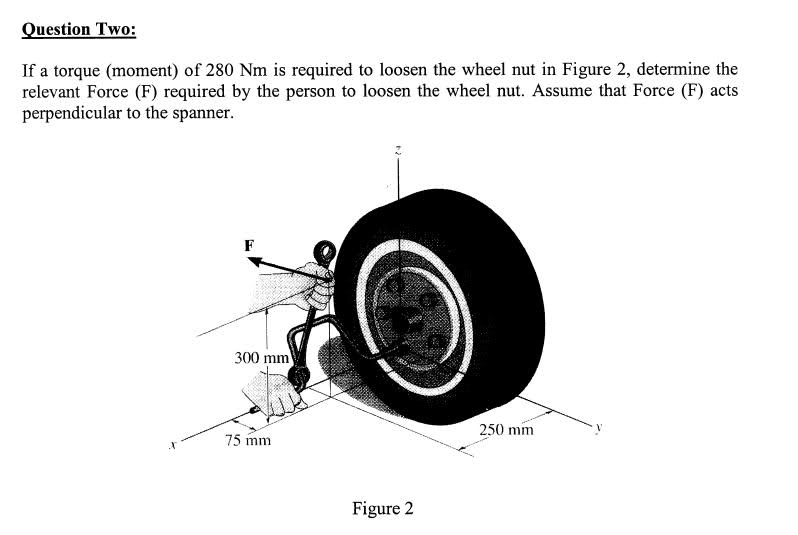
nd1o2r.jpg


And also this question, thanks a lot :)
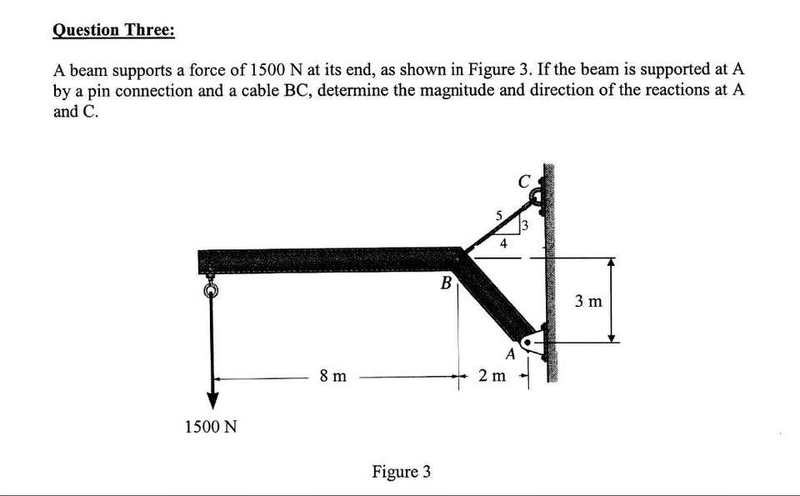
2wefgw7.jpg
 
Last edited:
Engineering news on Phys.org
You just need to sum the torques about the point where it makes contact.

T = r x F

F points in the opposite direction of the y-axis so F = -Fj.

To get r just write down how you get from the point to the force.

Example: If you move along the x-axis 30 mm positively and you reach the force r= 30i mm
 
rock.freak667 said:
You just need to sum the torques about the point where it makes contact.

T = r x F

F points in the opposite direction of the y-axis so F = -Fj.

To get r just write down how you get from the point to the force.

Example: If you move along the x-axis 30 mm positively and you reach the force r= 30i mm

Ok so I r=250i + 75j + 300k

And F is unkown. Because the moment is around the x axis, I got something like this (75*z)-(300*y)=280Nm

But wouldn't know where to go from there.
 
shaka091 said:
Ok so I r=250i + 75j + 300k

And F is unkown. Because the moment is around the x axis, I got something like this (75*z)-(300*y)=280Nm

But wouldn't know where to go from there.

The unit of r is mm, convert that to m.

F is perpendicular to the spanner. If the spanner is vertical (parallel to z) then the force is parallel to y. It is pointing in the -j direction so that F= -Fj

and r x F = 280i
 
Ok so, r=0.25i + 0.075j + 0.30k

because the force points in the -j direction I got, (0.075*0)-(0.30*-Fj) = 280Nm

which then got F=933.33 ?
 
Yes that should be correct.

Draw the free body diagram for the second problem and use the same set of equilibrium conditions:

∑Fx = ∑Fy = ∑Fz = ∑M = 0
 
Thanks for your help, lol turns out I should have just used this formula M=F*D

with distance being (300^2+250^2)^0.5 * F = 280
 
shaka091 said:
Thanks for your help, lol turns out I should have just used this formula M=F*D

with distance being (300^2+250^2)^0.5 * F = 280

Not quite.
The 250 mm dimension is not relevant. This dim could be made larger or smaller without changing the force (F) required.
The problem states "Assume that Force (F) acts perpendicular to the spanner". This greatly simplifies the problem.

Final answer should be about 905 N.