High Voltage in a Cloud Chamber?

Click For Summary
SUMMARY

The forum discussion centers on constructing a dry ice cloud chamber and the incorporation of an electrostatic field to visualize particle tracks. Users recommend utilizing a high voltage DC supply, such as a Van de Graaff generator or a Whimshurst machine, to create the necessary electrostatic field. The discussion emphasizes safety, suggesting low-current options to minimize risk, and encourages users to first build a basic chamber before adding complex features like an ion scrubber. Participants share insights on electrode placement and voltage requirements to enhance particle detection.

PREREQUISITES
  • Understanding of cloud chamber design principles
  • Knowledge of high voltage DC supplies, specifically Van de Graaff generators and Whimshurst machines
  • Familiarity with particle physics and charged particle behavior
  • Basic electrical safety practices when working with high voltage
NEXT STEPS
  • Research the construction and operation of Van de Graaff generators
  • Learn about the principles of electrostatics and electric fields in particle detection
  • Explore the design and functionality of ion scrubbers in cloud chambers
  • Investigate safe practices for using high voltage equipment in educational settings
USEFUL FOR

High school students, educators, hobbyists, and anyone interested in building cloud chambers and exploring particle physics through hands-on experimentation.

Jayssos
Messages
7
Reaction score
0
Hello all!

Firstly, thanks for reading this post!

I am a high school student attempting to make a basic, dry ice cloud chamber. I have made several cloud chamber designs and I am about to start making it. However, before constructing the product I would appreciate some members to provide answers to the silly questions I have.

One, it has recently come to my attention that an electrostatic field is required on top of the chamber to make tracks easier to visualise. However, after looking at several tutorials on cloud chambers I realized that not many put electrostatic fields on top of the chambers. Therefore, I am wondering how I could possibly adapt an electrostatic field to my designs?

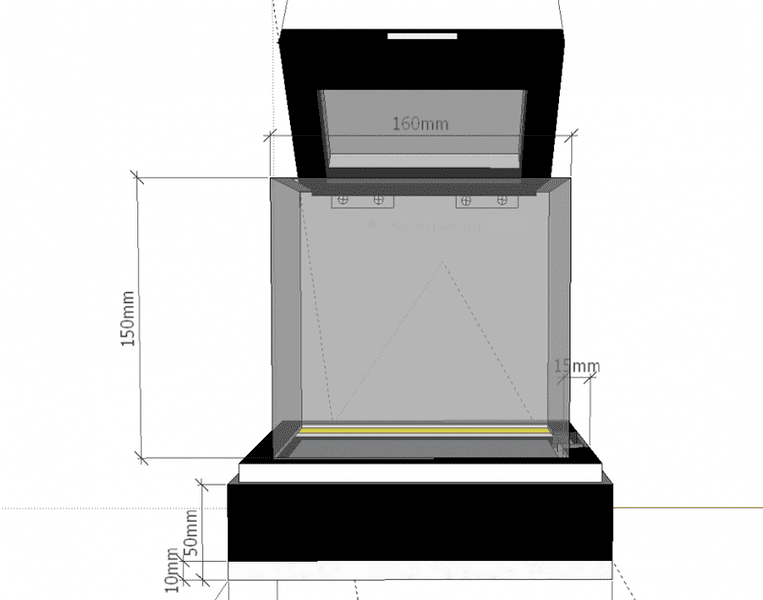
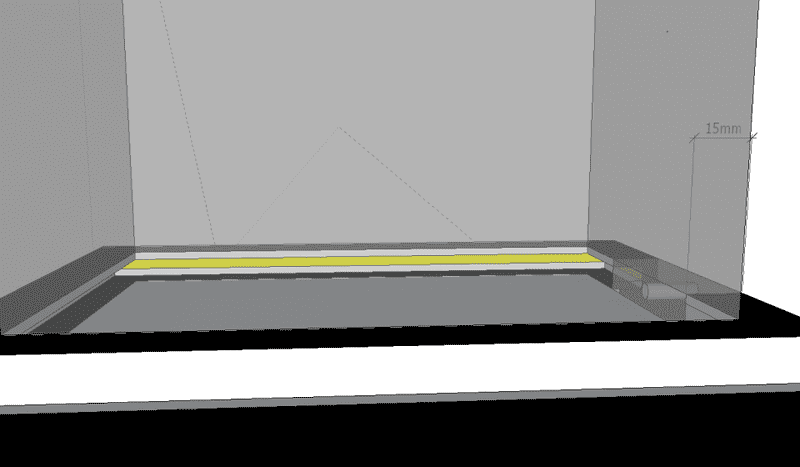
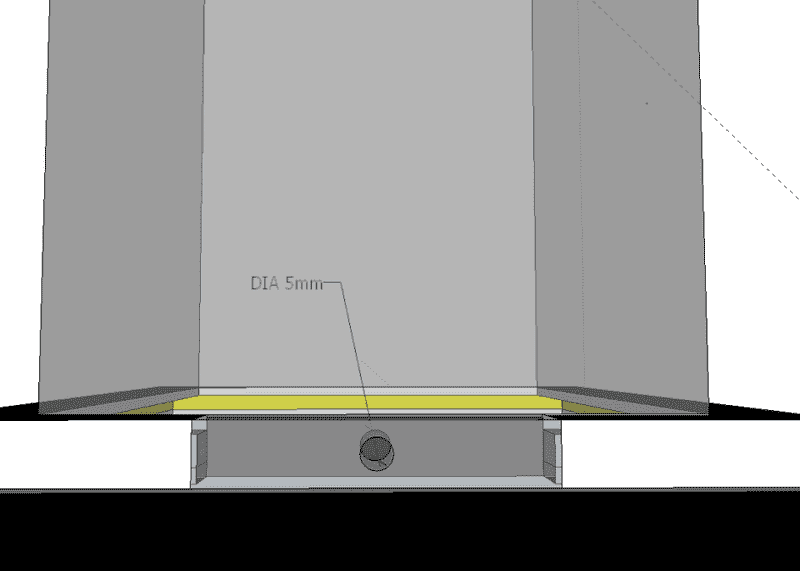
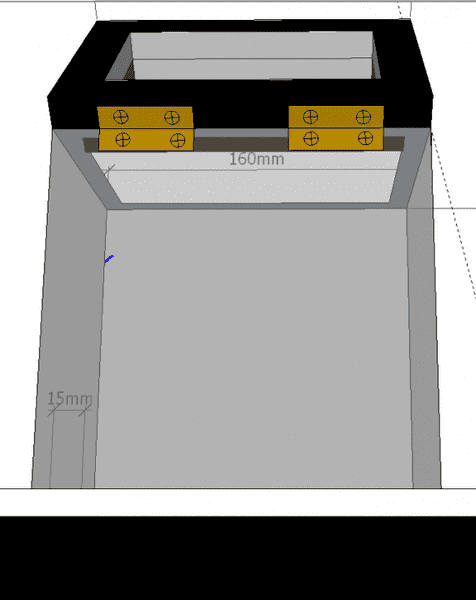
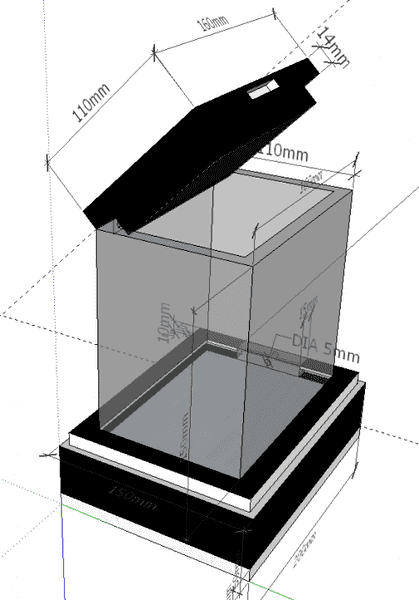
Screenshots of my design (made on sketchup):
CC3 Screenshot #5.PNG
CC3 Screenshot #1.PNG
CC3 Screenshot #2.PNG
CC3 Screenshot #3.PNG
CC3 Screenshot #4.PNG


As visible in the images above, the cover for my cloud chamber is almost like a lid with some sort of a hinge, allowing it to open and close with being removed from the body of the chamber. There is a small hole in the side of the chamber for rubber stoppers that carry radioactive isotopes into the chamber (this is used in testing). The lid is preferably made of acrylic, with a simple rectangular (empty in the middle) strip of black felt stuck to the lids base. So there is still a visible area in the hole created by that black felt. Furthermore, the yellow lines next to the small hole are LED strips.

Question: How can I supply an electrostatic field to the top of my chamber (in this specific design) - feel free to criticize the design itself before answering my main question, I am open to suggestions.
 
Last edited:
Physics news on Phys.org
Just as when you want a Fish dinner, first catch the fish.

For an electrstatic field, you need a high voltage DC supply of some sort, a few thousand volts. Some safe sources would be a small Whimhurst Machine or a small Van de Graf generator . They can be either built or purchased. Google them for details. Another possibility is a High Voltage DC power supply, NOT recommended due to safety considerations, they can actually kill you if grabbed at the wrong time or place.

Once you have a High Voltage source, put a piece of Aluminium foil or similar on the top and another piece on the bottom of the cloud chamber. Then connect the leads from the power source, one to each piece of foil.

What you gain for all this work is that the paths of any charged particles in the chamber, instead of being straight, will curve either upward or downward depending on their charge and the polarity at the top and bottom of the chamber.

Sounds like a fun project with or without the electrostatic field. Please keep us updated on the project.

Ohh, and HAVE FUN!
 
  • Like
Likes   Reactions: Jayssos
Tom.G said:
Just as when you want a Fish dinner, first catch the fish.

For an electrstatic field, you need a high voltage DC supply of some sort, a few thousand volts. Some safe sources would be a small Whimhurst Machine or a small Van de Graf generator . They can be either built or purchased. Google them for details. Another possibility is a High Voltage DC power supply, NOT recommended due to safety considerations, they can actually kill you if grabbed at the wrong time or place.

Once you have a High Voltage source, put a piece of Aluminium foil or similar on the top and another piece on the bottom of the cloud chamber. Then connect the leads from the power source, one to each piece of foil.

What you gain for all this work is that the paths of any charged particles in the chamber, instead of being straight, will curve either upward or downward depending on their charge and the polarity at the top and bottom of the chamber.

Sounds like a fun project with or without the electrostatic field. Please keep us updated on the project.

Ohh, and HAVE FUN!
Thanks for the reply!

Okay, so it appears that an electrostatic field would allow the charged particles to curve upwards or downwards? I thought I saw something online about it acting as an "ion scrubber" or something. The curved tracks are interesting but what about the ion scrubber?
 
Do you have a link to the "ion scrubber"? The only place I've seen that term used is as a sales pitch for electrostatic air cleaners.
 
Hmmm, interesting. However there's not much information there. I wish he had shown before-and-after images of particle trails with and without the scrubber working. I also looked at another video that shows a "scrubber" of some sort. As shown, the scrubber structure isn't likely to show curved particle paths. The electrode spacing is rather large for the not-very-high voltage being used.

My overall suggetion would be get the basic chamber working and then decide if you want to add an "ion scrubber" and/or an overall electric field. You will probably learn more that way than you would by doing everything at once.

The videos did bring to mind an alternative though: Put the "ion scrubber" in the active area at the bottom of the chamber. This would greatly increase the particle path curvature since the electric field would be stronger between the closely spaced electrodes than the top-and-bottom electrode approach i suggested earlier. The top-and-bottom electrode spacing was assuming the whole chamber would be actively detecting and the availability of a higher voltage.
 
  • Like
Likes   Reactions: Jayssos
Tom.G said:
Hmmm, interesting. However there's not much information there. I wish he had shown before-and-after images of particle trails with and without the scrubber working. I also looked at another video that shows a "scrubber" of some sort. As shown, the scrubber structure isn't likely to show curved particle paths. The electrode spacing is rather large for the not-very-high voltage being used.

My overall suggetion would be get the basic chamber working and then decide if you want to add an "ion scrubber" and/or an overall electric field. You will probably learn more that way than you would by doing everything at once.

The videos did bring to mind an alternative though: Put the "ion scrubber" in the active area at the bottom of the chamber. This would greatly increase the particle path curvature since the electric field would be stronger between the closely spaced electrodes than the top-and-bottom electrode approach i suggested earlier. The top-and-bottom electrode spacing was assuming the whole chamber would be actively detecting and the availability of a higher voltage.


Will continue to research this concept, but thanks for the suggestions! Once I have got it working I'll show you guys what its like!
 
Tom.G said:
The top-and-bottom electrode spacing was assuming the whole chamber would be actively detecting and the availability of a higher voltage
A close spacing gives much better value for the available voltage. Why go for many kV when a few hundred V could do the job? I am thinking SAFETY in an educational environment.
 
sophiecentaur said:
A close spacing gives much better value for the available voltage. Why go for many kV when a few hundred V could do the job? I am thinking SAFETY in an educational environment.

Hmm... I see your point. Perhaps I should start off without any electricity but as time progresses, add these suggestions to my designs.
 
  • #10
sophiecentaur said:
I am thinking SAFETY in an educational environment.
Yes! Thats why the suggestion of a Van de Graf or a Whimhurst in Post #2, they have such a tiny current, especially the smaller ones, that they are non-lethal. And they supply DC rather than AC, which is needed to show a curved particle path.

My father and I built an 18 inch tall Van de Graf when I was in high school. Great fun; just don't draw a spark to bare skin, it can give a pinpoint burn. Hold a key or other piece of metal in your hand to draw a spark. I've seen kits online for smaller (6 to 10 inches?) Van de Grafs that would be plenty large enough for the Cloud Chamber. The only functional drawback I can think of is with their tiny current they don't work worth a darn in high humidity.
 
  • #11
Tom.G said:
a Whimhurst in
Those things are deadly. Definitely not for the School Equipment list any more. The capacitors on a Wimshurst are much greater in value than the few pF of a Van der Graaf machine. They could easily give someone a heart attack - despite that, we used one on a door knob and gave a fellow pupil a big scare. (Mr Scales never got to hear about it, though)
Probably the safest and most controllable would be a 5kV lab supply with a nice fat 10M resistor in series. Some lab supplies have a switched internal resistor.
 
  • #12
Tom.G said:
Yes! Thats why the suggestion of a Van de Graf or a Whimhurst in Post #2, they have such a tiny current, especially the smaller ones, that they are non-lethal. And they supply DC rather than AC, which is needed to show a curved particle path.

My father and I built an 18 inch tall Van de Graf when I was in high school. Great fun; just don't draw a spark to bare skin, it can give a pinpoint burn. Hold a key or other piece of metal in your hand to draw a spark. I've seen kits online for smaller (6 to 10 inches?) Van de Grafs that would be plenty large enough for the Cloud Chamber. The only functional drawback I can think of is with their tiny current they don't work worth a darn in high humidity.
That's true. But I think
sophiecentaur said:
Those things are deadly. Definitely not for the School Equipment list any more. The capacitors on a Wimshurst are much greater in value than the few pF of a Van der Graaf machine. They could easily give someone a heart attack - despite that, we used one on a door knob and gave a fellow pupil a big scare. (Mr Scales never got to hear about it, though)
Probably the safest and most controllable would be a 5kV lab supply with a nice fat 10M resistor in series. Some lab supplies have a switched internal resistor.
Good idea! So I would need to build a circuit on my chamber I suppose?
 
  • #13
Jayssos said:
That's true. But I think

Good idea! So I would need to build a circuit on my chamber I suppose?
Does your College not already have one? If they have a supply of radioactive isotopes then they must have some reasonable facilities.
 
  • #14
sophiecentaur said:
Does your College not already have one? If they have a supply of radioactive isotopes then they must have some reasonable facilities.
It does, I'm just figuring out how I would apply the high voltage only to the cover of my chamber
 
  • #15
Jayssos said:
It does, I'm just figuring out how I would apply the high voltage only to the cover of my chamber
Not just to the cover. Between two plates, to produce a uniform up/down field, one on top and one underneath. And take care!
 
  • #16
I'm currently attempting a cloud chamber as well, and also wonder about the electrostatic part.

Could something like this unit be used? https://www.aliexpress.com/item/air...trage-5-0kv-dc-ionizer-density/768290803.html

While it supposedly generates 5kV, it only outputs 12uA max, so should be safe. I'm thinking hooking it up to a metal grid at the top of the chamber. If so I'd be getting the 12V variant so I don't have to fiddle with 230V.
 
  • #17
Lord Crc said:
I'm currently attempting a cloud chamber as well, and also wonder about the electrostatic part.

Could something like this unit be used? https://www.aliexpress.com/item/air...trage-5-0kv-dc-ionizer-density/768290803.html

While it supposedly generates 5kV, it only outputs 12uA max, so should be safe. I'm thinking hooking it up to a metal grid at the top of the chamber. If so I'd be getting the 12V variant so I don't have to fiddle with 230V.

Looks like a winner to me. Just don't grab it to "test" the safety!

If it does 'bite' you it will certainly get your attention but that's about all, the current is way too low for any real damage.
As an extra precaution, whenever working with it be sure the area behind you is clear. Since it is high voltage DC, there is a possibility that if you do get shocked some of your muscles will contract, and stay contracted until you are free of the voltage. With a clear area behind you, you can jump or fall back if you can't let go. (Saved me from screaming for help a few times. :redface:)
 
  • Like
Likes   Reactions: Lord Crc
  • #18
Tom.G said:
Looks like a winner to me.

Thanks, I ordered it and will report back my findings :)

Tom.G said:
Just don't grab it to "test" the safety!

This is what we have significant others for, right? "Hey honey, mind holding this for a second?" :biggrin:
 

Similar threads

  • · Replies 4 ·
Replies
4
Views
3K
  • · Replies 3 ·
Replies
3
Views
3K
  • · Replies 2 ·
Replies
2
Views
2K
  • · Replies 28 ·
Replies
28
Views
28K
  • · Replies 5 ·
Replies
5
Views
5K
  • · Replies 4 ·
Replies
4
Views
2K
  • · Replies 6 ·
Replies
6
Views
6K
  • · Replies 2 ·
Replies
2
Views
2K
  • · Replies 4 ·
Replies
4
Views
3K
  • · Replies 9 ·
Replies
9
Views
9K