Hillbilly Fractal Antenna Reflector (and digital TV antenna suggestions)

Click For Summary

Discussion Overview

The discussion revolves around improving over-the-air digital TV reception using various antenna designs and configurations, including the use of fractal reflectors and DIY solutions. Participants share their experiences with different antennas, suggest modifications, and discuss the implications of digital TV transitions.

Discussion Character

  • Exploratory
  • Technical explanation
  • Debate/contested
  • Experimental/applied

Main Points Raised

  • One participant notes a decline in digital TV reception and experiments with reflector combinations to enhance signal strength for a UHF dipole antenna.
  • Another participant humorously suggests not worrying about reception quality unless it affects viewing preferences.
  • A participant discusses the challenges of camouflaging a potential antenna and considers manual adjustments for indoor antennas.
  • One participant emphasizes that under federal law, landlords cannot prevent antenna installation for over-the-air reception, while also sharing insights on the transition from analog to digital TV frequencies.
  • Another participant argues that the term "Digital Antenna" is misleading, asserting that any antenna can receive both analog and digital signals effectively.
  • A participant shares a detailed DIY approach for creating a halfwave dipole antenna, including calculations for optimal lengths based on RF channel frequencies.
  • One participant reports satisfaction with a new omni-directional antenna, noting improved picture quality but still experiencing variable reception for specific channels.
  • There are inquiries about the internal structure of the new antenna, with participants expressing curiosity about its design.
  • Another participant confirms better overall performance with the new antenna compared to a previous model but notes ongoing variability with certain channels.

Areas of Agreement / Disagreement

Participants express a range of opinions on the effectiveness of different antenna types and configurations, with no clear consensus on the best approach. Some participants agree on the misleading nature of the term "Digital Antenna," while others share personal experiences that highlight variability in reception quality.

Contextual Notes

Participants mention various factors that could affect reception quality, such as physical obstructions and antenna design, but do not resolve these issues or provide definitive solutions.

Who May Find This Useful

Individuals interested in improving their over-the-air digital TV reception, those considering DIY antenna projects, and participants in discussions about antenna technology and digital broadcasting.

berkeman
Admin
Messages
69,409
Reaction score
24,805
So the quality of my over-the-air digital TV reception has been getting worse over the past few months. Probably the digital TV antenna that I'm using is getting old and starting to degrade. Last night I resorted to trying different reflector combinations to try to boost the signal for the horizontal UHF dipole antenna (inside the rotator disc on the top of the antenna unit). I could hand-hold it in a reasonable reflector position, but it was hard to figure out a way to mount it permanently.

So I went the fractal reflector route shown in the picture below (the antenna unit was already hanging from the ceiling). It actually worked a lot better than I expected, but it probably won't work for all stations (since you have to use the rotation function to find the best direction to point the UHF dipole in the disc -- the local stations are spread through about a 90 degree arc to my north.

Anyway, it looks like it's time to spring for a new over-the-air digital TV antenna. We live in a 2nd floor apartment and the TV is next to the balcony, so I could probably camouflage a fairly large antenna below the railing if that would help. (I already have a camouflage HAM radio antenna on the balcony). Does anybody have any suggestions for good digital TV antennas (USA models)? Clearly it needs to have rotational capability (or phased array capability, if that exists for digital TV antennas).

Thanks for any ideas! :smile:
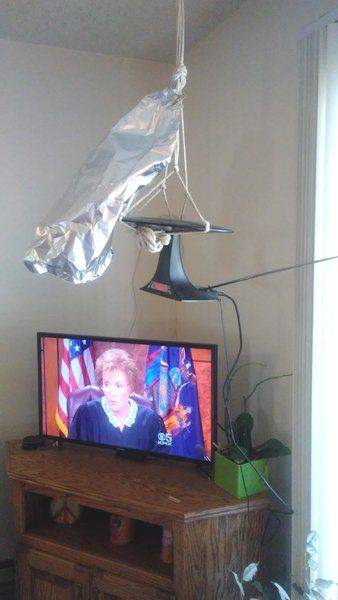
Hillbilly Fractal Antenna Reflector Fixed02.jpg
 
Last edited:
  • Like
Likes   Reactions: ryaamaak
Engineering news on Phys.org
Don't worry about it until you find something better than Judge Judy. :):):):)
 
  • Like
Likes   Reactions: Paul Colby, Tom.G, davenn and 1 other person
This looks to be a good candidate, but may be hard to camouflage on our balcony (unless I can come up with some "88" theme...). Also doesn't have a built-in rotor system, but I suppose I could do manual position changes if it's indoors and I compile a list of the broadcast station directions...

http://www.antennasdirect.com/blog/indoor-vs-outdoor-tv-antennas/
Digital 88 Antenna.jpg
 
  • Like
Likes   Reactions: ryaamaak
Under federal law landlords cannot prevent you from erecting an antenna for over-the-air reception. But they can of course make common sense rules like don't drill holes through the shingles as in that photo. So if your apartment has a rooftop airconditioner unit or a chimney to which you could affix an unobtrusive antenna, i'd do it.

That said, and you doubtless know all this but for those who don't...

when US went to digital TV the TV frequencies didn't change, just most of the TV stations moved up to UHF but didn't tell you they'd changed frequency and kept on saying they were the same old channel number. I'm lucky here, ABC channel 8 stayed on channel 8 and PBS channel 19, already uhf, just hopped up one notch to RF channel 20..
Fallout from that is - "Digital Antenna" is a hoax, an antenna is an antenna whether it's receiving analog or digital TV. My friends are amazed when i tell them " Just keep your old pre-digital TV antenna, it'll work fine even in the face of Global Warming . "

So - if your reception is going downhill i'd say figure out why. Is there a new building between you and the stations? Is your wire corroding ? EMI ?

Next - if you have a soldering iron, here's what i suggest
go to this site
https://www.fcc.gov/media/engineering/dtvmaps
type in your address and it'll show your house on a map, select 'satellite' and you get a Google Earth image and you can drag the cursor around your yard.
It'll show a list of the stations that you are likely to receive and their strength
clicking on those stations shows directions to their towers ,
and it shows the actual channel number they broadcast over as RF (channel#) which is seldom the same as the one they're known by.
...
next
draw yourself a map with all the stations you want to receive
figure out halfwave dipole lengths for all of them,
here's a table of RF channel numbers and frequencies - note you need the RF channel number not the number the station goes by
http://otadtv.com/frequency/index.html
wavelength in meters is 300 / frequency in megaHertz
a halwave dipole is as the name implies a half wavelength long...
for example, channel 20 is 509 megaHertz , 300/509 = 0.589 meter = 23.2 inches
so a halfwave dipole would be 11.6 inches long
make a halfwave folded dipole(see below) from old TV twin lead that's about the right length for your weaker stations - the strong ones will boom in through a less than optimal antenna anyhow. Try it out in the room and see how it does... you can tape it to a yardstick for experimenting .

When i did this in Idaho I had stations as close as a few blocks and as far as fifty miles .
I was able to compromise , some of my HF dipole lengths turned out close to 3X the UHF ones and a dipole works well on odd harmonics.
I found one length that worked pretty well for all stations when pointed toward the weaker ones, but next time i wouldn't even try to please those nearby transmitters just design for the weak ones... I made a folded dipole from hardware store copper wire and 3/4 inch PVC pipe, mounted it to my rooftop airconditioner unit with conduit clamps and spray painted it same color. Condo management loved it...

I did something similar here in Arkansas but since aesthetics was not an issue i built big multi element Yagis.tuned exactly for the two stations that exist here .
we had a PF thread on it , if you want to see a REALLY hillbilly antenna check it out at https://www.physicsforums.com/threads/can-i-parallel-yagis.806936/
antenna-003-copy-jpg.jpg


Folded dipole is easy to make from old fashioned flat TV antenna wire - see http://users.wfu.edu/matthews/misc/dipole.html
dipole.gif

solid copper works as well and is easier to find.
You can hide it behind a piece of wood or a picture for indoors.i solder the "To TV" wires to a TV matching transformer and bring Coax into the back of TV...
079000403722sm.jpg

about four bucks retail , any hardware store

While experimenting in Idaho son and i tried a Fractal from some plans he found. A simple folded dipole made from hardware store copper wire and a matching transformer outperformed it .

That's one DIY approach.

Keep us posted ?

old jim.
 
Last edited:
  • Like
Likes   Reactions: ryaamaak, jim mcnamara and berkeman
Antenna4Berkeman.jpg
 
jim hardy said:
Fallout from that is - "Digital Antenna" is a hoax, an antenna is an antenna whether it's receiving analog or digital TV.
Yep. All my friends got rid of their outdoor antennas. Me, ... I just stepped out on the porch and took this photo.

myantenna.jpg
 
  • Like
Likes   Reactions: ryaamaak and jim hardy
Time for an update... :smile:

Based on an Amazon ad (directed at me because I'd searched for digital TV antennas and who knows what else), an advertisement popped up on one of my Internet browing pages for the Amazon "Best Seller" digital TV antenna. How could I go wrong? o0)

So I clicked through and now am the proud owner of the 1byone omni digital antenna. It's nice that I don't have to program rotational information into it for each station, but I wondered how the performance would be compared to the previous Radio Shack rotating spaceship antenna. :cool:

It's mounted outside on my apartment patio (a plus for reception), and the picture quality seems to be better now for most stations. My favorite station (KGO channel 7 Bay Area) seemed to have a marginal reception problem, but this simple experimental reflector inside of the wall seems to have helped. Some experimenting will now take place for the reflector to make it bigger and more stealthy...

hillbilly antenna reflector 2.jpg


Picture of a 1byone antenna mounted in a typical installation:

1byone-60-Miles-Range-Omni-directional-Amplified-Outdoor-HDTV-_1.jpg
 

Attachments

  • hillbilly antenna reflector 2.jpg
    hillbilly antenna reflector 2.jpg
    38.5 KB · Views: 1,830
  • 1byone-60-Miles-Range-Omni-directional-Amplified-Outdoor-HDTV-_1.jpg
    1byone-60-Miles-Range-Omni-directional-Amplified-Outdoor-HDTV-_1.jpg
    20.2 KB · Views: 1,610
  • Like
Likes   Reactions: dlgoff
So what's in it? A couple of crossed folded dipoles?
 
Tom.G said:
So what's in it? A couple of crossed folded dipoles?
It's much weirder than that. I don't recognize the structure -- maybe one of you knows what it is?

In this YouTube video, the guy takes it apart starting around 13:45...

 
  • Like
Likes   Reactions: Tom.G
  • #10
So how is it working for you?
 
  • Like
Likes   Reactions: jim hardy
  • #11
dlgoff said:
So how is it working for you?
Better overall compared to the Radio Shack model, but this one station (KGO 7) is still variable. There are 2 sub-channels available here (7-1 and 7-2), and usually 7-2 works well. But 7-1 is crazy variable, even with the reflector. I'll have to look into the position of the transmitters to see if there is a better location on my balcony for the antenna.

:smile:
 
  • Like
Likes   Reactions: dlgoff
  • #12
berkeman said:
But 7-1 is crazy variable, ...
I've noticed at times some of my subchannels will "freeze". No obvious reason. Maybe weather/clouds?
 
  • #13
berkeman said:
Better overall compared to the Radio Shack model, but this one station (KGO 7) is still variable. There are 2 sub-channels available here (7-1 and 7-2), and usually 7-2 works well. But 7-1 is crazy variable, even with the reflector. I'll have to look into the position of the transmitters to see if there is a better location on my balcony for the antenna.

:smile:
This isn't making sense to me. As far as I know subchannels are simply more data in the same transmitted signal. If you receive the channel you should be getting all subchannels too. That has been my experience.
 
  • #14
NTL2009 said:
This isn't making sense to me. As far as I know subchannels are simply more data in the same transmitted signal. If you receive the channel you should be getting all subchannels too. That has been my experience.
Yeah, I have to figure that out. I thought when I looked at the digital transmit station map a few years ago, that different transmit locations were sometimes used for different sub-channels, but I could be mistaken.
 
  • #15
Tom.G said:
So what's in it? A couple of crossed folded dipoles?
To me it looks like a printed Alford loop antenna structure. It is a way to synthesize a loop antenna that is the order of a wavelength in circumference while minimizing all of the pesky phase changes that muck up the desired omni pattern in a simple loop that size. If the circular pcb is about 1-foot in diameter and the relative permittivity is about 4, then I get that it is tuned to about 200 MHz, so channels 7-13 (assuming the "effective" permittivity is the average of the pcb and air).

I don't know what the red wire is supposed to be, though.

Jason
 
  • Like
Likes   Reactions: ryaamaak
  • #16
dlgoff said:
I've noticed at times some of my subchannels will "freeze". No obvious reason. Maybe weather/clouds?
Yeah, so far the 7-1 channel freezing seems to be correlated to high winds in my area. Maybe some multipath issue with something reflective nearby that is blowing around. Nothing obvious that I can see though.
 
  • Like
Likes   Reactions: dlgoff
  • #17
berkeman said:
Maybe some multipath issue with something reflective nearby that is blowing around.
Hey yea. Could clouds be reflective enough at those frequencies?
 
  • #18
berkeman said:
Yeah, so far the 7-1 channel freezing seems to be correlated to high winds in my area. Maybe some multipath issue with something reflective nearby that is blowing around. Nothing obvious that I can see though.
Likely a tree somewhere, not necesssarily nearby. Try moving the antenna about a foot, at a right angle to the station heading.
 
  • Like
Likes   Reactions: dlgoff and berkeman

Similar threads

  • · Replies 63 ·
3
Replies
63
Views
7K
Replies
4
Views
4K
Replies
20
Views
9K
  • · Replies 25 ·
Replies
25
Views
14K
  • · Replies 69 ·
3
Replies
69
Views
8K
  • · Replies 13 ·
Replies
13
Views
5K
  • · Replies 5 ·
Replies
5
Views
3K
  • · Replies 4 ·
Replies
4
Views
3K
Replies
29
Views
5K