How a positive Feedback Amplifier works?

Click For Summary
SUMMARY

A positive feedback amplifier operates by feeding the output back into the input, creating a loop that can lead to instability. Amplifiers with only positive feedback are inherently unstable, often resulting in the output sitting at the supply rails or oscillating, particularly when capacitors are involved. Negative feedback is essential for linear amplification, while positive feedback can enhance gain and is utilized in applications like oscillators and active filters. The regenerative receiver, a historical application of positive feedback, increased sensitivity and selectivity in radio receivers but was largely replaced by superheterodyne designs due to its tendency to cause interference.

PREREQUISITES
  • Understanding of amplifier circuits
  • Knowledge of feedback mechanisms in electronics
  • Familiarity with oscillators and their operation
  • Basic concepts of signal amplification and stability
NEXT STEPS
  • Research the principles of negative feedback in amplifiers
  • Learn about the design and function of regenerative receivers
  • Explore the role of positive feedback in oscillator circuits
  • Investigate the impact of feedback on amplifier stability and performance
USEFUL FOR

Electronics engineers, audio engineers, and students studying amplifier design and feedback systems will benefit from this discussion.

Frenemy90210
In a positive feedback amplifier, as I understand, output of the amplifier is fed back into the input of amplifier, essentially creating a loop. My question is specifically,
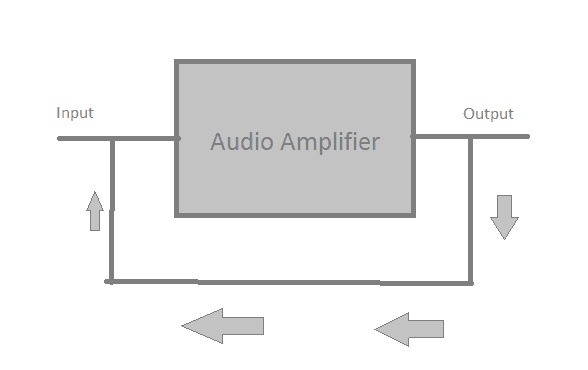
  • how the loop does not go in an infinite cycles ? what prevents it from going into an infinite loop ?
  • How many cycles (of amplification) does it perform before quitting the loop and signals comes out of the final output lead ?
upload_2017-10-8_14-14-11.png
 
Engineering news on Phys.org
Frenemy90210 said:
how the loop does not go in an infinite cycles ? what prevents it from going into an infinite loop ?

it is a continuous loop
Frenemy90210 said:
How many cycles (of amplification) does it perform before quitting the loop and signals comes out of the final output lead ?

immediately, why would you think that it didnt ?

disconnect the feedback line, where does the signal go ? ____________

reconnect the feedback line, where does the signal go ? ____________
 
Ohhh, also meant to say
I put your topic tital directly into google and got lots of hits on the use of positive and negative feedback and it's uses
 
"How many cycles (of amplification) does it perform before quitting the loop and signals comes out of the final output lead ?"
Before I can answer this question I must understand the meaning of "quitting the loop".
Please, can you explain?
 
Are you certain you mean positive feedback and not negative?
Amplifiers with only positive feedback are never stable. Either the output is going to to sit at the positive or negative supply rail or the amplifier will oscillate (if a capacitor is used for positive feedback). Negative feedback is widely used in amplifiiers to make them more linear. Stability of these can be an issue too. See https://www.allaboutcircuits.com/technical-articles/negative-feedback-part-4-introduction-to-stability/ for example.
 
  • Like
Likes   Reactions: NFuller
willem2 said:
Are you certain you mean positive feedback and not negative?
Amplifiers with only positive feedback are never stable. Either the output is going to to sit at the positive or negative supply rail or the amplifier will oscillate (if a capacitor is used for positive feedback). Negative feedback is widely used in amplifiiers to make them more linear. Stability of these can be an issue too. See https://www.allaboutcircuits.com/technical-articles/negative-feedback-part-4-introduction-to-stability/ for example.

This probably solves my misunderstanding. I thought -ve feedback amps were used for voltage regulators. The fact that +ve feedback amps go to saturation levels, which means they can not be used as signal amps. They must be negative feedback amplifiers to be used as signal amplifiers.
 
willem2 said:
Are you certain you mean positive feedback and not negative?
Amplifiers with only positive feedback are never stable. Either the output is going to to sit at the positive or negative supply rail or the amplifier will oscillate (if a capacitor is used for positive feedback). Negative feedback is widely used in amplifiiers to make them more linear. Stability of these can be an issue too. See https://www.allaboutcircuits.com/technical-articles/negative-feedback-part-4-introduction-to-stability/ for example.
I don't think it is true that an amplifier with positive feedback is always unstable. It is just that the gain around the loop must be less than 1. There are some properties of positive feedback which are useful, such as increasing the gain of a low gain amplifier, producing toggle action, increasing the Q of a resonant circuit and increasing input impedance.
 
  • Like
Likes   Reactions: jim hardy and berkeman
tech99 said:
I don't think it is true that an amplifier with positive feedback is always unstable. It is just that the gain around the loop must be less than 1. There are some properties of positive feedback which are useful, such as increasing the gain of a low gain amplifier, producing toggle action, increasing the Q of a resonant circuit and increasing input impedance.
Yes - that`s true.
As another example: Active filters contain (slight) positive feedback effects - otherwise large pole-Q values wouldn`t be achievable.
This is identical with closed-loop poles near the imag. axis. While increasing the pos. feedback factor the poles will move towards the imag. axis - and for infinite Q values (unity loop gain) we habe an oscillator.
 
  • #10
tech99 said:
I don't think it is true that an amplifier with positive feedback is always unstable.
Dead right there.
It is sometimes useful to use (a small amount of) positive feedback to make up for losses in a circuit. In the 'old days' of radio reception, many receivers were of the Tuned Radio Frequency (TRF) design. They used a simple resonant filter to select the wanted signal but the bandwidth of such a simple filter was very wide would not reject adjacent frequencies. This is because the poor Q factor of the inductor limits filter bandwidth. A 'sniff' of the output signal from the filter was fed back (positively) to make up for the loss and this produced a much sharper filter. They were not ideal to use as you had to control the amount of feedback with a knob for whichever frequency you were using. If you put in too much feedback you would make the thing oscillate, which sent RF interference out along the aerial wire, annoying all the neighbours.
I believe that the very simple receivers used for radio control (way back) also used TRF circuits.
 
  • Like
Likes   Reactions: jim hardy
  • #11
sophiecentaur said:
In the 'old days' of radio reception, many receivers were of the Tuned Radio Frequency (TRF) design.

The 'positive feedback' Sophie mentions was called "regeneration"

https://en.wikipedia.org/wiki/Regenerative_circuit said:
The regenerative receiver was invented in 1912[4] and patented in 1914[5] by American electrical engineer Edwin Armstrong when he was an undergraduate at Columbia University.[6] It was widely used in radio receivers between 1915 and World War II.[3] Advantages of regenerative receivers include increased sensitivity with modest hardware requirements, and increased selectivity because the Q factor of the tuned circuit will be increased when the amplifying vacuum tube or transistor has its feedback loop around the tuned circuit (via a "tickler" winding or a tapping on the coil) because it introduces some negative resistance.

Due partly to its tendency to radiate interference if the regeneration control is set too high,[3][2] by the 1930s the regenerative receiver was largely superseded by other TRF receiver designs (for example "reflex" receivers) and especially by another Armstrong invention - superheterodyne receivers[7] and is largely considered obsolete.[2][8] Regeneration (now called positive feedback) is still widely used in other areas of electronics, such as in oscillators and active filters, and bootstrapped amplifiers.

Being on the verge of oscillation they'd 'whistle' a lot
and that's why 1940's movies so often had a whistle in the soundtrack as an actor tunes in his radio - made it more realistic to audiences of the day..
 
  • #12
jim hardy said:
Being on the verge of oscillation they'd 'whistle' a lot
and that's why 1940's movies so often had a whistle in the soundtrack as an actor tunes in his radio - made it more realistic to audiences of the day..
Same gag as with old ladies' hearing aids. (It was always old ladies in films, for some reason.)
As a user of digital hearing aids (even) I am still guilty of taking people by surprise with a sudden whistle.
There was also the SSB receiver whistle, which would sweep through the whole audio band as they searched for the right BFO frequency.
 

Similar threads

  • · Replies 1 ·
Replies
1
Views
2K
  • · Replies 3 ·
Replies
3
Views
3K
  • · Replies 11 ·
Replies
11
Views
3K
  • · Replies 10 ·
Replies
10
Views
2K
  • · Replies 26 ·
Replies
26
Views
3K
  • · Replies 18 ·
Replies
18
Views
4K
  • · Replies 7 ·
Replies
7
Views
2K
  • · Replies 5 ·
Replies
5
Views
3K
  • · Replies 4 ·
Replies
4
Views
2K
Replies
5
Views
3K