How Are Trig Half-Angle Identities Derived from Basic Formulas?

  • Thread starter Thread starter Nikitin
  • Start date Start date
  • Tags Tags
    identities Trig
Click For Summary

Homework Help Overview

The discussion revolves around the derivation of trigonometric half-angle identities, specifically how they relate to angle-sum and difference identities. Participants express a need for clarification on these identities, which are expected knowledge for the course.

Discussion Character

  • Exploratory, Conceptual clarification, Mathematical reasoning

Approaches and Questions Raised

  • Participants explore the relationship between half-angle identities and fundamental trigonometric identities. Questions arise regarding the derivation process and the application of angle-sum identities.

Discussion Status

Some participants have provided insights into the derivation process, referencing fundamental identities and suggesting methods of manipulation. There is an ongoing exploration of different approaches to understanding the half-angle identities, but no consensus has been reached.

Contextual Notes

Participants note that the professor expects familiarity with these identities without prior instruction, which may affect their understanding and approach to the derivation process.

Nikitin
Messages
734
Reaction score
27
Apparently our professor expects us to know these half-angle identities
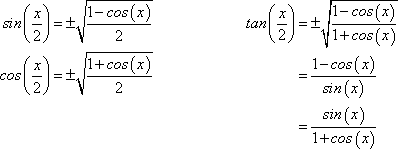
idents03.gif

(http://www.purplemath.com/modules/idents.htm)

Without going through them in class or us learning them in high school..

Can somebody explain how these were derived? Does the derivation come from the angle-sum and difference identities?
 
Last edited:
Physics news on Phys.org
Hi Nikitin! :smile:

Your professor is right, you do need to learn these.
Nikitin said:
Does the derivation come from the angle-sum and difference identities?

Yes, have a go! :smile:
 
thx. With a bit of effort it wasn't that hard :)
 
These are usually stated a bit differently:

For example, for sin2(x) = ½[1 – cos(2x)],

Taking the square root of both sides of the above identity, and letting θ = 2x, we have,

[itex]\displaystyle \sin(\theta/2)=\pm\sqrt{\frac{1-\cos(\theta)}{2}}\,,[/itex] where the ± sign indicates that you choose the correct sign depending upon the quadrant in which θ/2 lies.

Similar results hold for the other half-angle identities.
 
The fundamental identities are sin^2(a)+ cos^2(a)= 1, sin(a+ b)= sin(a)cos(b)+ cos(a)sin(b) and cos(a+ b)= cos(a)cos(b)- sin(a)sin(b). How you show those depends on exactly how you have defined "sine" and "cosine".

But from those cos(2a)= cos(a+ a)= cos^2(a)- sin^2(a). Of course, then, cos(2a)= cos^2(a)- (1- cos^2(a)= 2cos^2(a)- 1 and cos(2a)= (1- sin^2(a))- sin^2(a)= 1- 2sin^2(a).

From cos(2a)= 2cos^2(a)- 1, we have cos^2(a)= (1/2)(cos(2a)+ 1) so that [itex]cos(a)= \pm\sqrt{(1/2)(cos(2a)+ 1)}[/itex] and, setting b= 2a, [itex]cos(b/2)= \pm\sqrt{(1/2)(cos(b)+ 1)}[/itex].

From cos(2a)= 1- 2sin^2(a), we have sin^2(a)= (1/2)(1- cos(2a) so that [itex]sin(a)= \pm\sqrt{(1/2)(1- sin(2a)}[itex]and, setting b= 2a, [itex]sin(b/2)= \pm\sqrt{(1/2)(cos(b)+ 1)}[/itex]. <br /> <br /> Whether we use + or - for a given b depends on the quadrant b/2 is in which is NOT given by cos(b).[/itex][/itex]
 

Similar threads

Replies
4
Views
2K
  • · Replies 2 ·
Replies
2
Views
2K
Replies
1
Views
2K
  • · Replies 17 ·
Replies
17
Views
6K
  • · Replies 3 ·
Replies
3
Views
2K
  • · Replies 1 ·
Replies
1
Views
2K
  • · Replies 8 ·
Replies
8
Views
5K
Replies
2
Views
2K
  • · Replies 3 ·
Replies
3
Views
3K
  • · Replies 3 ·
Replies
3
Views
3K