How can I find the inertia of a rod with a pivot point?

Click For Summary

Discussion Overview

The discussion centers on calculating the moment of inertia of a rod with a pivot point located along its length. Participants explore the application of the parallel axis theorem and the implications of different pivot placements on the inertia calculation.

Discussion Character

  • Technical explanation
  • Mathematical reasoning

Main Points Raised

  • One participant questions whether the moment of inertia should be calculated as IStick cm = 1/12 * m * L² or if it involves additional terms due to the pivot point's location.
  • Another participant suggests revising the parallel axis theorem, stating that I = Ic + (md²), where Ic is the moment of inertia about the center of mass and d is the distance between the parallel axes.
  • Further clarification is sought on the meaning of Ic and the distance d in relation to the pivot point and the center of mass.
  • A participant identifies the center of mass as being at L/2 from one end and calculates the distance d as L/6 when the pivot is at 2L/3 from one end.

Areas of Agreement / Disagreement

Participants express differing views on the correct approach to calculating the moment of inertia, indicating that multiple competing models and interpretations remain unresolved.

Contextual Notes

There are limitations regarding the assumptions made about the pivot point's location and the definitions of terms used in the calculations, which have not been fully resolved.
Blockade
Messages
68
Reaction score
0
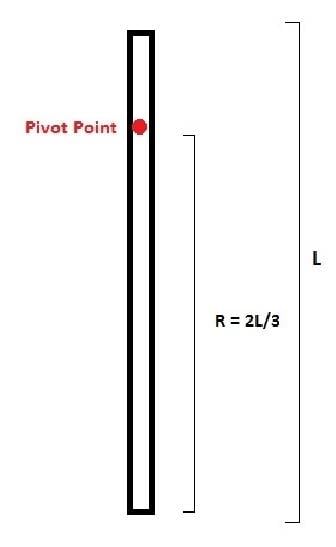
I have a question on finding the inertia of a rod with a pivot point somewhere along it's length.

So the inertia of a rod is IStick cm = 1/12 *m*L2
Does L2 = (2L/3)2 = 4L2/9 -> 1/12 *m*[4L2/9] or is it something like
m*L2/12 + m* (2L/3)2?

If it's the second one then may I ask why it's that?

Picture
e6416fa63e.jpg
 
Physics news on Phys.org
Revise parallel axis theorem; I = Ic + (md^2) Ic is MI about CM and d is the distance between parallel axes passing through CM and pivot. It can be proved first and then can be used.
 
Let'sthink said:
Revise parallel axis theorem; I = Ic + (md^2) Ic is MI about CM and d is the distance between parallel axes passing through CM and pivot. It can be proved first and then can be used.

so m*L2/12 + m* (2L/3)2
where Ic = m*L2/12
and md^2 = m* (2L/3)2when you said "MI about CM" you mean the mass around the center mass which is the entire rod? As for d is the "distance between parallel axes passing through CM and pivot" meaning the length between the end of the stick pass the center mass where it ends at the pivot?
 
center of mass is at the mid point of rod at L/2 from one end and if pivot is at 2L/3 from one end then d = (2L/3) - (L/2) = L/6. Ic is the MI about the axis passing through the point at L/2 from one end.
 

Similar threads

  • · Replies 2 ·
Replies
2
Views
2K
  • · Replies 12 ·
Replies
12
Views
2K
  • · Replies 69 ·
3
Replies
69
Views
6K
  • · Replies 5 ·
Replies
5
Views
3K
  • · Replies 1 ·
Replies
1
Views
2K
  • · Replies 49 ·
2
Replies
49
Views
6K
  • · Replies 2 ·
Replies
2
Views
3K
  • · Replies 5 ·
Replies
5
Views
3K
  • · Replies 10 ·
Replies
10
Views
2K
Replies
9
Views
2K