How can I increase the pull-push force of my solenoid with specific parameters?

  • Thread starter Thread starter Davx1992
  • Start date Start date
  • Tags Tags
    Force Solenoid
Click For Summary

Discussion Overview

This discussion revolves around the design and optimization of a solenoid to achieve a specific pull-push force, particularly in relation to pushing an iron bolt with a neodymium magnet. Participants explore various parameters such as wire gauge, current, and coil dimensions, as well as the calculations involved in estimating the magnetic force produced by the solenoid.

Discussion Character

  • Technical explanation
  • Mathematical reasoning
  • Debate/contested

Main Points Raised

  • One participant describes their solenoid setup, including wire length, diameter, and current, and expresses dissatisfaction with the pull force achieved.
  • Another participant inquires if the solenoid was tested with a bolt inside, suggesting that the setup may influence the force output.
  • A participant proposes a method to estimate the pull force based on the current, number of turns, and coil length, introducing the concept of magnetic energy density.
  • Calculations are presented by a participant to estimate the force produced by their solenoid, raising questions about the correctness of their results and the units of measurement.
  • Clarification is provided regarding the calculated force being in Newtons, along with an explanation of how to increase the force by modifying the setup, such as reducing the distance between the iron plate and the bolt.
  • A later reply seeks to integrate the new distance information into the existing formula to refine the force calculations.

Areas of Agreement / Disagreement

Participants express differing views on the effectiveness of their solenoid designs and the calculations involved. There is no consensus on the optimal parameters or methods to achieve the desired force, and multiple competing approaches are presented.

Contextual Notes

Participants mention various assumptions regarding wire gauge, current, and coil dimensions, but these assumptions are not universally agreed upon. The discussion includes unresolved mathematical steps and dependencies on specific configurations.

Who May Find This Useful

This discussion may be useful for individuals interested in electromagnet design, solenoid applications, and those seeking to understand the calculations involved in estimating magnetic forces.

Davx1992
Messages
3
Reaction score
0
Hello, I have some problems with my solenoid calculations. I have spent many hours, on searching for Formulas, and answers, but exact answer I cannot find. I made 2 electromagnets, and then tried with solenoids.
Last solenoid was made with 120 m long wire, 0,3 mm, center diameter was 12 mm and 4 cm long. I achieved 0,5 A on 12V. But solenoid pull force was weak.
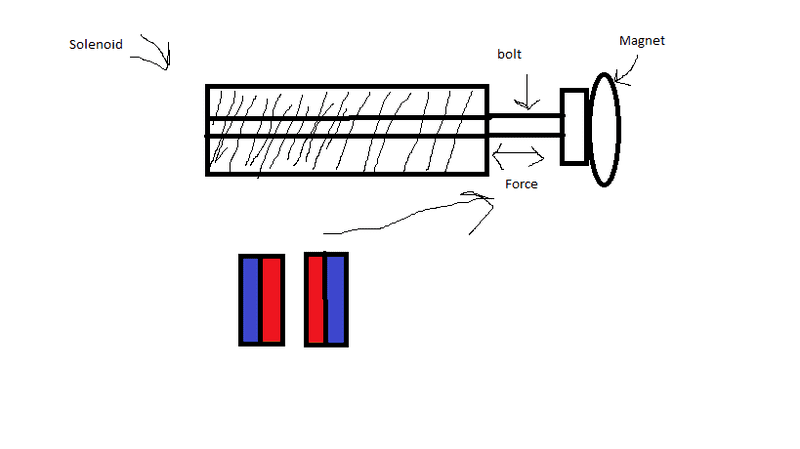
So here is my question: My goal is to make solenoid which can push iron bolt (center) with neodymium magnet with push force similar with when put two permament magnets with same poles.
I planned max 1A and 12 V. How can I make solenoid with max force with such parameters, and what kind of wire I need- 0.3, 0.5, 0.6, 0.7, how long, Is it even possible, to gain such solenoid force, with such parameters.
Thanks.
And here is an image to show my idea.
009b85c.png
 
Engineering news on Phys.org
Hello Dave, :welcome:

Did you also try out your solenoid with the bolt inside?
 
Yeap, I made electromagnets with bolt inside. It was weak. I think problem is with wire, its too tight problably. And when I made my coil current was 0,5 A.
Now I think that i have to make solenoid with 0.5 or 0.6 mm wire, with 1A current, but I don't know how to calculate force, what I can reach and will it be enough for my project.
 
The ordinary pull force, for an iron bolt, can be estimated easily. The product of the current and the number of turns divided by the coil length gives the estimation of the magnetic field H inside the coil. The magnetic constant (1.26 microhenry/m) divided by 2 and multiplyed by the square of H gives the magnetic energy density inside the coil. Finally, the product of that energy density and the bolt cross section area gives the estimation of the magnetic pulling force (provided the end of the bolt is inside the coil).

As for pushing a permanent magnet, it's way more complicated, and the force must be much weaker...
 
Last edited:
Thanks for answer,
My calculations: 1000 turns Current: 1A , length 0,04m
H=25000
Then : (0.00000126/2) * 25000^2 = 393,75

Then: 393,75* 0.00005527000m² = 0,021 ??
Is it correct, and is it kg or lb?? What I calculated?
 
It's 0.021 Newton

https://en.wikipedia.org/wiki/Newton_(unit)

Your energy density is 393.75 joule/cubic_meter ; when you multiply it by 0.000055 square_meter , it gives 0.021 joule/meter - and joule/meter is exactly Newton, the SI unit for force.

0.021 Newton is the force you need to lift a 2.14 gram weight - not very much...

To increase the force, one should use additional iron things in order to concentrate the magnetic energy near the bolt end, like here:
s-l225.jpg
197-004-512E13B5.jpg

- the field H (not B ! ) is concentrated between the back iron plate and the internal end of the bolt (plunger). For example, it may be 4mm between them instead of your 40 mm - and then, the field is 10 times greater and the force is 100 times stronger.
 
Last edited:
  • Like
Likes   Reactions: Davx1992 and BvU
AlexCaledin said:
It's 0.021 Newton

https://en.wikipedia.org/wiki/Newton_(unit)

Your energy density is 393.75 joule/cubic_meter ; when you multiply it by 0.000055 square_meter , it gives 0.021 joule/meter - and joule/meter is exactly Newton, the SI unit for force.

0.021 Newton is the force you need to lift a 2.14 gram weight - not very much...

To increase the force, one should use additional iron things in order to concentrate the magnetic energy near the bolt end, like here:
View attachment 186520 View attachment 186521
- the field H (not B ! ) is concentrated between the back iron plate and the internal end of the bolt (plunger). For example, it may be 4mm between them instead of your 40 mm - and then, the field is 10 times greater and the force is 100 times stronger.
I'm building a coil to test a solenoid and your comments helped a lot. Would you mind plugging this last comment about the distance from the plunger end to the back iron plate into the formula you mentioned earlier? E.g: the solenoid is still 4cm long, but the bolt is almost reaching the end of it (just 4mm to reach it) how to use this info in the formula? Thanks in advance.
 

Similar threads

  • · Replies 4 ·
Replies
4
Views
6K
  • · Replies 37 ·
2
Replies
37
Views
5K
Replies
23
Views
5K
  • · Replies 1 ·
Replies
1
Views
4K
Replies
1
Views
2K
  • · Replies 6 ·
Replies
6
Views
3K
Replies
2
Views
3K
  • · Replies 3 ·
Replies
3
Views
2K
  • · Replies 1 ·
Replies
1
Views
5K
  • · Replies 1 ·
Replies
1
Views
3K
