How can I remove ambiguity in defining the centre of gravity?

  • Context: Graduate 
  • Thread starter Thread starter mechprog
  • Start date Start date
  • Tags Tags
    Cog
Click For Summary

Discussion Overview

The discussion revolves around the definition and mathematical treatment of the center of gravity (CoG) and its relationship to the center of mass (CoM). Participants explore the implications of defining CoG in terms of gravitational torque and the challenges in eliminating an arbitrary parameter, lambda, from the equations. The conversation includes theoretical considerations, physical interpretations, and attempts to clarify the mathematical foundations of these concepts.

Discussion Character

  • Exploratory
  • Technical explanation
  • Debate/contested
  • Mathematical reasoning

Main Points Raised

  • Some participants propose that the position of CoG can be defined using the moments of elemental weights, leading to an equation that includes an arbitrary parameter, lambda.
  • Others argue that lambda cannot be eliminated and that the definition of CoM precedes that of CoG, suggesting that CoG is a property derived from CoM in a uniform gravitational field.
  • A participant suggests a physical method to find CoG by hanging the body at different points and finding the intersection of the lines of gravity.
  • Another participant expresses uncertainty about the assumption that CoG "sticks" to the body during rotation, questioning whether the lines of force will intersect after reorientation.
  • Some participants discuss the implications of lambda being zero, indicating that it corresponds to a fixed point, while others maintain that this assumption may not hold universally.
  • A later reply clarifies that CoM is a special case of CoG, asserting that while CoM exists and is fixed, CoG may include other points that do not satisfy the "stick" condition.
  • There is a suggestion that the definition of CoG should include the condition that it remains unchanged upon reorientation of the body, which relates to the value of lambda.

Areas of Agreement / Disagreement

Participants express differing views on the definition and implications of CoG and CoM, with no consensus reached on whether lambda can be eliminated or the assumptions regarding the "stick" condition of CoG. The discussion remains unresolved, with multiple competing perspectives presented.

Contextual Notes

Participants note that the definition of CoG may be incomplete without considering the implications of reorientation and the conditions under which lambda can be set to zero. The discussion also highlights the dependence on the uniformity of the gravitational field for certain conclusions.

mechprog
Messages
27
Reaction score
0
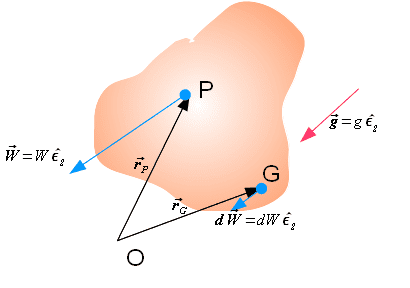
Consider the body shown below
attachment.php?attachmentid=26945&stc=1&d=1278997793.png

Now, if G be the centre of gravity (or centre of any parallel uniformly distributed body force), then we define its position by equating the moment of total weight by moments of elemental weights about the same point i.e.
\vec{r_{G}}\times W \vec{\epsilon_{g}}=\int\int\int_V \vec{r_P} \times dW \vec{\epsilon_{g}}
or
\left(\vec{r_{G}}-\frac{1}{W}\int\int\int_V \vec{r_P}dW\right) \times\vec{\epsilon_{g}}=0
which explicitly gives,
\vec{r_{G}}=\frac{1}{W}\int\int\int_V \vec{r_P} dW + \lambda \vec{\epsilon_{g}}
Now the question is: how to do away with the \lambda(an arbitrary number)
Seeing the question physically, this ambiguity in definition of comes from the transmissibility of force (from the point of view of moment).
This can be removed (mathematically, making \lambda=0) by using the fact that centre of gravity has no bindings for orientation of the body.
So, how can I rotate the body and reduce the line of gravity (as defined above) to a point.
 

Attachments

  • CoG.PNG
    CoG.PNG
    8.2 KB · Views: 583
Physics news on Phys.org
If you define CoG so, then lamdba cannot be eliminated. Even if lambda=1 or 2 or any number but 0, the formula you derived shows that the position of G is independent from the orientation of the body.

I think that in fact, the definition of center of mass comes first:\vec{r}_{CoM}=\frac{1}{M}\Sigma \vec{r}\Delta m
Then when we apply that concept to the case of uniform force field (uniform gravity in particular), we call CoM as CoG (in uniform force field). At this point, the definition of CoG you gave us above is just a property of CoG. By comparing 2 equations (i.e. the equation derived by you and the definition of CoM), we easily deduce that lambda = 0.
 
hikaru1221 said:
If you define CoG so, then lamdba cannot be eliminated. Even if lambda=1 or 2 or any number but 0, the formula you derived shows that the position of G is independent from the orientation of the body.

I think that in fact, the definition of center of mass comes first:\vec{r}_{CoM}=\frac{1}{M}\Sigma \vec{r}\Delta m
Then when we apply that concept to the case of uniform force field (uniform gravity in particular), we call CoM as CoG (in uniform force field). At this point, the definition of CoG you gave us above is just a property of CoG. By comparing 2 equations (i.e. the equation derived by you and the definition of CoM), we easily deduce that lambda = 0.

I have already given you what has to be done physically (1. Rotate the body along with the line of gravity, 2. take its intersection with the new line of gravity and finally 3. show that this point is the point of concurrency of any line of gravity obtained by reorienting the body in any way). My only question is how this can be done mathematically ( i.e. proving \lambda=0).
 
I understand your physical proof like this:
1 - Hang the body by a rope at an arbitrarily chosen point. Call d1 the line on the body aligned with the rope.
2 - Hang it at another point and we have another line d2. The point of intersection between d1 and d2 is G.
3 - Repeat the process again and show that we get the same G.
Is it what you meant?
 
Exactly, but how to accomplish this mathematically?
Actually this physical idea is taken from a book by I H Shames (a renowned author of classical mechanics textbooks). But he uses the phrase "it can be showed that...". That is why I am struggling with it.
Further, I do not say that the way I have conceived is the only way out.
 
The physical approach actually makes one implicit assumption: G is "stick" on the body. See the figure. When we rotate the body about O, we can see that G doesn't move relatively to the body. On the other hand, another point A, which is vertically below (or above) G, is not "stick" to the body, and eventually, it is still at the same vertical position relative to G after we rotate the body.

Now we can easily see that the moment of gravitational force on the body about O is \vec{M_O}=\vec{OG}\times m\vec{g} = \vec{OA}\times m\vec{g} provided that the gravitational field is uniform and points vertically upwards. In this case, while G corresponds to lambda=0, A corresponds to lambda = some value but 0!

You define CoG only via the total gravitational torque, therefore the final formula you deduce will except both G and A as solutions. Only when we include the other condition in the definition (i.e. G is "stick" on the body) can we eliminate lambda. This condition is already included in the definition of CoM.

I've thought of one way to eliminate lambda "mathematically" by using the other condition (I'm not sure if it's really math or not). This condition implies that G is independent from the gravity. If we switch the direction of gravity to another unit vector \hat{h}, the vector \vec{OG} remains the same. By subtracting the 2 formulas, \lambda (\hat{\epsilon } - \hat{h})=0. So lambda = 0.

Another way is to use a point B on the body. The condition implies if A satisfies the condition, the angles [\vec{OB};\vec{BA}]=[\vec{OB'};\vec{B'A'}] = angle of rotation. There are 2 cases:
_ If A is G, it is solved.
_ If A is not G, then because GA // G'A' and BG is not parallel to B'G', the angle (BGA) is different from (B'G'A'). Thus, BA is different from B'A', plus the facts that the angle (ABG) can be expressed in terms of the lengths BA, BG, GA, and (A'B'G') is similar, GA=G'A', BG=B'G', we can conclude that (ABG) is different from (A'B'G'). Because:

[\vec{OB};\vec{BA}]=[\vec{OB};\vec{BG}] + \hat{ABG}

[\vec{OB'};\vec{B'A'}]=[\vec{OB'};\vec{B'G'}] + \hat{A'B'G'}

[\vec{OB};\vec{BG}]=[\vec{OB'};\vec{B'G'}]

We shall see that: [\vec{OB};\vec{BA}]\neq [\vec{OB'};\vec{B'A'}]

This means A doesn't satisfy the condition.

Just my 2 cents :wink:
 

Attachments

  • untitled.JPG
    untitled.JPG
    18.8 KB · Views: 467
Last edited:
The game is not over!
G 'sticks' to the body is an unwarranted assumption. (Why?)
When we rotate the body we do not know whether the lines of forces (new and old) intersect, that is what we have to check. In other words we do not know, at least before doing the analysis, that whether the CoG exists or not. If it exists it will definitely 'stick'. But assuming it to be fixed when we do not know whether it exists or not (no one can say this from the equations I gave earlier) seems to be incorrect!
See the corrected figure below.
And as of cents.....first find their CoG:smile:.
attachment.php?attachmentid=26957&stc=1&d=1279113110.png
 

Attachments

  • CoG.PNG
    CoG.PNG
    8.8 KB · Views: 541
Oh G in my previous post is CoM, not CoG, i.e. lambda corresponding to G is 0, so it really exists and is fixed. Does it solve the problem? :wink:

EDIT: To clarify what I said:
CoM = the point determined by the CoM formula I cited and corresponding to lambda=0 in your equation. CoM exists and is fixed.
"CoG" = the point determined by the condition about the torque and accompanied by an arbitrary value of lambda.
So CoM is a special case of "CoG", which means there is at least one point in the solution set of "CoG" satisfying the "stick" condition. I have proved that the other points in the set don't satisfy the condition, thus CoM is the real CoG we need to find.
 
Last edited:
Thanks for 'sticking' with the question! (is there no one other than you and me interested?)
One thing you should note that the definition of CoG above is incomplete. The complete definition should imply (at least implicitly) that CoG (LoG: line of gravity, if it serves the purpose of equivalence) must be such that it must not change by reorienting the body. And this point must be represented by the value of lambda=0. (See eqn. above is that of line with parameter lambda.)

Yes, CoM is indeed a point that exists by definition (its position, velocity and acceleration are weighted (strictly: massed:smile:) average of constituent's corresponding properties).
Next note that, as opposed to my wrong assertion earlier, uniformity of force field is not a necessary condition for defining CoG. If uniformity exists then only we can cancel out field intensity (g) from the RHS of the final definition (i.e. with lambda=0) and get the expression of CoM (this seems to be coincidence- but may have hidden physical consequence(s)).
My suggestion: Let the CoM rest in the dynamics bulky book, statics can remain pure from CoM. (And here let me point out a subtle difference between training of engineers and physicist-former see statics first in detail and move for dynamics later, while latter mainly study dynamics, statics forms a cornerstone of their study-a special case F=0, but both are justified-latter you know why, former: afterall a lot of structures are to be dealt statically (not for physicists who say nothing is at [absolute] rest!) )
 
  • #10
mechprog said:
Thanks for 'sticking' with the question! (is there no one other than you and me interested?)
Well things in this forum seem to be like if the thread is already replied, nobody cares about it.

One thing you should note that the definition of CoG above is incomplete. The complete definition should imply (at least implicitly) that CoG (LoG: line of gravity, if it serves the purpose of equivalence) must be such that it must not change by reorienting the body. And this point must be represented by the value of lambda=0. (See eqn. above is that of line with parameter lambda.)
Is that what I'm pointing out from the start (the "stick" condition)?

Yes, CoM is indeed a point that exists by definition (its position, velocity and acceleration are weighted (strictly: massed:smile:) average of constituent's corresponding properties).
Next note that, as opposed to my wrong assertion earlier, uniformity of force field is not a necessary condition for defining CoG. If uniformity exists then only we can cancel out field intensity (g) from the RHS of the final definition (i.e. with lambda=0) and get the expression of CoM (this seems to be coincidence- but may have hidden physical consequence(s)).
I'm not sure what the exact definition of CoG is, but since "gravity" is included in the term, I think it should somehow be related to the force field, which means we consider a body interacting with something else (there are 2 things here!). If we remove the gravitational acceleration g, then there is no "field" in the formula, which means there is only 1 thing left - the body.
My own opinion about the relation between CoM and CoG is written post #2.

(And here let me point out a subtle difference between training of engineers and physicist-former see statics first in detail and move for dynamics later, while latter mainly study dynamics, statics forms a cornerstone of their study-a special case F=0, but both are justified-latter you know why, former: afterall a lot of structures are to be dealt statically (not for physicists who say nothing is at [absolute] rest!) )

I believe many physics textbooks start with dynamics first. However I've also seen some deal with statics first :wink:
I don't see how we can deal with a bicycle statically.
 
  • #11
hikaru1221 said:
Is that what I'm pointing out from the start (the "stick" condition)?
Yes, you right in saying this (I was wrong in understanding).
It would be nice for me if we don't invoke CoM here (it seems unnecessary and inelegant way of doing this).
Well, one may think that the thread has been stretched unnecessarily :zzz: so if you like we can quit, but if you still enjoy hooking with it- you're welcome to bear with me :smile:
 
  • #12
Because CoM is the name assigned for the particular point G which corresponds to lambda=0, I used it without caution. If you would like a solution that avoids using the term "CoM", it's fine; just replace CoM with "the point which corresponds to lambda=0". Howsoever we solve the problem, we eventually end up with that point, so it's inevitable however we call it.

I enjoy debating :smile: So if you don't want to start a new thread then I would like to bear with you and invite you to bear with me :biggrin:
 
  • #13
Eureka!
Well there is nothing new, but a slight modification to the first proof given by you in post#6 will serve our purpose well.
Remember my objection to it in post#7. \vec{r_G} in the two equations may not be the same (actually they are not a fixed vector but locii representing straight lines. And from the equations of straight lines
\vec{r_G}=\frac{1}{W}\int\int\int_W \vec{r} dW + \lambda \hat{\epsilon}
\vec{r_G}=\frac{1}{W}\int\int\int_W \vec{r} dW + \mu \hat{\eta}
we though they both are in different directions but pass through a common point (what's it?)
Or we can simply equate to get the common point as \lambda \hat{\epsilon}=\mu \hat{\eta} implies both lambda and mu to be zero.
If this was what you meant earlier then accept apologies (for wasting your time) from this fickle-mind:wink:
But, if you thought that \vec{r_G} is a 'point' to be equated then you were wrong (eqns I gave are of lines and we were to find their common point).
About mu: I used different parameter in the second eqn. because we do not know anything about it from the original eqn.
 
Last edited:
  • #14
Yours and mine are the same :wink: You were finding the common point, I was finding the point which is independent from the direction of the force field. The two conditions are actually the same. There is just a bit difference in the explanations: while I fix the parameter, you set it as a varying parameter.
 

Similar threads

Replies
9
Views
1K
  • · Replies 9 ·
Replies
9
Views
1K
  • · Replies 2 ·
Replies
2
Views
1K
  • · Replies 13 ·
Replies
13
Views
6K
  • · Replies 3 ·
Replies
3
Views
2K
Replies
1
Views
2K
  • · Replies 3 ·
Replies
3
Views
2K
  • · Replies 10 ·
Replies
10
Views
3K
  • · Replies 22 ·
Replies
22
Views
1K
  • · Replies 2 ·
Replies
2
Views
2K