How Do Forces Transfer in Scissor Lift Beams?

Click For Summary

Discussion Overview

The discussion revolves around understanding the force transfer in the beams of a scissor lift, particularly focusing on the role of pins and a hydraulic piston. Participants explore how loads are distributed among the components and the implications for bearing stress calculations. The scope includes theoretical analysis and practical application related to structural engineering.

Discussion Character

  • Exploratory
  • Technical explanation
  • Debate/contested
  • Homework-related

Main Points Raised

  • One participant expresses confusion about how forces are transferred through the beams and the role of the piston in this process.
  • Another participant suggests that the force at the pin where the piston connects is primarily from the piston itself, while the forces at another pin should include contributions from both the piston and reactions from adjacent pins.
  • A participant questions the correctness of the previous claims, noting the absence of free-body diagrams and the need for thorough structural analysis to determine forces accurately.
  • Concerns are raised about the complexity of analyzing the structure due to the hydraulic piston breaking symmetry, which complicates the load distribution.
  • One participant proposes that the bearing stress in the pins should account for both the piston load and the load from the beams.
  • Another participant indicates that while the hydraulic cylinder may reduce the load on the lower structure, it cannot be assumed that the load at a specific pin is negligible without further analysis.

Areas of Agreement / Disagreement

Participants do not reach a consensus on the exact nature of the forces acting on the pins or the implications for bearing stress. Multiple competing views and uncertainties remain regarding the analysis of the scissor lift structure.

Contextual Notes

Participants highlight the need for valid free-body diagrams and detailed structural analysis to clarify the force distribution. There is also mention of potential internal redundancy in the structure, which remains unresolved.

Who May Find This Useful

This discussion may be of interest to students and professionals in engineering, particularly those focused on structural analysis and design of mechanical systems involving hydraulic components.
Kingvilla
Messages
3
Reaction score
0
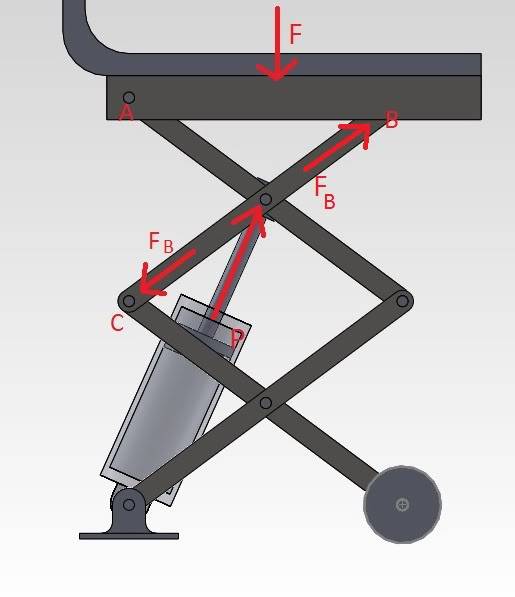
I am trying to understand how calculate the forces in the beams or atleast how they relate to each other. There is a pin at the top right its just hidden as it is a wheel behind the rail. I am confused at the pin where the cylinder connects on how the load would be transferred to the lower parts of the beam. I originally thought (as shown in the picture) that the piston wouldn't make a difference in transfering the load along the beam but now I think it would. I am also trying to calculate the bearing stress in the pins and am not sure if I only include the piston load or the load from the beams as well. Also at pin C I feel like there would be little load because the piston would take most of it, is this correct?

Freebody.jpg
 
Physics news on Phys.org
Kingvilla: Is this a school assignment?
 
No it's not but wasn't sure if I should have posted it HW section. I was thinking of designing a basic scissor lift for a project and just wanted clarification on how the forces acton the pins. But I believe I figured out how the forces react on the pins. For the pin where the piston is attached inbetween pin B and C I believe the force that the pin is experience is only from the piston. Then the forces acting on pin C I just sum the forces from the piston and reaction at pin B.
 
Kingvilla: If it is coursework-related, or if you are a student, then it would go in the homework forum. Are you a student?
Kingvilla said:
For the pin where the piston is attached in between pin B and C, I believe the force that the pin is experience is only from the piston. Then the forces acting on pin C, I just sum the forces from the piston and reaction at pin B.
I am not saying, with certainty, this is incorrect, but it currently does not necessarily sound correct to me. You did not yet show any valid free-body diagrams, and you did not show your work. Therefore, we do not know if your answer is correct. Even though this structure is externally statically determinate, I am not sure, at this time, if it is internally statically determinate, because I did not investigate it. It might have some internal redundancy, but I am currently not sure.
 
Yes I'm a student. Sorry, is there a way to move the post to the homework section? If not I will just repost it there.
 
Yes, you can have a thread moved. Just hit the Report button, and say something like: "I am a student. Please move this thread to the engineering homework forum. Thanks." And later, it might be moved.
 
Moved the thread to homework. Just hit the Report button next time you want something moved!
 
Kingvilla: I think this structure is probably internally statically determinate. But the analysis is complicated, and lengthy. You picked a tedious, challenging problem, if you are a beginner.

You generally do not just look at a structural network and say, "I think the force that the pin is experiencing is only from the piston." The way you find out is by structural analysis, piecemeal solving for all the unknowns, in each part. Once you solve for the unknowns, then you can compute the force on each pin. There are approximately twenty or more unknowns in this structure. This structure is not a truss. The hydraulic cylinder is the only axial member in this structure.
 
What makes this horrible to analyze, compared with a "normal" scissor truss, is that the piston breaks the symmetry of the model and the loads.

The simple-minded way to do this would be just write out a lot of equations in a lot of variables and solve them, but computers are much better at that than people.

You might be able to get a start on this by thinking about what happens if the piston extends a small amount. The pressure inside the piston is doing some work to extend the rod. and that is lifting the weight on the platform by a related distance (depending on the geometry of the system). I think that would give you the piston force without needing to find anything else. Then, you could find the reactions at the base, and possibly work through the structure one joint at a time...
 
  • #10
Kingvilla said:
I am also trying to calculate the bearing stress in the pins, and am not sure if I only include the piston load, or the load from the beams, as well.
You would include the load from the beams, also.
Kingvilla said:
Also, at pin C, I feel like there would be little load, because the piston would take most of it. Is this correct?
The hydraulic cylinder would probably reduce the load in the lower structure, but I currently do not think we can claim it is little load on the lower structure, without performing some analysis.
 

Similar threads

  • · Replies 3 ·
Replies
3
Views
3K
  • · Replies 6 ·
Replies
6
Views
2K
Replies
4
Views
4K
  • · Replies 4 ·
Replies
4
Views
3K
Replies
4
Views
2K
  • · Replies 1 ·
Replies
1
Views
2K
Replies
1
Views
2K
  • · Replies 2 ·
Replies
2
Views
3K
Replies
3
Views
13K
  • · Replies 2 ·
Replies
2
Views
3K