How do I deal with a failed electronic project?

  • Thread starter Thread starter Planobilly
  • Start date Start date
  • Tags Tags
    Electronic Project
Click For Summary
SUMMARY

Billy's amplifier project, which combines elements from a Fender Bassman and a Fender EVH 5150, encountered multiple issues, including a significant 60Hz hum, microphonic components in the preamp stage, and unusual interactions between gain and volume controls. The hum was identified as a priority for troubleshooting, with suggestions to test the power supply and inspect tube connections. Ultimately, the microphonic issue was resolved by correcting the bias circuit wiring. The project highlights the complexities of building high-gain amplifiers on turret boards and the need for careful design and troubleshooting.

PREREQUISITES
  • Understanding of tube amplifier design, specifically Class AB push-pull configurations.
  • Familiarity with troubleshooting techniques for audio equipment, including using oscilloscopes.
  • Knowledge of component interactions in audio circuits, particularly gain and volume control relationships.
  • Experience with soldering and circuit board assembly, especially turret board layouts.
NEXT STEPS
  • Research methods for reducing 60Hz hum in tube amplifiers, including grounding techniques and power supply design.
  • Learn about the effects of microphonic tubes and how to test and replace them effectively.
  • Investigate the use of logarithmic taper potentiometers in audio applications to understand their impact on volume control.
  • Explore best practices for designing and troubleshooting high-gain amplifier circuits on turret boards.
USEFUL FOR

Electronics hobbyists, audio engineers, and anyone involved in building or troubleshooting tube amplifiers, particularly those interested in high-gain designs and complex circuitry.

  • #31
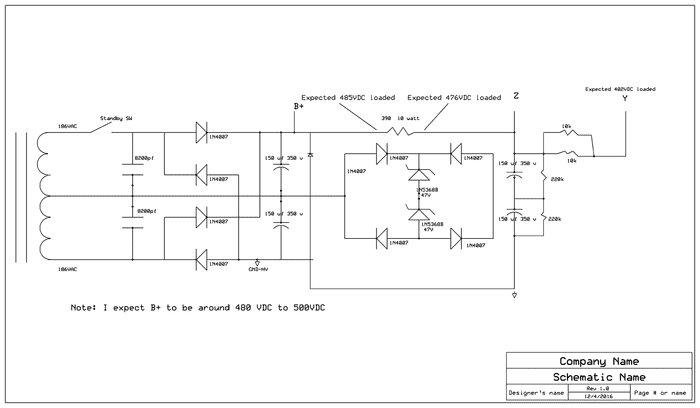
Redraw of the possible new HT power supply circuit.

z2QxiLH.png


Also the current HT bridge does not have a blown diode as the ripple is 120Hz.
 
Engineering news on Phys.org
  • #32
Have you covered the bottom of the chassis with a shielding material like an aluminum sheet? Also is the scope prorerly grounded?
 
  • #33
So - what is the diode bridge with the zeners doing? One end is connected to the transformer center tap, the other is floating in the air?
 
  • #34
Just a couple of general points: make sure the power supply ground is _between_ the filter caps and the rest of the circuit. Otherwise, the bypassed current will be pumping circuit ground.
Always make sure you know where every return path is for every current you use and make sure the forward and return paths/loops have as small an area as possible.
Pretend that the scope ground is 200V@5amps away from the ground of your power supply and hook the scope ground up so that the current will not go through any circuit ground paths. Unless you have a special scope life will be easier.
 
  • #35
Arydberg...Yes and Yes

Svein... More drawing mistakes...sorry...the zener idea is to stabilize the grid supply.

8KlQ7KF.png


Rrogers...I assume you mean I should remove the first ground I have on the above schematic. I will have to think about your scope comment. I don't have much experience with a scope to begin with...still learning.

Thanks,

Billy
 
  • #36
The Zener idea seems more mysterious the longer I look at it. Since I am not quite sure where you have connections in your schematic and where the lines are just crossing without any connection I may be wrong, but:
  • If we mentally remove the transformer center tap and everything connected to it, you have a standard bridge rectifier setup, only with serially connected smoothing capacitors. I can live with that.
  • Now to the center tap. The way it is connected, it will have a DC potential at the half of B+, including the ripple.And it looks like you try to connect it to half the Z potential though a 100V AC drop...
  • The standby switch. When that switch is open, you still have an AC path through the lower half of the transformer. Exactly what happens to B+ is a little unclear, but it will be at least 240V.
So - exactly what are your specifications for the supply?
 
  • #37
Wow. Cloth covered wires! You ARE striving for authenticity. But there's plastic in there, too. Or, are the cloth-covers original? In which case, I'd consider replacing them, the rubber insulation on those old things oxidizes and cracks, cracks that you can't see under the cloth.
 
  • #38
Planobilly said:
Arydberg...Yes and Yes

Svein... More drawing mistakes...sorry...the zener idea is to stabilize the grid supply.

8KlQ7KF.png


Rrogers...I assume you mean I should remove the first ground I have on the above schematic. I will have to think about your scope comment. I don't have much experience with a scope to begin with...still learning.

Thanks,

Billy
It's the same thing about currents: the heavy bypass caps should shunt the 60Hz 60/120 Hz currents around the load/signal circuitry. So picture the 60/120 currents going in the top and coming out the bottom of the cap and then going back to the rectifiers and regulators. You want the signal circuitry to "see" the stable cap voltage not the bypassed current. So the grounding of the signal circuitry should be nailed to the bottom of the cap; otherwise it will be exposed to the 60Hz current. Been there done that :) This exposes you to some other problems, like ESD so it's not a cure-all but one factor to balance.
As far as the scope goes:
1) Plug it into the same 115vac wall socket as the circuit. This will go a long way towards mitigation of scope ground interference. There was a story about different instruments plugged into different outlets in the 60's at a hospital, and then the janitor plugging in a vacuum cleaner in the hall; sending a current through the patient's heart. Not a good scene; but memorable. Know where your kids and currents are! In any case, the scope ground will be pumping current out unless it's a very good (and more expensive) design so try to make sure that where you attach the scope ground to your circuit won't interfere with your circuit operation. This can work both ways; there are a couple of tests that can be done to make sure you are seeing the truth on the scope. One important one is to put the scope probe to the point where the scope ground is connected and look at the residual (with your circuit active); this a simple "common mode" test of how much you can believe readings. Unfortunately, it doesn't cover all possible things that can cause false signals.
Try-- http://cp.literature.agilent.com/litweb/pdf/5989-7894EN.pdf
Common mode is item 6.
Agilent has been in business for a number of years and know's what they are talking about. (A few missteps but whose counting?)
The point is: keep a critical attitude about the whole schmear, everything connected to your assembly, when trying to dig out interference in particular 60/120 Hz.
 
Last edited by a moderator:
  • #39
rrogers said:
It's the same thing about currents: the heavy bypass caps should shunt the 60Hz 60/120 Hz currents around the load/signal circuitry. So picture the 60/120 currents going in the top and coming out the bottom of the cap and then going back to the rectifiers and regulators. You want the signal circuitry to "see" the stable cap voltage not the bypassed current. So the grounding of the signal circuitry should be nailed to the bottom of the cap; otherwise it will be exposed to the 60Hz current. Been there done that :) This exposes you to some other problems, like ESD so it's not a cure-all but one factor to balance.
As far as the scope goes:
1) Plug it into the same 115vac wall socket as the circuit. This will go a long way towards mitigation of scope ground interference. There was a story about different instruments plugged into different outlets in the 60's at a hospital, and then the janitor plugging in a vacuum cleaner in the hall; sending a current through the patient's heart. Not a good scene; but memorable. Know where your kids and currents are! In any case, the scope ground will be pumping current out unless it's a very good (and more expensive) design so try to make sure that where you attach the scope ground to your circuit won't interfere with your circuit operation. This can work both ways; there are a couple of tests that can be done to make sure you are seeing the truth on the scope. One important one is to put the scope probe to the point where the scope ground is connected and look at the residual (with your circuit active); this a simple "common mode" test of how much you can believe readings. Unfortunately, it doesn't cover all possible things that can cause false signals.
Try-- http://cp.literature.agilent.com/litweb/pdf/5989-7894EN.pdf
Common mode is item 6.
Agilent has been in business for a number of years and know's what they are talking about. (A few missteps but whose counting?)
The point is: keep a critical attitude about the whole schmear, everything connected to your assembly, when trying to dig out interference in particular 60/120 Hz.
Just to emphasize: over 90% of the time hum (60/120 hz) is due to improper grounding. I can give exceptions but they are one or two in 50 years and due to loops in 60/120 Hz lines _around_ the circuitry or poor bypassing.
 
Last edited by a moderator:

Similar threads

  • · Replies 3 ·
Replies
3
Views
2K
  • · Replies 2 ·
Replies
2
Views
2K
  • · Replies 49 ·
2
Replies
49
Views
7K
  • · Replies 5 ·
Replies
5
Views
2K
  • · Replies 4 ·
Replies
4
Views
2K
Replies
12
Views
3K
  • · Replies 3 ·
Replies
3
Views
2K
  • · Replies 3 ·
Replies
3
Views
1K
  • · Replies 3 ·
Replies
3
Views
2K
  • · Replies 12 ·
Replies
12
Views
3K