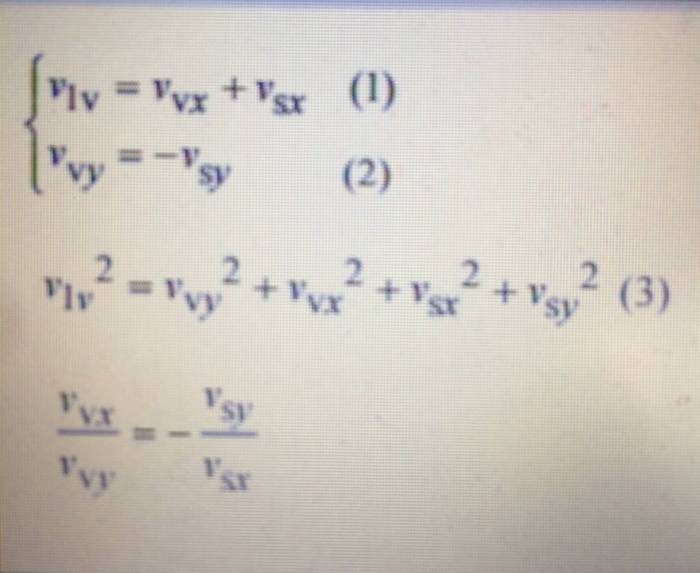
How do I use equations to solve a physics problem and reach the final result?

  • Thread starter Thread starter Drizzy
  • Start date Start date
  • Tags Tags
    Physics
Click For Summary

Homework Help Overview

The discussion revolves around using equations to solve a physics problem, specifically focusing on the manipulation of multiple equations to derive a final result. The subject area appears to involve kinematics or dynamics, given the references to velocity components.

Discussion Character

  • Exploratory, Assumption checking, Problem interpretation

Approaches and Questions Raised

  • Participants discuss the validity of steps taken in the solution process, with some questioning the cancellation of terms and the correctness of specific equations. There are attempts to clarify which equations should be manipulated and how to proceed from a particular step.

Discussion Status

There is ongoing exploration of the problem, with participants providing hints and suggestions for moving forward. Some guidance has been offered regarding which equations to focus on and how to rearrange them, but no consensus has been reached on the correct path to the final result.

Contextual Notes

Participants note potential confusion regarding the labeling of equations and the steps taken in the solution process. There are indications of misinterpretations of previous posts, which may affect the clarity of the discussion.

Drizzy
Messages
210
Reaction score
1
end result 1. Homework Statement

WTXwv2P.jpg
So I have equation 1,2 and 3. And the end result should be the last equation. How am I going to get that answer?

Homework Equations

The Attempt at a Solution


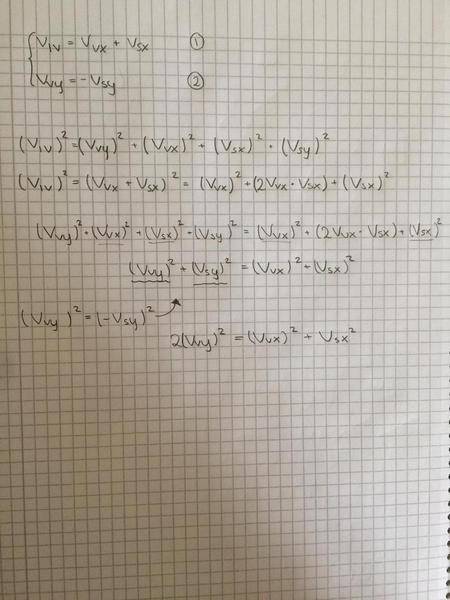
I have come so far:

oQyinwY.jpg
 
Physics news on Phys.org
Images of working make it hard to write a response that refers to specific steps.
Your working down to the fifth line (including the rehash of given equations 1 and 2) is ok, but you seem to have canceled some wrong terms to get the sixth line.
 
oops. the sixth step should be:

(Vvy)^2 + (Vsy)^2 =2Vvx * Vsx

The terms that I canceled out have a line underneath.

How do I move forward from this?
 
The 4th line in your solution is incorrect. You should be able to solve for 2vvxvsx. In your 3rd equation, try moving the vsy to the other side, and then squaring the resulting equation. What do you get?Chet
 
OMVFuDm.jpg
 
Drizzy said:
OMVFuDm.jpg
Follow Chet's hint at what to do with eqn 3.
 
I moved it to the right
 
Drizzy said:
I moved it to the right
Well, after squaring both sides, what did you get? Did one side resemble one side of the second line of your post #5?
 
My answer is sqrt of what I wrote but that is wrong. The answer should be the last equation in my first pricture.
 
  • #10
Drizzy said:
My answer is sqrt of what I wrote but that is wrong. The answer should be the last equation in my first pricture.
ok, I see the confusion. Chet wrote:
Chestermiller said:
In your 3rd equation, try moving the vsy to the other side, and then squaring the resulting equation.
But by 3rd eqn I think he meant eqn (2) in the problem statement. Try it with that.
 
  • #11
haruspex said:
ok, I see the confusion. Chet wrote:

But by 3rd eqn I think he meant eqn (2) in the problem statement. Try it with that.
Yes. Thanks.
 

Similar threads

Replies
20
Views
3K
  • · Replies 3 ·
Replies
3
Views
2K
Replies
4
Views
3K
  • · Replies 64 ·
3
Replies
64
Views
7K
  • · Replies 2 ·
Replies
2
Views
1K
  • · Replies 18 ·
Replies
18
Views
1K
  • · Replies 32 ·
2
Replies
32
Views
3K
  • · Replies 9 ·
Replies
9
Views
2K
  • · Replies 8 ·
Replies
8
Views
3K
  • · Replies 20 ·
Replies
20
Views
1K