How do vectors and electric field lines differ in representing electric fields?

Click For Summary

Discussion Overview

The discussion revolves around the differences between vectors and electric field lines in representing electric fields, particularly in the context of Gauss's law and the behavior of electric fields around charged objects like spheres and cylinders. Participants explore theoretical concepts, reasoning behind electric field behavior, and the implications of symmetry in electrostatics.

Discussion Character

  • Exploratory
  • Technical explanation
  • Conceptual clarification
  • Debate/contested

Main Points Raised

  • One participant expresses confusion about why the electric field outside a charged sphere behaves as if the charge were concentrated at its center, suggesting a relationship to the behavior of two charges at a distance.
  • Another participant explains that electric field lines from a charge are radially inward or outward, depending on the charge type, and that this resembles the field lines from a charged sphere.
  • A different participant emphasizes the role of symmetry in determining the electric field around a uniformly charged sphere, noting that the electric field is the same in magnitude at any point equidistant from the center.
  • There is a discussion about the application of Gauss's law to an infinite charged plane and the necessity of symmetry for accurate results, with a caution that real conductive cylinders could disrupt this symmetry.
  • Some participants propose that vectors and electric field lines serve different purposes, with vectors representing quantities with magnitude and direction, while electric field lines provide a visual representation of the electric field.

Areas of Agreement / Disagreement

Participants express varying levels of understanding and interpretation of Gauss's law and the behavior of electric fields. There is no clear consensus on the reasoning behind the electric field behavior or the implications of symmetry, indicating multiple competing views remain.

Contextual Notes

Participants mention the need for symmetry in applying Gauss's law and the potential complications introduced by real conductive materials, but these aspects remain unresolved and depend on specific conditions.

Korisnik
Messages
62
Reaction score
1
I'm stuck on some high school physics, Gauss law...

1. It says this: The electric field outside the sphere is equal as if the charge of the sphere was in it's center.

I don't understand this, why is this true? I get it - experiments have showed that and that's how you calculate it; but what's the reasoning behind it?

My explanation: Is it the same as if for example we had 2 different (in size) charges of opposite signs that are at a small distance from each other. Then when we are closer to the smaller one, let's say a negative one, we feel the negative force (if that was possible), but as we move away from it, we feel the positive force of the other charge (which is positive and more "charged"). So when we are a mile away from both these charges, we actually feel only the positive force, and don't even know there is actually a smaller negative charge next to the positive one. I think it has something to do with that, but I can't understand it completely.

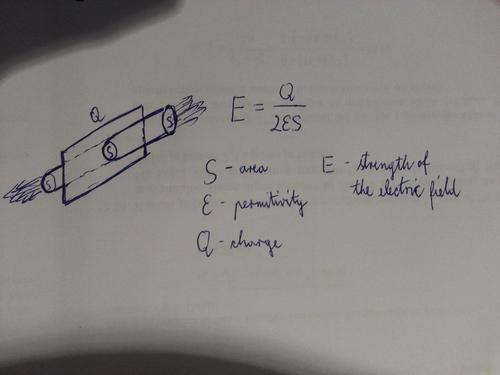
2. It says this: If we imagine 2 cylinders with the same base of area S on a charged board (Q charged). The "force lines" that are coming out of that part of the board are going through the two second bases of the cylinders so the strength of the electric field by Gauss law:
\begin{equation}E=\frac{Q}{2\epsilon S}.\end{equation}
odDNeyu.jpg


Sorry because of the bad drawing, the cylinders are attached to the board in 90°...

I'm not quite sure what they mean by this text... Do they mean - because the force lines are only going in these directions on a charged plate (←→), if you connect a non-conducting (? they don't say what kind of a cylinder it is) cylinder, they would still go in these directions, because of the polarisation of the cylinder. If it doesn't polarize, if it's a conductor - then both of the charges will flow in any of the directions (depending on the fact in which cylinder they flew into), and they will accumulate on the flat surface, while not many will accumulate on the curved one (?)...

Thanks for help in advance.
 
Physics news on Phys.org
Why are you working with cylinders when you are talking about a sphere?
 
HallsofIvy said:
Why are you working with cylinders when you are talking about a sphere?
That's the way material in the book is presented; first the sphere then the cylinders... I didn't want to open 2 topics for separate questions.
 
Korisnik said:
I'm stuck on some high school physics, Gauss law...

1. It says this: The electric field outside the sphere is equal as if the charge of the sphere was in it's center.
.
The electric field lines emerging from a charge is either radially inward or radially outward,depending upon the type of charge.The electric field lines emerging from sphere(on which charges are situated on its surface) is also radially inward or radially outward,depending upon the type of charge on its surface.So the diagram of electric field lines emerging from sphere resembles with the diagram of electric field lines emerging from a charge.So we can assume that the electric field outside the sphere is equal as if the charge of the sphere was in it's center.
 
Satvik Pandey said:
The electric field lines emerging from a charge is either radially inward or radially outward,depending upon the type of charge.The electric field lines emerging from sphere(on which charges are situated on its surface) is also radially inward or radially outward,depending upon the type of charge on its surface.So the diagram of electric field lines emerging from sphere resembles with the diagram of electric field lines emerging from a charge.So we can assume that the electric field outside the sphere is equal as if the charge of the sphere was in it's center.
So we basically move them like vectors...
 
1. When we consider a sphere we always have an additional law in our side (besides the law of inverse square or Gauss's Law). It is the law of symmetry. A homogeneous charged sphere has a perfect symmetry in 3D space , so we know that the electric field at distance R from the center of the sphere will be the same in magnitude (regardless if we take R distance left of the center or right of the center or upwards or diagonally e.t.c) and will depend only on the scalar quantity R.

Also the direction of the electric field will have to satisfy this symmetry imposed by the sphere and the only choice that satisfies this symmetry, together with the condition that the electric field is perpendicular in the surface of the sphere (i suppose you already have been taught why this holds) is that the direction is the line that connects the point at distance R with the center of the sphere (that is referred as the radial direction).

So from symmetry we are armed with the result that the e-field around the sphere has the same magnitude everywhere at distance R and radial direction . So if we consider an imaginary sphere surface with radius R, cocentric with the first sphere and apply Gauss's law to this imaginary surface, we will have

E4 \pi R^2=\frac{q}{\epsilon_0} , E=\frac{q}{4\pi\epsilon_0R^2} hence E satisfies the inverse square law as if it was that the charge q of the sphere was concentrated in the center of the sphere.

2. Again there is a symmetry imposed by the charged board. In order for this symmetry to be perfect, the charged board has to be an infinite plane and to have homogeneous charge density across all of its infinite surface. The cylinders we consider (it is actually one imaginary cylinder crossing the plane ) in order to apply Gauss's law have to be imaginary. If they arent imaginary and they are conductive then they break the symmetry, the symmetry law doesn't hold and by just applying Gauss's Law alone we can't conclude the result regarding the magnitude of the electric field neither its direction.

So big conclusion is , in electrostatics, Gauss's law is applied on an imaginary closed surface and usually with a help of a symmetry law.
 
Korisnik said:
So we basically move them like vectors...
Vectors and electric field lines are different.The concept of Vectors has been evolve to deal with quantity which has magnitude and direction (like velocity,force etc) whereas electric field lines are pictorial representation of electric field around electric charges.Here in both cases the diagram of electric field lines are same,so we can assume that instead of a sphere (having charge q) there is only charge q located at sphere's center.
 

Similar threads

  • · Replies 7 ·
Replies
7
Views
1K
  • · Replies 29 ·
Replies
29
Views
2K
  • · Replies 9 ·
Replies
9
Views
3K
  • · Replies 2 ·
Replies
2
Views
2K
  • · Replies 5 ·
Replies
5
Views
4K
  • · Replies 83 ·
3
Replies
83
Views
5K
  • · Replies 1 ·
Replies
1
Views
2K
  • · Replies 17 ·
Replies
17
Views
2K
  • · Replies 20 ·
Replies
20
Views
2K
  • · Replies 1 ·
Replies
1
Views
2K