Why Do We Consider External Electric Fields in Gauss' Law Calculations?

  • Context: Undergrad 
  • Thread starter Thread starter swirlydragon
  • Start date Start date
  • Tags Tags
    Gauss Gauss' law Law
Click For Summary

Discussion Overview

The discussion revolves around the application of Gauss' Law in the context of electric fields produced by charges both inside and outside a Gaussian surface. Participants explore the implications of considering external electric fields when calculating net flux and the resultant electric field, questioning the necessity of including these external contributions in numerical problems.

Discussion Character

  • Exploratory
  • Technical explanation
  • Debate/contested

Main Points Raised

  • Some participants assert that Gauss' Law only accounts for charges inside the surface when determining net flux, as external charges produce zero net flux.
  • Others propose that while external charges do not contribute to net flux, their electric fields still exist and can influence calculations.
  • A participant suggests dividing the electric field into components from internal and external charges, noting that the integral of the external field would be zero.
  • Another participant questions whether it is possible to solve Gauss Law problems without considering the electric field from external charges, given that the net flux is zero.
  • One participant explains that the electric field from external charges can be calculated separately and then summed with the field from internal charges to find the total electric field.
  • Another response emphasizes the principle of superposition, suggesting that one can ignore external charges when applying Gauss' Law to find the electric field due to enclosed charges and then add the effects of external fields afterward.

Areas of Agreement / Disagreement

Participants express differing views on the role of external electric fields in Gauss' Law calculations. While there is some agreement on the idea that external charges do not contribute to net flux, there is no consensus on whether or how to include their electric fields in numerical solutions.

Contextual Notes

Some participants highlight the importance of symmetry in applying Gauss' Law, suggesting that specific configurations may affect how external fields are treated in calculations. The discussion also reflects varying interpretations of how to approach problems involving both internal and external charges.

swirlydragon
Messages
2
Reaction score
0
According to Gauss Law, we only consider charges which are inside the surface to produce net flux.
We disregard the charges outside the surface because they produce zero net flux (as the electric field lines enter the surface and leave the surface producing zero net flux)
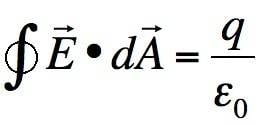
My question is, since we don't consider the charges outside the surface to produce flux then why do we consider the electric field of those charges when solving Gauss Law problems?
In the formula, we consider only the charges inside the Gaussian surface but when it comes to electric field, we consider electric field caused by all the charges (whether they be inside or outside the Gaussian surface). Why?
main-qimg-0984e30591a0778448038088e6a03223-c.jpg
 
Physics news on Phys.org
swirlydragon said:
According to Gauss Law, we only consider charges which are inside the surface to produce net flux.
We disregard the charges outside the surface because they produce zero net flux (as the electric field lines enter the surface and leave the surface producing zero net flux)
My question is, since we don't consider the charges outside the surface to produce flux then why do we consider the electric field of those charges when solving Gauss Law problems?
In the formula, we consider only the charges inside the Gaussian surface but when it comes to electric field, we consider electric field caused by all the charges (whether they be inside or outside the Gaussian surface). Why?
main-qimg-0984e30591a0778448038088e6a03223-c.jpg
You can divide the integral in two parts since the electric field can be considered as the sum of two components. One produced by the charge inside and the other produced by charges outside let's say Ein and Eout. The integral of Eout will be cero so Gauss law will only help you to get the value of Ein but it doesn't mean tha Eout doesn't exists.
 
  • Like
Likes   Reactions: swirlydragon
@Diegor
Ok I understand that, but if what you say is true then if I don't consider electric field by the outside charge in the above formula then it should also not change the result because the result is zero anyway. So does that mean I can solve Gauss Law numericals without considering the electric field by the outside charge?
Thnx for replying
 
Consider two point charges of the same sign that are separated by some small distance d.

These two points will repel each other in a way described by the coulombic interaction of their electric fields.

Draw an enclosed surface that surrounds one point charge but not the other. Call the enclosed charge point A.

Imagine the field lines. The lines of point A will exit the surface. No matter what shape the surface is or anything like that, they ALL exit, so long as the surface is enclosed.

Now consider the second point charge. Some of its field lines may enter the surface, but they will all exit the same surface too, eventually. So the NET FLUX for charges outside the surface is zero. Its not that there is zero flux.

I hope this helps.
 
swirlydragon said:
@Diegor
Ok I understand that, but if what you say is true then if I don't consider electric field by the outside charge in the above formula then it should also not change the result because the result is zero anyway. So does that mean I can solve Gauss Law numericals without considering the electric field by the outside charge?
Thnx for replying
You can use Gauss law to calculate the field produced by internal charges. Then you will have to use another method (for ex. Coulomb law or gauss law but with another surface) to calculate the field produced by external charges and finally sum both fields to get the total electric field. Usually Gauss law is usefull when there is certain simetry in the electric field.

An simple example where you can see this is getting E field between two parallel plates of a capacitor. There gauss law is used two times with two separated closed surfaces that share one side or face that is where the field is to be calculated. In the web you can find it it's a very common example.
 
Last edited:
swirlydragon said:
@Diegor
Ok I understand that, but if what you say is true then if I don't consider electric field by the outside charge in the above formula then it should also not change the result because the result is zero anyway. So does that mean I can solve Gauss Law numericals without considering the electric field by the outside charge?
Thnx for replying
The point is, the flux of the electric field through a closed surface depends only on the enclosed charge. If you have charges outside the closed surface as well, the ##\mathbf{E}## field accommodates the outside charges as well as the ones inside, but the flux still remains only a function of the enclosed charge.

Now, to answer your question, what you can do is use the principle of superposition. Pretend that the charges outside the Gaussian surface don't exist, and then use Gauss's law to calculate the E-field solely due to the enclosed charge. Then add to this field the vector sum of whatever E-field the outside charges generate.
 

Similar threads

  • · Replies 7 ·
Replies
7
Views
1K
  • · Replies 9 ·
Replies
9
Views
3K
  • · Replies 83 ·
3
Replies
83
Views
5K
  • · Replies 1 ·
Replies
1
Views
2K
  • · Replies 30 ·
2
Replies
30
Views
3K
  • · Replies 8 ·
Replies
8
Views
2K
  • · Replies 2 ·
Replies
2
Views
2K
  • · Replies 7 ·
Replies
7
Views
3K
  • · Replies 29 ·
Replies
29
Views
2K
  • · Replies 1 ·
Replies
1
Views
1K