How do you calculate a thickness dependant impedance to a so

  • Context: Undergrad 
  • Thread starter Thread starter rwooduk
  • Start date Start date
  • Tags Tags
    Impedance Thickness
Click For Summary

Discussion Overview

The discussion revolves around calculating the thickness-dependent impedance of silicone in relation to water as ultrasound waves pass through them. Participants explore the implications of acoustic impedance at the boundary between two different media and how thickness may or may not factor into these calculations.

Discussion Character

  • Technical explanation
  • Conceptual clarification
  • Debate/contested

Main Points Raised

  • One participant seeks a method to calculate the impedance at the water-silicone boundary and expresses confusion over the lack of thickness consideration in existing equations.
  • Another participant clarifies that specific acoustic impedance is defined for a particular medium and suggests using the equation ##Z=\rho c## to calculate impedance for each medium.
  • There is a discussion about whether the impedance at the boundary affects the reflection and transmission of sound waves, with some participants asserting that it is the difference in specific acoustic impedance that determines the reflection intensity.
  • One participant questions how the thickness of the material factors into the equation, leading to a response that thickness does not affect specific acoustic impedance but may relate to attenuation modeled by an exponential decay equation.
  • There is acknowledgment that the density of the medium influences the linear attenuation coefficient for ultrasound, which may impact how sound waves are attenuated as they pass through the medium.

Areas of Agreement / Disagreement

Participants generally agree that specific acoustic impedance is a property of the medium itself and does not depend on thickness. However, there is some disagreement regarding the role of thickness in relation to attenuation and how it may influence the overall behavior of ultrasound in the materials.

Contextual Notes

Participants discuss the relationship between acoustic impedance and attenuation without resolving the nuances of how thickness might influence practical applications in ultrasound scenarios.

rwooduk
Messages
757
Reaction score
59
... sound wave?

I need a simple method to calculate the impedance between water and silicone as ultrasound passes through them i.e. how much of the signal is reflected at the water silicone boundary.

The problem is I am having trouble finding the required equations, Wiki is extremely complicated (https://en.wikipedia.org/wiki/Acoustic_impedance) and other sites give an equation that doesn't include the thickness of the material (how is this possible? - please see image at end of this):

##I_{reflected} = I_{original} \frac{(Z_{1}-Z_{2})^{2}}{(Z_{1}+Z_{2})^{2}}##

My set up will be like this:
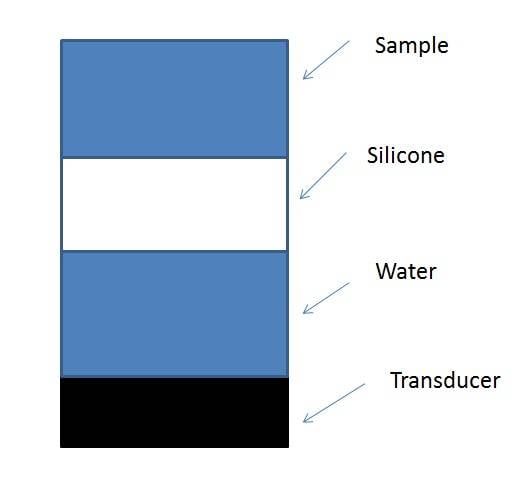
oW2VM97.jpg


The idea of the silicone is to stop the sample from harming the transducer, also the silicone can't be in contact with the transducer as this could also cause harm to it. But I want as little as possible impedance from the silicone so I need to know how to calculate a thickness dependent impedance.

Can anyone suggest an equation that would be suited?

Thanks for any help on this.

Table showing thickness dependence of the material:
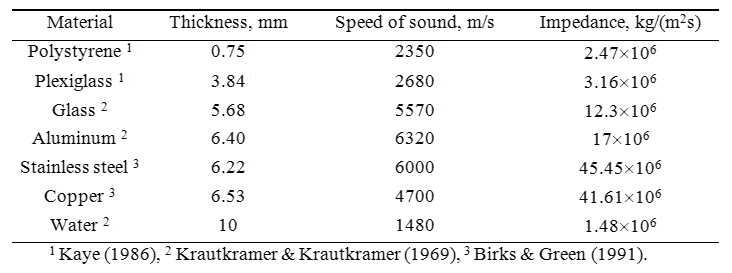
main3_table1.gif
 
Physics news on Phys.org
rwooduk said:
to calculate the impedance between water and silicone as ultrasound passes through them
Specific acoustic impedance is defined for a particular medium, not between mediums.

rwooduk said:
Ireflected=Ioriginal(Z1−Z2)2(Z1+Z2)2
Btw, this equation only works if sound is incident normally on a medium boundary. (This appears to be the case here.)

I think you can simply use ##Z=\rho c## to calculate the specific acoustic impedance for any medium (##\rho ## is the density of the medium and ##c## is the speed of sound in that medium), and then use the formula you posted to get your answer.
 
  • Like
Likes   Reactions: rwooduk
Many thanks for the reply.

PWiz said:
Specific acoustic impedance is defined for a particular medium, not between mediums.

Thanks, I see, so the impedance of a material determines the degree to which the sound wave is attenuated? Wouldn't there be an impedance at the boundary between materials, hence why it can provide a measure of reflected and transmitted wave?

PWiz said:
Btw, this equation only works if sound is incident normally on a medium boundary. (This appears to be the case here.)

I think you can simply use ##Z=\rho c## to calculate the specific acoustic impedance for any medium (##\rho ## is the density of the medium and ##c## is the speed of sound in that medium), and then use the formula you posted to get your answer.

How would thickness of the material be factored into the equation?
 
rwooduk said:
How would thickness of the material be factored into the equation?
It doesn't come into the equation. The specific acoustic impedance is a property of a medium. The thickness of the medium has no effect on its value. Perhaps you want to know about the attenuation of ultrasound within a particular medium? If so, you can (approximately) model its behavior: ##I = I_0 e^{-k x}##, where ##I_0## is the incident intensity, ##k## is the linear attenuation coefficient and ##x## is the thickness of the medium through which the ultrasound passes.
rwooduk said:
Wouldn't there be an impedance at the boundary between materials, hence why it can provide a measure of reflected and transmitted wave?
No. It's the difference between the specific acoustic impedance of the two media that determines the fraction of intensity that gets reflected.
rwooduk said:
so the impedance of a material determines the degree to which the sound wave is attenuated
Sort of. The density of the medium has an impact on the linear attenuation coefficient of the medium for ultrasound of any particular frequency.
 
  • Like
Likes   Reactions: rwooduk
PWiz said:
It doesn't come into the equation. The specific acoustic impedance is a property of a medium. The thickness of the medium has no effect on its value. Perhaps you want to know about the attenuation of ultrasound within a particular medium? If so, you can (approximately) model its behavior: ##I = I_0 e^{-k x}##, where ##I_0## is the incident intensity, ##k## is the linear attenuation coefficient and ##x## is the thickness of the medium through which the ultrasound passes.

No. It's the difference between the specific acoustic impedance of the two media that determines the fraction of intensity that gets reflected.

Sort of. The density of the medium has an impact on the linear attenuation coefficient of the medium for ultrasound of any particular frequency.

Ahh I've got it! Thats really helpful! Many thanks!
 

Similar threads

  • · Replies 4 ·
Replies
4
Views
2K
  • · Replies 1 ·
Replies
1
Views
3K
  • · Replies 7 ·
Replies
7
Views
2K
  • · Replies 3 ·
Replies
3
Views
2K
Replies
4
Views
2K
  • · Replies 2 ·
Replies
2
Views
4K
Replies
5
Views
8K
Replies
6
Views
3K
Replies
6
Views
1K
  • · Replies 1 ·
Replies
1
Views
7K