How Do You Calculate Values Using pV Diagrams for a Monatomic Gas?

  • Context: Engineering 
  • Thread starter Thread starter cheetah
  • Start date Start date
  • Tags Tags
    Diagrams Thermodynamics
Click For Summary
SUMMARY

This discussion focuses on calculating values using pV diagrams for a monatomic gas in a thermodynamics context. The user presents a graph and mentions specific processes labeled AB, BC, AD, and DC, with calculated work values of 0 J for AB and DC, 2026 J for BC, and 810.4 J for AD. The conversation emphasizes the importance of showing effort in problem-solving and understanding the underlying principles of thermodynamics before seeking assistance.

PREREQUISITES
  • Understanding of pV diagrams and their significance in thermodynamics
  • Knowledge of work calculations for thermodynamic processes
  • Familiarity with monatomic gas behavior and equations of state
  • Basic proficiency in interpreting graphical data in physics
NEXT STEPS
  • Study the First Law of Thermodynamics and its application to monatomic gases
  • Learn how to derive work done during isothermal and adiabatic processes
  • Explore the Ideal Gas Law and its implications for pV diagrams
  • Investigate specific heat capacities for monatomic gases and their role in thermodynamic calculations
USEFUL FOR

Students studying thermodynamics, particularly those tackling assignments involving pV diagrams and monatomic gases, as well as educators seeking to enhance their teaching methods in this area.

cheetah
Messages
2
Reaction score
0
Homework Statement
Consider the processes shown in Fig. 1 for a monatomic gas.
a) Find the work done in each of the processes AB, BC, AD, and DC.
b) Find the internal energy change in processes AB and BC.
c) Find the internal energy difference between states C and A.
d) Find the total heat added in the ADC process.
e) From the information given, can you find the heat added in process AD? Why or why
not?
Relevant Equations
Eint = Q − W
I’m having trouble with a Thermodynamics Assignment and could use some help. I’ve been given the below graph and told to consider the processes shown for a monatomic gas. I’ve been asked to answer these questions with no further information besides the graph.
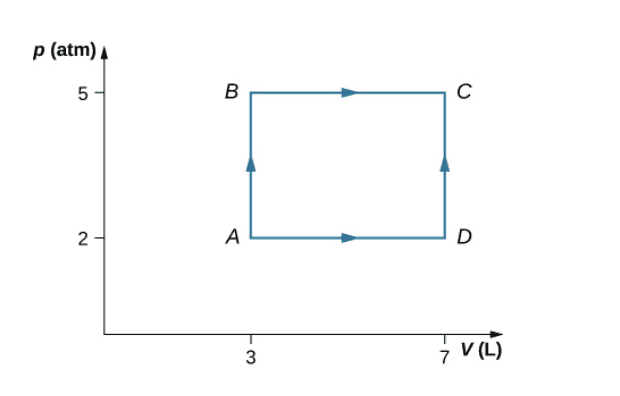
1710793385005.png
 
Physics news on Phys.org
Welcome to PF. :smile:

We are not allowed to help you until you show some effort on your problem. What parts can you start working on? It's hard to believe you have been given this question without the material having been covered in class or in your textbook.
 
I believe I've solved question a.
AB and DC = 0 (since they're constants)
BC = 20 (2026J)
AD = 8 (810.4J)
 
That's helpful. What equations did you use to calculate those values?
 

Similar threads

  • · Replies 14 ·
Replies
14
Views
3K
Replies
3
Views
2K
  • · Replies 3 ·
Replies
3
Views
3K
  • · Replies 4 ·
Replies
4
Views
2K
  • · Replies 7 ·
Replies
7
Views
3K
  • · Replies 3 ·
Replies
3
Views
3K
  • · Replies 5 ·
Replies
5
Views
2K
  • · Replies 2 ·
Replies
2
Views
2K
  • · Replies 6 ·
Replies
6
Views
3K
  • · Replies 2 ·
Replies
2
Views
2K