How Do You Prove Limits at Infinity?

  • Context:
  • Thread starter Thread starter goody1
  • Start date Start date
  • Tags Tags
    Definition Limit
Join the discussion
Ask a follow-up here, or get your own question answered by working scientists, mathematicians and engineers — people, not an autocomplete.
Real named experts · corrections over time · the nuance an AI answer skips
3 replies · 2K views
goody1
Messages
16
Reaction score
0
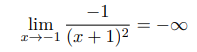
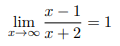
Hi, can anybody help me with this two limits? I have to prove them by the definition of limit. Thank you in advance.
View attachment 9630 View attachment 9631
 

Attachments
  • limitka.png
    limitka.png
    1.1 KB · Views: 167
  • limitka2.png
    limitka2.png
    1.3 KB · Views: 141
Physics news on Phys.org
goody said:
Hi, can anybody help me with this two limits? I have to prove them by the definition of limit. Thank you in advance.
Hi Goody, and welcome to MHB!

To prove that $$\lim_{x\to\infty}\frac{x-1}{x+2} = 1$$, you have to show that, given $\varepsilon > 0$, you can find $N$ such that $$\left|\frac{x-1}{x+2} - 1\right| < \varepsilon$$ whenever $x>N$.

So, first you should simplify $$\left|\frac{x-1}{x+2} - 1\right|$$. Then you should see how large $x$ has to be in order to make that expression less than $\varepsilon$.

To prove that $$\lim_{x\to-1}\frac{-1}{(x+1)^2} = -\infty$$, you have to show that, given $M$, you can find $\delta>0$ such that $$\frac{-1}{(x+1)^2} < -M$$ whenever $|x+1| < \delta$. That is actually an easier calculation than the first one, so you might want to try that one first.
 
goody said:
Hi Opalg! Do you think I got it correct?
Not quite, although you started correctly. The limit in this case is as $x\to\infty$, so you want to see what happens when $x$ gets large. This means that the inequality $\dfrac3{|x+2|}<\varepsilon$ has to hold for all $x$ greater than $N$ (where you think of $N$ as being a large number).

Write the inequality as $|x+2| > \dfrac3\varepsilon$, and you see that this will be true if $x > \dfrac3\varepsilon -2$. So you can take $N = \dfrac3\varepsilon -2$. More simply, you could take $N = \dfrac3\varepsilon$, which will satisfy the required condition with a bit to spare.