k_squared
- 62
- 0
1. Homework Statement
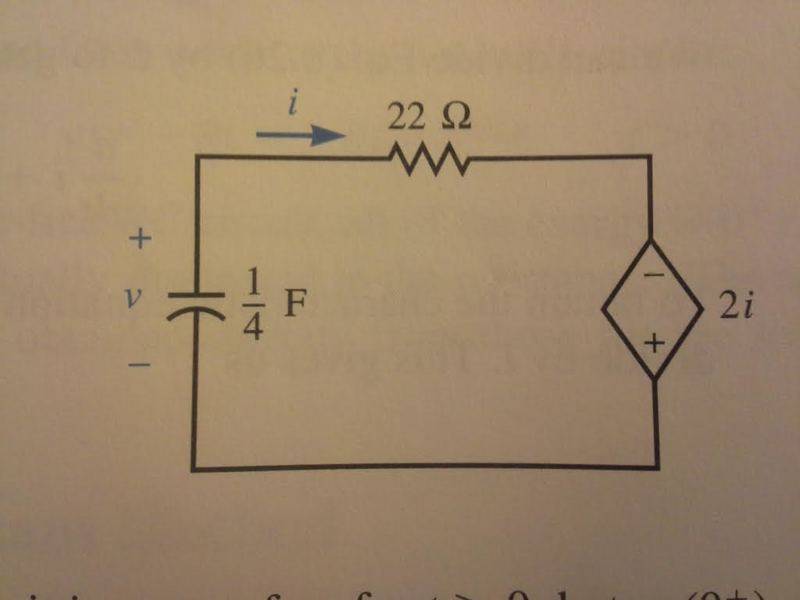
For the following circuit, use KVL to write a differential equation in terms of current i and solve for the source-free current response if v(0+) = 40 V.
$$(s-s_1)Ae^{st}=0$$
$$i=C(d/dt)v$$
$$v=Ae^{s_1*t}$$
$$i=(-1/R)V_0e^{\frac{-t/}{RC}}$$
[/B]
Finding the initial current is not so difficult. We have: $$-40 +22i-2i=0$$, for an initial current of 2 amps.
I came up with: $$(4)i-22(d/dt)i+2(d/dt)i=0$$, thus with 4/24, we have $$s+1/6=0$$.
However the answer is $$2e^{-\frac{1}{5}t}$$, meaning that s_1= 1\5, not 1\6!
I assume the two and the four have to be the same sign, because they are both voltage sources that are lined up with each other such that their voltage becomes greater rather than lesser. However, this means that s_1 becomes positive, or the sources of voltage in this circuit (ie, the capacitor and the dependent voltage source) have different signs!
Alas, s_1 is negative as expected. Therefore, I must be missing something.
What am I doing wrong?
For the following circuit, use KVL to write a differential equation in terms of current i and solve for the source-free current response if v(0+) = 40 V.
Homework Equations
$$(s-s_1)Ae^{st}=0$$
$$i=C(d/dt)v$$
$$v=Ae^{s_1*t}$$
$$i=(-1/R)V_0e^{\frac{-t/}{RC}}$$
The Attempt at a Solution
[/B]
Finding the initial current is not so difficult. We have: $$-40 +22i-2i=0$$, for an initial current of 2 amps.
I came up with: $$(4)i-22(d/dt)i+2(d/dt)i=0$$, thus with 4/24, we have $$s+1/6=0$$.
However the answer is $$2e^{-\frac{1}{5}t}$$, meaning that s_1= 1\5, not 1\6!
I assume the two and the four have to be the same sign, because they are both voltage sources that are lined up with each other such that their voltage becomes greater rather than lesser. However, this means that s_1 becomes positive, or the sources of voltage in this circuit (ie, the capacitor and the dependent voltage source) have different signs!
Alas, s_1 is negative as expected. Therefore, I must be missing something.
What am I doing wrong?