Nick L
- 1
- 0
Ok, I have 2 homework problems that I don't really know where to even start.
The first one is:
A homemade capacitor is assembled by placing two 15-cm pie tins 20 cm apart and connecting them to opposite terminals of a battery. Calculate the following:
a) the capacitance
b) the charge on each plate
c) the electric field halfway between the plates
d) the work done by the battery to charge the plates
I was able to get part a, but I don't know where to begin for parts b,c, and d.
The second problem uses Kirchhoff's Rules.
Find the current in each of the three resistors of the circuit below:
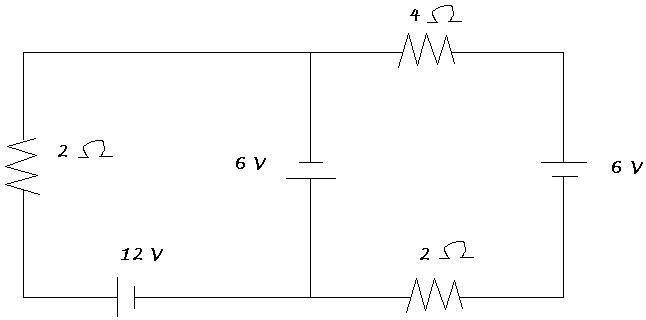
I did not have any idea where to start with this one. I believe it has something to do with loops.
Any help on either of this would really be appreciated.
The first one is:
A homemade capacitor is assembled by placing two 15-cm pie tins 20 cm apart and connecting them to opposite terminals of a battery. Calculate the following:
a) the capacitance
b) the charge on each plate
c) the electric field halfway between the plates
d) the work done by the battery to charge the plates
I was able to get part a, but I don't know where to begin for parts b,c, and d.
The second problem uses Kirchhoff's Rules.
Find the current in each of the three resistors of the circuit below:
I did not have any idea where to start with this one. I believe it has something to do with loops.
Any help on either of this would really be appreciated.