How Do You Solve for C in This Integral Equation?
- Context: MHB
- Thread starter scottshannon
- Start date
Click For Summary
SUMMARY
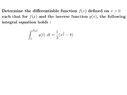
The integral equation discussed is given by $\int_1^{f(x)}g(t) \,dt =\frac{1}{3}\left(x^{3/2}-8\right)$, with the relationship $f^{-1}(x)=g(x)$. By applying the fundamental theorem of calculus, the derivative $f'(x)$ is derived as $f'(x)=\frac{1}{2\sqrt{x}}$. Integrating this yields the function $f(x)=\sqrt{x}+C$. The discussion focuses on determining the constant $C$ in the context of the integral equation.
PREREQUISITES- Understanding of integral calculus and the fundamental theorem of calculus
- Familiarity with inverse functions and their properties
- Knowledge of differentiation and integration techniques
- Ability to manipulate algebraic expressions and solve for constants
- Explore methods for determining constants in integral equations
- Study the properties of inverse functions in calculus
- Learn advanced integration techniques, including integration by substitution
- Investigate applications of the fundamental theorem of calculus in solving differential equations
Students and professionals in mathematics, particularly those studying calculus, integral equations, and differential equations. This discussion is beneficial for anyone looking to deepen their understanding of solving for constants in mathematical functions.
Similar threads
- · Replies 3 ·
- · Replies 10 ·
- · Replies 2 ·
- · Replies 8 ·
- · Replies 31 ·
Graduate
Help with simplifying an integral
- · Replies 6 ·
- · Replies 1 ·
- · Replies 11 ·
- · Replies 3 ·
Undergrad
Solving an Integral using Feyman's trick
- · Replies 8 ·