How Does an Additive Constant Impact Potential Energy Calculations?

  • Context: Undergrad 
  • Thread starter Thread starter shanepitts
  • Start date Start date
  • Tags Tags
    Constant
Click For Summary
SUMMARY

The discussion centers on the role of an additive constant in potential energy calculations, specifically in the context of gravitational potential energy. The two formulas discussed are U=mgz, which uses the Earth's surface as a reference point, and a formula with an additive constant that sets the potential energy to zero at z=0. The additive constant allows for flexibility in defining the reference point of potential energy, as it can be adjusted without affecting the physical differences in potential energy between two points. This concept is crucial for understanding how potential energy is calculated in various scenarios.

PREREQUISITES
  • Understanding of gravitational potential energy
  • Familiarity with the concept of reference points in physics
  • Basic knowledge of calculus, specifically indefinite integrals
  • Knowledge of the formula for gravitational force, U=mgz
NEXT STEPS
  • Study the implications of reference points in potential energy calculations
  • Learn about the concept of zero potential energy in different contexts
  • Explore the mathematical properties of indefinite integrals and additive constants
  • Investigate how potential energy is applied in various physics problems and real-world scenarios
USEFUL FOR

Students studying physics, particularly those focusing on mechanics and energy concepts, as well as educators looking to clarify the concept of additive constants in potential energy calculations.
shanepitts
Messages
84
Reaction score
1
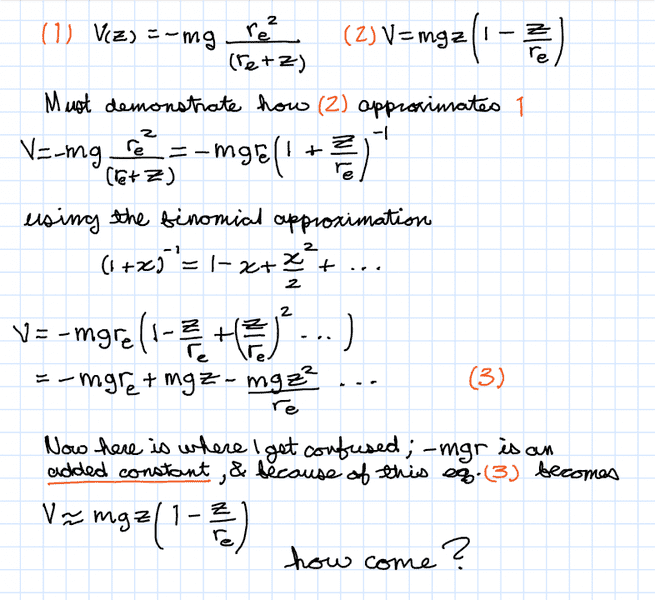
Pictured below was a problem shown in class with solution. I didn't have time to ask the professor a question about the last step involving an additive constant.

V is potential energy, re=Earth radius and z is distance from Earth's surface.

Screenshot_2015-08-05-11-37-00-1.png


What is an additive constant, and how does it allow the last transformation?
 
Physics news on Phys.org
You know (I hope) that the value of the potential energy depends on the reference point.
In the first formula, the reference point is at infinite. That means the energy becomes closer and closer to zero as z increases to infinite.

The other formula, U=mgz uses the surface of the Earth as reference.
So you need to change your formula to take this into account. Without the additive term, the energy at z=0 will be -mgR.
By adding +mgR you make the energy zero at z=0.
 
  • Like
Likes   Reactions: shanepitts
An additive constant is a constant that you add on. A very typical example is when you do an indefinite integral.

##\int x dx = \frac{x^2}{2} + c ##

Here ##c## is an additive constant.

The zero of a potential can be defined where you like. This is because you only ever see differences in potential from one place to another. (Well... I guess strictly speaking that is not universally true. But for purposes of your homework assignment it is.) That means you can add any constant onto the potential and get an equally valid potential. All it does is redefine where the zero is. By using the form that your assignment has it has defined the zero of ##V(z)## to be at ##z=0## which seems a natural place to define it.
 
  • Like
Likes   Reactions: shanepitts
nasu said:
You know (I hope) that the value of the potential energy depends on the reference point.
In the first formula, the reference point is at infinite. That means the energy becomes closer and closer to zero as z increases to infinite.

The other formula, U=mgz uses the surface of the Earth as reference.
So you need to change your formula to take this into account. Without the additive term, the energy at z=0 will be -mgR.
By adding +mgR you make the energy zero at z=0.

Thank you for your detailed answer, I fully fathom now.
 
DEvens said:
An additive constant is a constant that you add on. A very typical example is when you do an indefinite integral.

##\int x dx = \frac{x^2}{2} + c ##

Here ##c## is an additive constant.

The zero of a potential can be defined where you like. This is because you only ever see differences in potential from one place to another. (Well... I guess strictly speaking that is not universally true. But for purposes of your homework assignment it is.) That means you can add any constant onto the potential and get an equally valid potential. All it does is redefine where the zero is. By using the form that your assignment has it has defined the zero of ##V(z)## to be at ##z=0## which seems a natural place to define it.

Thanks
 

Similar threads

  • · Replies 2 ·
Replies
2
Views
2K
  • · Replies 6 ·
Replies
6
Views
2K
  • · Replies 27 ·
Replies
27
Views
12K
  • · Replies 6 ·
Replies
6
Views
2K
  • · Replies 4 ·
Replies
4
Views
2K
  • · Replies 31 ·
2
Replies
31
Views
4K
Replies
7
Views
2K
  • · Replies 5 ·
Replies
5
Views
3K
Replies
29
Views
3K
  • · Replies 3 ·
Replies
3
Views
401