How to relate the gravitational potential energy zero to the axes?

Click For Summary

Discussion Overview

The discussion revolves around the definition and sign of gravitational potential energy (referred to as potential energy) in relation to the choice of coordinate axes. Participants explore how the orientation of the axes affects the calculation of potential energy, particularly in scenarios where the positive z-axis is defined differently. The scope includes conceptual reasoning and mathematical formulation.

Discussion Character

  • Exploratory, Conceptual clarification, Mathematical reasoning

Main Points Raised

  • One participant presents two cases for defining potential energy based on the orientation of the z-axis, questioning whether to use ##U = mgz## or ##U = -mgz## in case B.
  • Another participant emphasizes the importance of coupling potential energy definitions with work definitions, noting that consistency in sign conventions is crucial.
  • A later reply agrees with the reasoning for case B, stating it is valid for scenarios near the Earth's surface but may not hold for objects far from it.
  • Another participant highlights that the change in potential energy (##\Delta U##) is the key quantity, noting that it remains consistent regardless of the coordinate system used.
  • A final post revisits case B, deriving the potential energy from the gravitational force and confirming the expression ##U = -mgz##, seeking validation of this conclusion.

Areas of Agreement / Disagreement

Participants express some agreement on the reasoning behind potential energy definitions, but there is no consensus on the absolute correctness of the expressions used, particularly in different contexts. The discussion remains open regarding the implications of coordinate system choices on potential energy calculations.

Contextual Notes

Participants acknowledge that the assumptions made about the gravitational force being constant may not apply universally, especially for objects at varying distances from the Earth's surface. The discussion also highlights the dependency of potential energy definitions on the chosen reference point.

peguerosdc
Messages
28
Reaction score
7
(Throughout all my post, I will refer to “gravitational potential energy” just as “potential energy”)

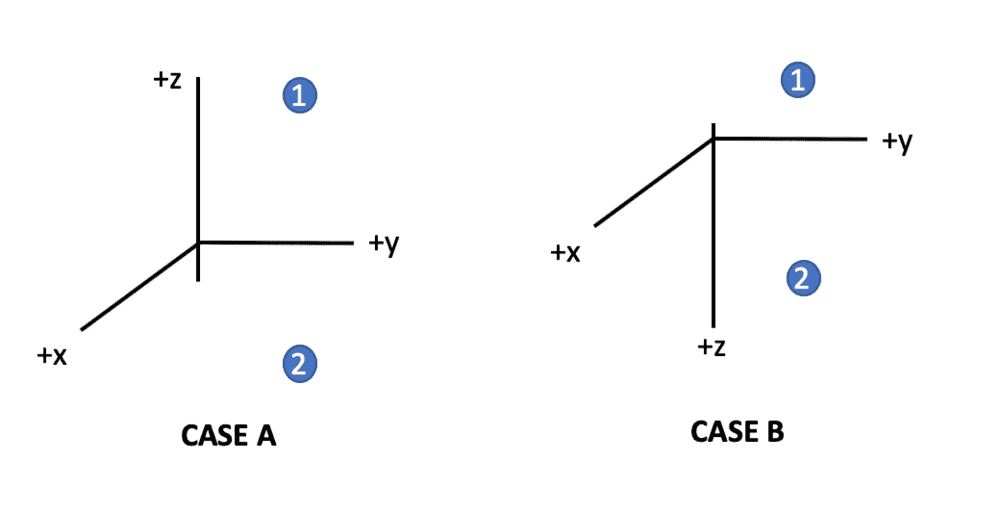
Hi! I have this confusion about when is potential energy positive/negative and how it is related to how we define our axes. I think it is easier to understand my confusion with the following examples:
Screen Shot 2019-08-31 at 2.43.11 PM.png

In case A, I have defined my axes to be as shown in the picture, with +z pointing up (x and y really don’t matter in my example). Suppose gravity points down (so it is in the direction of negative z) and that there is a particle (a blue ball) somewhere in the 3D plane.

As this is the most common set-up according to all the examples I have seen, I would define the potential energy as ##U = mgz## where the zero reference is where all the axes intersect. In this set-up, if particle is at position 1, the potential energy would be positive and if it as position 2, it would be negative.

My confusion is in case B, where I have defined my positive z axis pointing down keeping the zero reference at the intersection of the axes and the gravitational force pointing down (which in this case would be in the +z direction). In this case, should the potential energy be defined as ##U = mgz## or ##U = -mgz## ?

What I think:


If the object is above the zero reference, its potential energy must be positive and if it is below, it should be negative, independently of how the axes are defined.
So, based on this, I think the correct answer is ##U = - mgz## because:
  • If the particle is above the reference (at position 1), “z” would be negative, which would make U positive, agreeing with my assumption.
  • If the particle is below the reference (at position 2), “z” would be positive, which would make U negative, agreeing with my assumption.
Is my reasoning correct?
 
Physics news on Phys.org
You have to couple it with the definitions of work. Force x distance. Which direction of force is positive? Which direction of movement is positive? If we do positive work, then presumable the result is a positive change in potential energy.

You can make the physics work with all sign conventions, as long as you are consistent.
 
peguerosdc said:
Summary: How does the sign of U change when I flip the direction of the axes?

(Throughout all my post, I will refer to “gravitational potential energy” just as “potential energy”)

Hi! I have this confusion about when is potential energy positive/negative and how it is related to how we define our axes. I think it is easier to understand my confusion with the following examples:

View attachment 248937
In case A, I have defined my axes to be as shown in the picture, with +z pointing up (x and y really don’t matter in my example). Suppose gravity points down (so it is in the direction of negative z) and that there is a particle (a blue ball) somewhere in the 3D plane.

As this is the most common set-up according to all the examples I have seen, I would define the potential energy as ##U = mgz## where the zero reference is where all the axes intersect. In this set-up, if particle is at position 1, the potential energy would be positive and if it as position 2, it would be negative.

My confusion is in case B, where I have defined my positive z axis pointing down keeping the zero reference at the intersection of the axes and the gravitational force pointing down (which in this case would be in the +z direction). In this case, should the potential energy be defined as ##U = mgz## or ##U = -mgz## ?

What I think:


If the object is above the zero reference, its potential energy must be positive and if it is below, it should be negative, independently of how the axes are defined.
So, based on this, I think the correct answer is ##U = - mgz## because:
  • If the particle is above the reference (at position 1), “z” would be negative, which would make U positive, agreeing with my assumption.
  • If the particle is below the reference (at position 2), “z” would be positive, which would make U negative, agreeing with my assumption.
Is my reasoning correct?
Yes, your reasoning is good for the case where "downward" is always in the same direction. That is a good assumption for objects that stay in a small area near the surface of the Earth, not so much for objects far from Earth's surface.
 
Note that ##\Delta U## is the physically meaningful quantity. So when the blue ball moves from Position 1 to Position 2 ##U## decreases, thus ##\Delta U## is negative. And when the blue ball moves from Position 2 to Position 1 ##U## increases, thus ##\Delta U## is positive. In all cases ##W=-\Delta U##, where ##W## is the work done by gravity. These statements are all true regardless of how you set up the coordinate system.
 
Thanks to everyone for your responses!

So, I worked case B again starting from the relation between the potential energy and the force and this is what I've got:

As the gravitational force is pointing downwards (on the +z direction):

## \vec F = mg \hat z ##

Then, taking the 0 as my reference, the potential energy must be:

## U = - \int \vec F \cdot d \vec l' = - \int_0^z m g dz' = -mgz ##

Now it looks more solid to me, but still want to check if it is correct.
 

Similar threads

  • · Replies 46 ·
2
Replies
46
Views
5K
  • · Replies 10 ·
Replies
10
Views
3K
  • · Replies 9 ·
Replies
9
Views
2K
  • · Replies 54 ·
2
Replies
54
Views
7K
Replies
6
Views
2K
  • · Replies 10 ·
Replies
10
Views
2K
  • · Replies 10 ·
Replies
10
Views
7K
  • · Replies 2 ·
Replies
2
Views
2K
  • · Replies 6 ·
Replies
6
Views
2K
  • · Replies 27 ·
Replies
27
Views
12K