How Does Expansion Affect Internal Energy in a Monatomic Ideal Gas?

  • Thread starter Thread starter Dan13
  • Start date Start date
  • Tags Tags
    Thermodynamics
Click For Summary
SUMMARY

The discussion focuses on calculating the change in internal energy for a monatomic ideal gas expanding from 100 cm³ to 200 cm³ at a constant pressure of 1.0 × 10⁵ Pa. The relevant equation used is ΔU = (C_v/R)PΔV, where C_v for a monatomic gas is defined as (3/2)R. The conclusion emphasizes that the internal energy change can be accurately determined using these established thermodynamic principles.

PREREQUISITES
  • Understanding of the ideal gas law
  • Familiarity with thermodynamic concepts such as internal energy
  • Knowledge of specific heat capacities, particularly C_v for monatomic gases
  • Basic algebra for manipulating equations
NEXT STEPS
  • Study the ideal gas law and its applications in thermodynamics
  • Learn about the derivation and implications of specific heat capacities
  • Explore the relationship between work done and internal energy changes in thermodynamic processes
  • Investigate real gas behavior and deviations from ideal gas assumptions
USEFUL FOR

Students of thermodynamics, physics enthusiasts, and professionals in engineering fields who require a solid understanding of gas behavior and energy transformations.

Dan13
Messages
3
Reaction score
0
Homework Statement
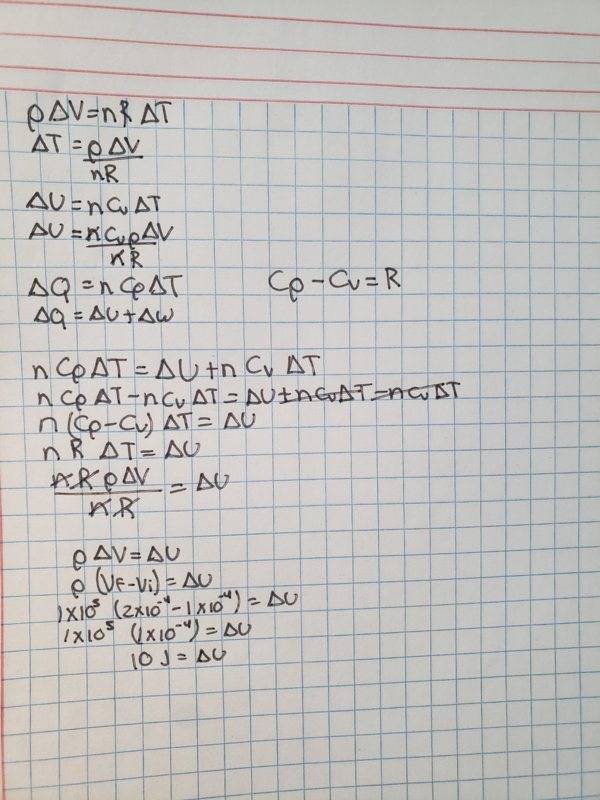
A monatomic ideal gas expands from 100cm³ to 200cm³ at a constant
pressure of 1.0 × 10⁵ Pa. Find the change in the internal energy of the gas.
Relevant Equations
Included in my attempt at a solution
Problem Statement: A monatomic ideal gas expands from 100cm³ to 200cm³ at a constant
pressure of 1.0 × 10⁵ Pa. Find the change in the internal energy of the gas.
Relevant Equations: Included in my attempt at a solution
?hash=c4678eef3b07e5626b30b43e36341bb0.jpg
 

Attachments

  • 20190801_183011.jpg
    20190801_183011.jpg
    67.6 KB · Views: 297
Physics news on Phys.org
You almost had it, but not quite. You had $$\Delta U=\frac{C_v}{R}P\Delta V$$And we know that, for a monatomic gas, $$C_v=\frac{3}{2}R$$Therefore,...
 
  • Like
Likes   Reactions: Dan13

Similar threads

Replies
4
Views
2K
  • · Replies 4 ·
Replies
4
Views
3K
  • · Replies 33 ·
2
Replies
33
Views
3K
  • · Replies 4 ·
Replies
4
Views
2K
  • · Replies 4 ·
Replies
4
Views
4K
  • · Replies 9 ·
Replies
9
Views
2K
Replies
5
Views
3K
  • · Replies 2 ·
Replies
2
Views
3K
Replies
4
Views
3K
  • · Replies 2 ·
Replies
2
Views
2K