How Does Mass Affect Spring Stretch in Hooke's Law?

Click For Summary
SUMMARY

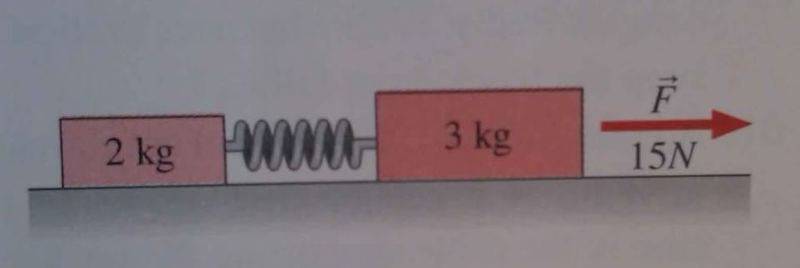
The discussion centers on the application of Hooke's Law to a system involving a 2.0 kg mass and a 3.0 kg mass connected by a massless spring with a spring constant of 140 N/m. When a 15 N force is applied to the 3.0 kg mass, the spring stretches 4.28 cm, calculated using the force acting on the 2.0 kg mass. The necessity of using the smaller mass for calculations is emphasized, as applying the force directly to the larger mass yields an incorrect result due to the direction of force affecting the spring's behavior.

PREREQUISITES
  • Understanding of Hooke's Law and spring constants
  • Basic principles of Newtonian mechanics
  • Knowledge of force and mass relationships
  • Familiarity with frictionless surface dynamics
NEXT STEPS
  • Study the implications of mass distribution in spring systems
  • Learn about force diagrams and their role in mechanics
  • Explore advanced applications of Hooke's Law in real-world scenarios
  • Investigate the effects of friction on spring dynamics
USEFUL FOR

Physics students, mechanical engineers, and anyone interested in understanding the dynamics of mass-spring systems and the application of Hooke's Law in practical situations.

mateomy
Messages
305
Reaction score
0
A 2.0 kg mass and a 3.0 kg mass are on a horizontal frictionless surface, connected by a massless spring with spring constant k=140N/m. A 15 N force is applied to the larger mass, as a shown (see picture). How much does the spring stretch from its equilibrium length?

hookesExample.jpg


I've solved this problem -the answer is 4.28cm- but I had to do it using the force on the smaller of the masses (2 kg). My question is why I have to take it from that mass? Why couldn't you just find it from the 3 kg mass, by just taking the initial 15 N force as proportional to the Force of the spring? If you do this the book says that answer is wrong. The physical interpretation of WHY we have to to find it from the 2kg force is eluding me.
 
Physics news on Phys.org
The direction of force makes all the difference.
 

Similar threads

Replies
17
Views
2K
Replies
3
Views
2K
  • · Replies 4 ·
Replies
4
Views
2K
  • · Replies 5 ·
Replies
5
Views
3K
  • · Replies 35 ·
2
Replies
35
Views
5K
  • · Replies 8 ·
Replies
8
Views
3K
  • · Replies 18 ·
Replies
18
Views
2K
  • · Replies 3 ·
Replies
3
Views
2K
  • · Replies 16 ·
Replies
16
Views
2K
Replies
13
Views
3K