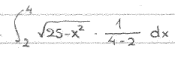
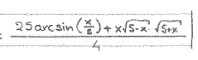
How does one jump from that integral to that integral?

  • Thread starter Thread starter fateswarm
  • Start date Start date
  • Tags Tags
    Integral Jump
Click For Summary
The discussion centers on the transition between two integrals, specifically questioning how to move from one integral to another without an apparent x^2 term. A factor of 1/(4-2) is noted within the integral, which is explained as stemming from a Uniform distribution U(2,4). Participants emphasize the importance of following a homework template for clarity and completeness in future posts. There is a clear directive for users to avoid responding to threads that do not adhere to these guidelines. Overall, the conversation highlights the need for structured problem presentation in mathematical discussions.
fateswarm
Messages
17
Reaction score
0
I had to do

RpAcqZS.png


but it was given as a shortcut that

cPMBHsZ.png


and the result was

lrNMhGU.png


How does one go from the 2nd to the 3d when there isn't an x^2 in the beginning there?
 
Physics news on Phys.org
The first integral looks funny. Why is there a factor of 1/(4-2) inside the integral?

In future, you should follow the homework template and state the complete, original problem, along with any work you have done toward finding the solution.
 
SteamKing said:
The first integral looks funny. Why is there a factor of 1/(4-2) inside the integral?

In future, you should follow the homework template and state the complete, original problem, along with any work you have done toward finding the solution.

It has no ambiguity, it is actually 1/(4-2). It was based on a Uniform distribution of U(2,4).
 
fateswarm, this is unacceptable. Please start a new thread and USE THE TEMPLATE. You may not substitute pictures, you must type it all in.

Helpers, please do not respond to threads that are missing the homework template or do not follow the rules.

Thank you.
 

Attachments

  • fateswarm.jpg
    fateswarm.jpg
    18.6 KB · Views: 429
Question: A clock's minute hand has length 4 and its hour hand has length 3. What is the distance between the tips at the moment when it is increasing most rapidly?(Putnam Exam Question) Answer: Making assumption that both the hands moves at constant angular velocities, the answer is ## \sqrt{7} .## But don't you think this assumption is somewhat doubtful and wrong?

Similar threads

  • · Replies 9 ·
Replies
9
Views
2K
  • · Replies 6 ·
Replies
6
Views
2K
  • · Replies 5 ·
Replies
5
Views
2K
Replies
2
Views
1K
  • · Replies 3 ·
Replies
3
Views
2K
Replies
2
Views
2K
  • · Replies 3 ·
Replies
3
Views
2K
  • · Replies 5 ·
Replies
5
Views
2K
Replies
7
Views
2K
Replies
9
Views
2K