Joymaker
- 1
- 0
Here's a little thought experiment that highlights a problem I'm having with angular momentum.
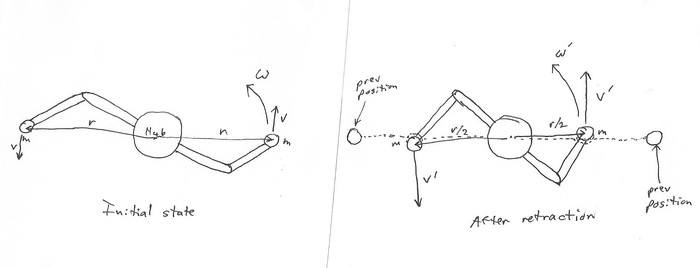
Here's my little experimental gizmo, spinning freely and leisurely in space. It has a hub and a pair of robot arms (whose mass we can ignore) holding a pair of masses m each at a distance r from the center. It is spinning with angular velocity ω, so that each mass is moving with speed v = rω. We'll view it at a snapshot in time when the radius vector lies along the X axis.
At a command from me, my gizmo will retract the robot arms until each mass is now r/2 from the center. It can do it very fast, so fast that only a tiny fraction of one rotation will have taken place during that time. 1°, let's say, just for example.
Now here's the problem. Regardless of the kinetic energy that was generated and wasted retracting the arm so fast, all that took place in the X direction (approximately). But my mass was moving with a linear momentum of p = mv in the Y direction. So this should be unchanged. We should now have r' = r/2, v' = v, ω' = v'/r' = 2ω. Spinning twice as fast as it used to be, which seems perfectly logical.
But no! Conservation of angular momentum works with the quantity Moment of Inertia: I = mr2. It declares that L = Iω = mvr is conserved. So once I have pulled in my masses, r' = r/2, v' = 2v, ω' = v'/r' = 4ω. My gizmo is now spinning four times as fast as it used to be. And the momentum of my mass in the Y direction is now p' = mv' = 2mv. How is it possible? How did a radial force (robot arm, pulling along X) give rise to a tangential acceleration (mass, moving faster along Y)? Seems to violate the laws of linear momentum!
Here's my little experimental gizmo, spinning freely and leisurely in space. It has a hub and a pair of robot arms (whose mass we can ignore) holding a pair of masses m each at a distance r from the center. It is spinning with angular velocity ω, so that each mass is moving with speed v = rω. We'll view it at a snapshot in time when the radius vector lies along the X axis.
At a command from me, my gizmo will retract the robot arms until each mass is now r/2 from the center. It can do it very fast, so fast that only a tiny fraction of one rotation will have taken place during that time. 1°, let's say, just for example.
Now here's the problem. Regardless of the kinetic energy that was generated and wasted retracting the arm so fast, all that took place in the X direction (approximately). But my mass was moving with a linear momentum of p = mv in the Y direction. So this should be unchanged. We should now have r' = r/2, v' = v, ω' = v'/r' = 2ω. Spinning twice as fast as it used to be, which seems perfectly logical.
But no! Conservation of angular momentum works with the quantity Moment of Inertia: I = mr2. It declares that L = Iω = mvr is conserved. So once I have pulled in my masses, r' = r/2, v' = 2v, ω' = v'/r' = 4ω. My gizmo is now spinning four times as fast as it used to be. And the momentum of my mass in the Y direction is now p' = mv' = 2mv. How is it possible? How did a radial force (robot arm, pulling along X) give rise to a tangential acceleration (mass, moving faster along Y)? Seems to violate the laws of linear momentum!