How Does the Two-Particle Green Function Relate to Hartree-Fock Theory?

Click For Summary

Discussion Overview

The discussion revolves around the relationship between the two-particle Green function and Hartree-Fock theory, exploring the mathematical connections and graphical representations in the context of many-body physics. Participants seek clarification on specific equations and concepts, as well as alternative approaches to understanding the theory.

Discussion Character

  • Exploratory
  • Technical explanation
  • Conceptual clarification
  • Debate/contested
  • Mathematical reasoning

Main Points Raised

  • One participant questions the relationship between a figure in a book and Hartree-Fock theory, specifically regarding the propagation of particles and the implications of time ordering.
  • Another participant suggests that writing the two-particle Green function as a product of single-particle Green functions leads to the Hartree-Fock equations, noting the complexity of the proof.
  • A participant expresses confusion about the matching of graphs to specific relations in the text and suggests that there may be an error in the graphical representation.
  • Some participants share resources, including a link to notes on Green functions, and offer to help simplify the concepts for those struggling with the material.
  • There is a request for a simpler approach to Hartree-Fock theory, contrasting it with the use of Wick's theorem, indicating a preference for more physically intuitive methods.
  • A participant expresses difficulty in understanding the transition between different formulations of the Hartree-Fock equations and seeks guidance on specific equations from the text.

Areas of Agreement / Disagreement

Participants do not reach a consensus on the clarity of the graphical representations or the best approach to understanding Hartree-Fock theory. Multiple competing views on the methods and proofs remain, with some participants expressing confusion and others offering resources and alternative explanations.

Contextual Notes

Participants mention specific equations and references to texts, indicating a reliance on particular notations and methods that may not be universally understood. There are unresolved questions regarding the clarity of the proofs and the relationships between different formulations of the theory.

Rzbs
Messages
52
Reaction score
11
TL;DR
relation between two-particle green function and Hartree-Fock
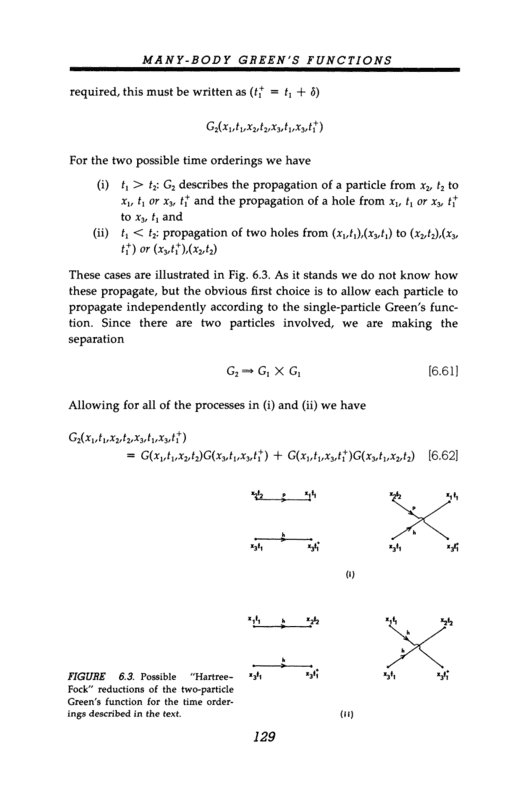
could anyone explain why in the page of book this figure is related to hartree-fock? I mean why if t1>t2 we have these possibilities? and why not particle propagate from x2t2 to x3t3 instead x3t3+?
1596383273547.png
1596383273547.png
 
Physics news on Phys.org
Because you can show that if you write ##G_{12} = G_1G_2## you can get HF equations. It's not difficult but it's not easy as well. I can look up my old notes if you are interested in a formal proof.
 
  • Like
Likes   Reactions: Rzbs
dRic2 said:
Because you can show that if you write ##G_{12} = G_1G_2## you can get HF equations. It's not difficult but it's not easy as well. I can look up my old notes if you are interested in a formal proof.
Thanks very much for your answer
I really want to why these spliting of G2 result in HF and I want to match the graphs to relation 6.62 but I think the right-up graph does'n match to any of G1s.
I will be grateful if you check your notes or introduce a book with similar notation of this book: Inkson, manybody theory of solids.
 
fateme said:
but I think the right-up graph does'n match to any of G1s.
It looks like an error to me too, but don't take my world without checking for yourself.

Anyway I'll be back this afternoon or tomorrow because I need some time to find and make sense of my notes again o0)
 
Thanks again for replying.
 
Last edited:
Thanks a lot but I think it's not the thing I'm looking for. Because I am new in many-body physics I want a simple approach and according to Inkson's book there are two approaches "equation of motion method ...more physically understandable than the use of wick's theorem" . And many of books I think use wick theorem, whereas I need another method.
So I think I need a proof for HF like its proof for Hartree potential.
Screenshot_20200805-091802.png
 
The article I linked says exactly the same things as the one you posted. What is not clear to you ?
 
Actually I didn't follow the proof and it's notations. I can't understand the relation between the HF formula that was in the first chapter and the HF formula in terms of green function; It's not clear to me. I want to start with 6.66 eq. and reach to 1.30 or 1.31 eq. It's not clear for me at all how can I do this.
Screenshot_20200805-180140.png
 

Similar threads

  • · Replies 9 ·
Replies
9
Views
4K
  • · Replies 4 ·
Replies
4
Views
3K
  • · Replies 1 ·
Replies
1
Views
2K
  • · Replies 3 ·
Replies
3
Views
3K
  • · Replies 1 ·
Replies
1
Views
3K
  • · Replies 13 ·
Replies
13
Views
3K
  • · Replies 0 ·
Replies
0
Views
1K
  • · Replies 1 ·
Replies
1
Views
1K
  • · Replies 1 ·
Replies
1
Views
2K
  • · Replies 1 ·
Replies
1
Views
2K