How does this fit the equation of a hyperbola?

  • Thread starter Thread starter sparkle123
  • Start date Start date
  • Tags Tags
    Fit Hyperbola
Click For Summary

Homework Help Overview

The discussion revolves around the equation of a hyperbola and its application in modeling enzyme-catalyzed reactions, specifically how the initial rate of reaction (vo) relates to substrate concentration ([S]).

Discussion Character

  • Exploratory, Conceptual clarification, Mathematical reasoning

Approaches and Questions Raised

  • Participants explore the definitions of variables involved in the hyperbola equation and their relevance to the model. Questions arise about how the model connects to the hyperbola's characteristics, particularly in terms of plotting and understanding asymptotes.

Discussion Status

Some participants have provided clarifications regarding the definitions of the variables and have noted the relationship between the model and the hyperbola. There is an ongoing exploration of the geometric parameters and their significance in the context of the problem.

Contextual Notes

Participants are discussing the implications of the parameters a and b in relation to the hyperbola's geometric properties and the relevance of asymptotes in the specific case of the enzyme-catalyzed reaction model.

sparkle123
Messages
172
Reaction score
0
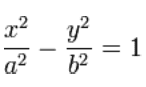
As far as I know, a hyperbola has the equation
a50e632b.png

So how does this (below) work?
04b1aca6.png

Thanks!
 
Physics news on Phys.org
Do you have the definitions of v0, S and ?
 
is substrate concentration
vo is the initial rate of an enzyme-catalyzed reaction
Thanks!
 
sparkle123 said:
is substrate concentration
vo is the initial rate of an enzyme-catalyzed reaction
Thanks!


Ah, so we're talking about a model where vo is predicted based on a substrate concentration .
I presume the model leads to the formula you presented?

I guess you should know that y = 1/x also describes a hyperbola with its asymptotes aligned with the coordinate axes.
If you would draw a plot of your formula, you'll see that it is a hyperbola.

You can see that for instance here: http://www.wolframalpha.com/input/?i=Plot[(2+x)/(3+++x),+{x,+-15,+15}

The parameters a and b seem to be arbitrary parameters that do not describe the geometric shape of the hyperbola.
I could find out what the actual geometric parameters are, but I suspect that's not really relevant in your case?

[EDIT]I guess that was is relevant in your case is the location of the asymptotes, which are at = -b and at v0 = a [/EDIT].
 
Last edited by a moderator:
Thank you! :)
 

Similar threads

Replies
4
Views
4K
  • · Replies 29 ·
Replies
29
Views
4K
Replies
7
Views
2K
  • · Replies 5 ·
Replies
5
Views
2K
  • · Replies 3 ·
Replies
3
Views
2K
  • · Replies 6 ·
Replies
6
Views
2K
Replies
5
Views
3K
  • · Replies 19 ·
Replies
19
Views
2K
  • · Replies 13 ·
Replies
13
Views
3K
  • · Replies 1 ·
Replies
1
Views
2K
