How Is Equation 15.5.7 Derived in Schaum's Outline of Quantum Mechanics?

Click For Summary

Homework Help Overview

The discussion revolves around the derivation of Equation 15.5.7 from Schaum's Outline of Quantum Mechanics, specifically focusing on the mathematical relationships and substitutions involved in the process.

Discussion Character

  • Exploratory, Mathematical reasoning, Assumption checking

Approaches and Questions Raised

  • Participants explore the use of trigonometric identities and complex exponentials in deriving the equation. Questions arise regarding the interpretation of components in the equations and the conditions under which certain relations hold true.

Discussion Status

There is an ongoing exploration of different approaches to derive the equation, with some participants suggesting specific substitutions and others questioning the assumptions behind the relationships. No consensus has been reached, but various lines of reasoning are being discussed.

Contextual Notes

Participants are working within the constraints of the equations provided in the outline, and there is some ambiguity regarding the interpretation of the terms involved, particularly concerning the orthogonality of functions and the implications of certain substitutions.

jhon
Messages
21
Reaction score
0
in Schaum's Outline of Theory and Problems of Quantum Mechanics

how did they got eq 15.5.7
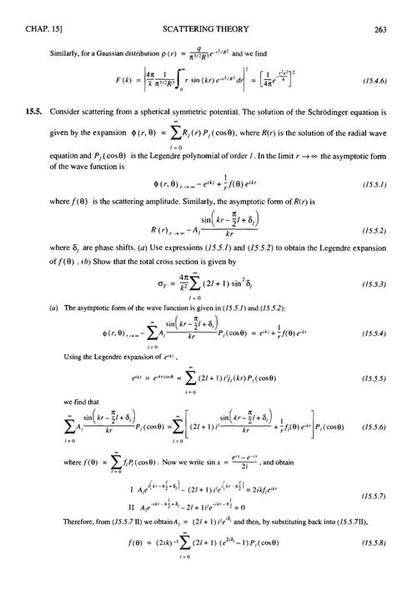
qpnns5.jpg
 
Physics news on Phys.org
Did you try using the relation

\sin[x]=\frac{\exp[ix]-\exp[-ix]}{2i}

in Equation 15.5.6 and expanding to see what you get? It looks like you should get the result they obtain if you work at it using that relation.
 
the second eq II ?? it's equale zero why??
 
If you have expanded Equation 15.5.6 using the substitution given, try separating the resulting equation into the real and imaginary components. It looks to me like Equation I in 15.5.7 is the imaginary part and Equation II of 15.5.7 is the real part after substituting for \sin[x].
 
I don't think that the two parts of 15.5.7 are the real and imaginary parts of 15.5.6, but rather they result from the fact that e^{ikr} and e^{-ikr} are orthogonal functions of r, and hence the relation \alpha e^{ikr}+\beta e^{-ikr}=0[/itex] can only be true for all r if \alpha=\beta=0.
 
jdwood983 and gabbagabbahey thanks for help
 

Similar threads

  • · Replies 27 ·
Replies
27
Views
2K
  • · Replies 14 ·
Replies
14
Views
3K
  • · Replies 15 ·
Replies
15
Views
2K
  • · Replies 10 ·
Replies
10
Views
2K
Replies
3
Views
2K
  • · Replies 22 ·
Replies
22
Views
4K
  • · Replies 1 ·
Replies
1
Views
2K
  • · Replies 24 ·
Replies
24
Views
8K
  • · Replies 26 ·
Replies
26
Views
9K
Replies
2
Views
2K