How is Radius of Curvature Computed for a Given Curve?

Join the discussion
Registration is free. Ask a follow-up in this thread, or start your own.
2 replies · 2K views
WMDhamnekar
MHB
Messages
382
Reaction score
31
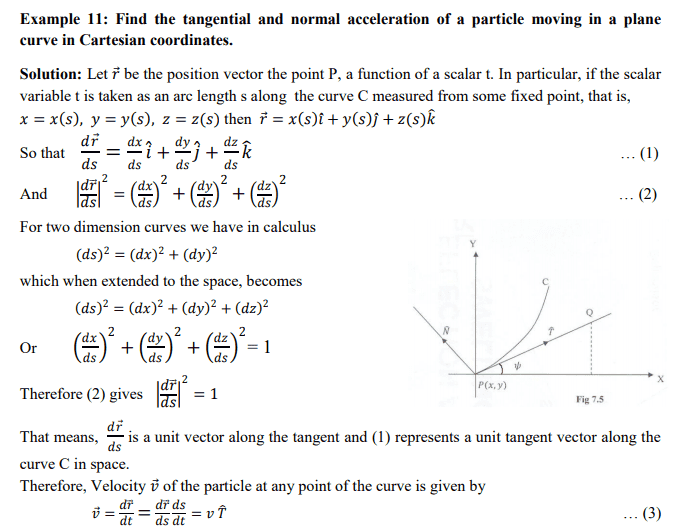
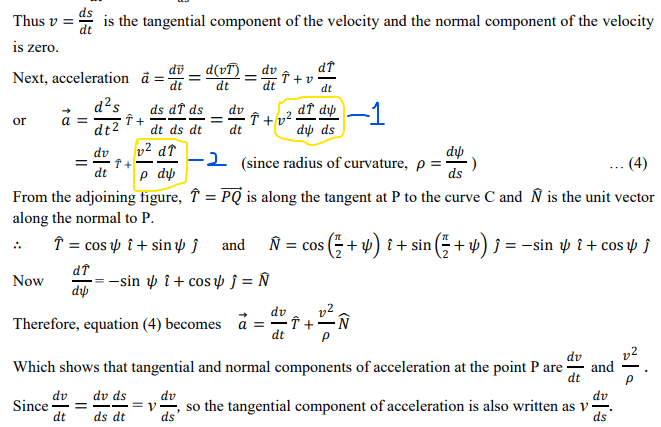
How did the author compute the highlighted term 2 from the highlighted term 1 in the following answer to the given question?

If $\rho =\frac{d\psi}{ds}$, then the term 2 should be $\upsilon^2 \frac{d\hat{T}}{d\psi}\rho$, but instead, it was written $\frac{\upsilon^2}{\rho}\frac{d\hat{T}}{d\psi}$

How is that computed? How to compute radius of curvature($\kappa$) if $\frac{d\hat{T}}{ds}= \kappa\hat{N}$
1626960504370.png

1626960525120.png
 
Last edited:
Physics news on Phys.org
It's a typo. Look at the units real quick. s has units of length and [math]\psi[/math] in is radians (or so I suppose, to make the derivatives right), which means [math]\psi[/math] is essentially unitless. So [math]\dfrac{d \psi }{ds}[/math] has units of 1 / length. Thus it's reasonable to suppose that [math]\dfrac{d \psi }{ds} = \dfrac{1}{ \rho }[/math]. You can look up the formula online... I checked it.

-Dan
 
To add to topsquark's answer, the radius of curvature is the radius of the circle that "fits" the curve.
If we traverse an angle $d\psi$ on a circle with radius $\rho$, we traverse an arc length of $ds=\rho\,d\psi$.
In other words, by definition we have $\rho = \frac{ds}{d\psi}$, which we can also write as $\frac{d\psi}{ds}=\frac 1\rho$ by the inverse function theorem.

This is also what the actual equation (4) and subsequent equations show. They just misquoted the definition of radius of curvature, but they did apply the real definition correctly.
 
Last edited: