rnielsen25
- 25
- 1
Hi everyone.
I'm trying to derive the formula for the characteristic age of a pulsar.
What I'm starting with is the following differential equation.
dP/dt=K*P2-n
What i think is odd, is several places they say solving this differential equation gives the following solution.
T=(P/((n-1)*dP/dt))*(1-(P0/P)n-1
Here is a picture of the equation too:
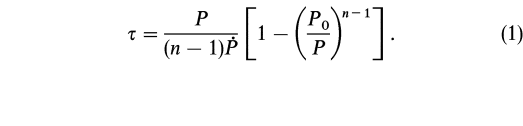
But how do you get from equation 1. to this equation.
Please help me out, if you could explain it step by step, i would really appreciate it.
Because it doesn't make sense if you're trying to separate both variables and integrate?
I'm trying to derive the formula for the characteristic age of a pulsar.
What I'm starting with is the following differential equation.
dP/dt=K*P2-n
What i think is odd, is several places they say solving this differential equation gives the following solution.
T=(P/((n-1)*dP/dt))*(1-(P0/P)n-1
Here is a picture of the equation too:
But how do you get from equation 1. to this equation.
Please help me out, if you could explain it step by step, i would really appreciate it.
Because it doesn't make sense if you're trying to separate both variables and integrate?
Last edited by a moderator: