How is Torque Shared in Equilibrium?

  • Context: Undergrad 
  • Thread starter Thread starter Curious3
  • Start date Start date
  • Tags Tags
    Torque
Click For Summary

Discussion Overview

The discussion centers on the concept of torque in systems at equilibrium, particularly in scenarios involving multiple forces and distances, such as a see-saw. Participants explore how torque is shared and whether forces or torques must be equal in various configurations.

Discussion Character

  • Exploratory
  • Technical explanation
  • Debate/contested

Main Points Raised

  • One participant questions how torque operates in equilibrium when multiple forces are involved, particularly in a see-saw scenario with applied torque on one side.
  • Another participant states that for static equilibrium, both forces and torques must sum to zero.
  • A participant expresses difficulty in solving for unknowns in a system with multiple forces, indicating a relationship like x+y=T where x and y are unknowns.
  • Some participants note that systems with too many unknown forces are termed "statically indeterminate" and require additional equations involving material properties to solve.

Areas of Agreement / Disagreement

Participants generally agree that both forces and torques must sum to zero for static equilibrium. However, there is uncertainty regarding the specific conditions under which forces or torques are equal, and the discussion remains unresolved regarding the implications of statically indeterminate systems.

Contextual Notes

The discussion highlights limitations in solving for unknowns in statically indeterminate systems and the need for additional information regarding material properties, which may not be fully addressed in the current context.

Curious3
Messages
7
Reaction score
0
Hey there, I'm trying to figure out how torque operates in combination and I can't find anything relating to this in any textbooks or online.

So if you a mass held by two strings in equilibrium, the force of gravity is split evenly between them right?
What happens if you have torque instead of a linear force?

A common example I have seen when looking around is that if you have three masses at known distances on a see-saw in equilibrium and you know two of the masses you can solve for the third.
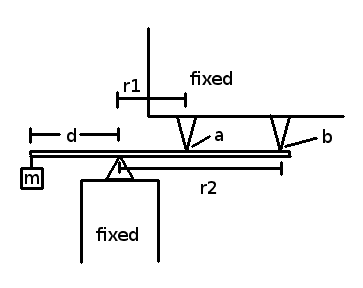
But now what happens if you have a system in equilibrium where you apply a torque on one side of the see saw which is opposed by two forces at different distances on the other?

I came up with a concrete example in the figure below so it is more clear.

Are the forces equal or are the torques equal? Or perhaps neither?
proxy.php?image=http%3A%2F%2Fi.imgur.com%2FvLvKC60.png
 
Physics news on Phys.org
For an object to be in static equilibrium both the forces and the torques must sum to 0.
 
DaleSpam said:
For an object to be in static equilibrium both the forces and the torques must sum to 0.

Right this is what I've been using to try to figure it out but I get stuck with something like x+y=T where x and y are unknown.
 
Yes, it is possible to have a system where you have too many unknown forces to solve. Such a system is known as "statically indeterminate".

In order to solve such a system you have to include the material properties of the beam and calculate the amount of stress and strain. This adds additional equations and gives you a system you can solve.
 
DaleSpam said:
Yes, it is possible to have a system where you have too many unknown forces to solve. Such a system is known as "statically indeterminate".

In order to solve such a system you have to include the material properties of the beam and calculate the amount of stress and strain. This adds additional equations and gives you a system you can solve.

Awesome, thank you so much!
 

Similar threads

  • · Replies 14 ·
Replies
14
Views
2K
  • · Replies 30 ·
2
Replies
30
Views
3K
  • · Replies 4 ·
Replies
4
Views
2K
  • · Replies 10 ·
Replies
10
Views
4K
  • · Replies 14 ·
Replies
14
Views
2K
  • · Replies 10 ·
Replies
10
Views
2K
  • · Replies 39 ·
2
Replies
39
Views
4K
  • · Replies 60 ·
3
Replies
60
Views
7K
  • · Replies 8 ·
Replies
8
Views
2K
  • · Replies 4 ·
Replies
4
Views
2K