How to avoid DC bias on output?

  • Thread starter Thread starter sherrellbc
  • Start date Start date
  • Tags Tags
    Bias Dc Output
Click For Summary

Discussion Overview

The discussion revolves around a BJT amplifier design issue, specifically addressing the problem of increasing DC bias observed at the output. Participants explore potential causes and solutions related to capacitor orientation and circuit behavior, with a focus on both theoretical and practical aspects of the circuit design.

Discussion Character

  • Technical explanation
  • Debate/contested
  • Experimental/applied

Main Points Raised

  • One participant reports an increasing DC bias on the output of their BJT amplifier, initially measuring around 2.11V and creeping up to approximately 3V.
  • Another participant suggests that the capacitor C2 may be installed backward, which could lead to improper functioning.
  • Concerns are raised that if C2 was indeed installed backward and passed DC, it might be damaged, although some participants believe the resistor values would limit the leakage current and likely prevent destruction.
  • There is a mention of the time constant associated with C2 and R4, indicating that it may take time for the DC voltages to stabilize after correcting the capacitor orientation.
  • Several participants express uncertainty about how to correctly orient electrolytic capacitors and discuss the importance of markings on the capacitors for identifying polarity.
  • One participant raises a question about the behavior of capacitors in AC designs or when AC is biased with DC, indicating a broader context for the discussion.
  • Another participant notes that in the absence of a signal, certain points in the circuit should exhibit expected voltage levels, reinforcing the importance of correct capacitor installation.

Areas of Agreement / Disagreement

Participants generally agree that the orientation of capacitor C2 is critical to the circuit's performance, but there is no consensus on the extent of damage that may have occurred if it was installed incorrectly. The discussion remains unresolved regarding the best approach to fully address the DC bias issue.

Contextual Notes

Participants mention the potential for electrolytic capacitors to fail or behave unpredictably if installed backward, highlighting the need for careful handling and installation. The discussion also touches on the time required for circuit components to stabilize after adjustments.

Who May Find This Useful

This discussion may be useful for electronics students, hobbyists working with BJT amplifiers, and professionals troubleshooting similar circuit issues related to capacitor orientation and DC biasing.

sherrellbc
Messages
83
Reaction score
0
I designed the BJT amplifier below. After substituting in for the values of the actual resistances measured in lab, I reran the simulation. The hand calculation I derived for the gain was nearly spot on with what I was seeing in Multisim.

Now, when in lab I get approximately the same value I should. The only issue is that I seem to have some sort of increasing DC bias on the output. The output will first start out at around 2.11V and slowly creep up until around 3V.

What can I do to avoid this problem? I thought perhaps by adding a larger capacitance, but it did not change much.
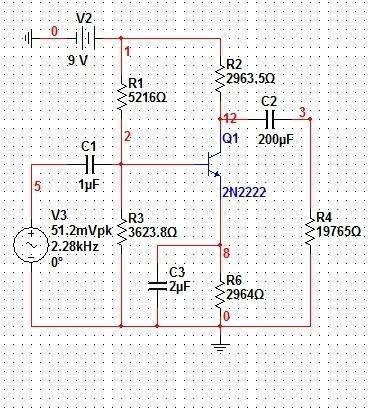
261z0o7.jpg
 
Engineering news on Phys.org
Sounds like C2 is installed backward.

At 200 uf it has to be electrolytic...
Its + side should go to the node of Q1 & R2 (your point 12), its - side to R4 (your point 3).
 
if C2 was backward and passed DC for a good bit, it's likely fried. then get a new C2 and put it in correctly.
 
rbj said:
if C2 was backward and passed DC for a good bit, it's likely fried. then get a new C2 and put it in correctly.

The size of the resistors in the circuit will limit the leakage current to less than a milliamp, so it's unlikely you destroyed it.

But after you connect it the right way round, it might take a little while before the capacitance and leakage current settle down to stable values (the chemistry going on inside the capacitor needs to get back to normal). If your measurements still seem to be drifting, just leave it running for an hour and then see what it's doing.
 
C2 and R4 have a time constant of around 4 seconds. You will have to wait for several seconds for DC voltages to settle (and change)
What is R4? (20000ohms?)
 
AlephZero said:
The size of the resistors in the circuit will limit the leakage current to less than a milliamp, so it's unlikely you destroyed it.

yeah, you're right. 20K ain't much of a load.

i've seen electrolytics literally explode when stuck in backwards. it ain't purty.
 
jim hardy said:
Sounds like C2 is installed backward.

At 200 uf it has to be electrolytic...
Its + side should go to the node of Q1 & R2 (your point 12), its - side to R4 (your point 3).

I am always unsure when it comes to wiring up electrolytic capacitors. How can you be certain which way to orient them?
 
sherrellbc said:
I am always unsure when it comes to wiring up electrolytic capacitors. How can you be certain which way to orient them?

They have markings on them that indicate the positive and/or negative terminals

attachment.php?attachmentid=57791&stc=1&d=1365744386.jpg


attachment.php?attachmentid=57792&stc=1&d=1365744386.jpg


Dave
 

Attachments

  • cap1.jpg
    cap1.jpg
    6.6 KB · Views: 493
  • cap2.jpg
    cap2.jpg
    4.4 KB · Views: 573
If you are working with DC then it's easy. What about when you implement them in AC design? Or AC biased with DC as in the BJT amplifier above?
 
Last edited:
  • #10
sherrellbc said:
I am always unsure when it comes to wiring up electrolytic capacitors. How can you be certain which way to orient them?
When in doubt, a multimeter will confirm the DC polarity.
 
  • #11
Observe on your schematic that, in absence of signal, point 12 will be positive about five or six volts (Vsupply minus Icollector R2)

and since the capacitor should block DC, point 3 will be zero.

So the cap should go + side to 12.

When installed backward , electrolytic capacitors don't block DC at all well. They'll 'leak' in the milliamps range. They eventually lose capacitance and some chemistrys like solid tantalum will even catch fire. (I was worried there might be one in my pacemaker that got recalled...)
When installed forward they do a good but not perfect job - DC leakage might be as much as a microamp ..


look to cornell dubelier website for their capacitor tutorials. Like everything else they are a world unto themselves...
 

Similar threads

  • · Replies 16 ·
Replies
16
Views
2K
  • · Replies 1 ·
Replies
1
Views
2K
  • · Replies 11 ·
Replies
11
Views
5K
  • · Replies 15 ·
Replies
15
Views
4K
Replies
9
Views
8K
  • · Replies 15 ·
Replies
15
Views
3K
  • · Replies 17 ·
Replies
17
Views
3K
  • · Replies 2 ·
Replies
2
Views
4K
  • · Replies 7 ·
Replies
7
Views
5K
Replies
2
Views
3K