How to calculate a pressure drop in a branch of a loop ring pipe

Click For Summary
Calculating pressure drop in a loop ring system requires detailed attention to each branch, including flow rates, pipe sizes, and lengths. The initial formula used worked for the main loop but not for all branches, indicating a need for adjustments. It is essential to include flow, pressure, and dimensions in the diagram for clarity and accuracy. A sanity check should be performed to ensure total usage flow matches compressor flow, and discrepancies should prompt recalculation using a Moody Diagram. For further study, "Compressed Air and Gas Data" by Charles W. Gibbs is recommended as a comprehensive resource.
Amaelle
Messages
309
Reaction score
54
Good day I'm trying to calculate the pressure drop in each branch of the following loop ring system
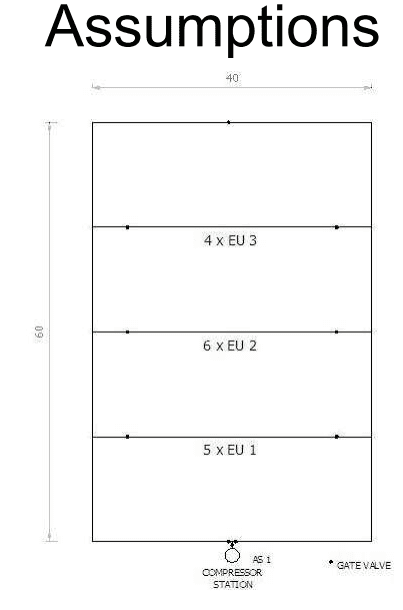
graph1 (1).png

I used the following formula to find the pressure drop
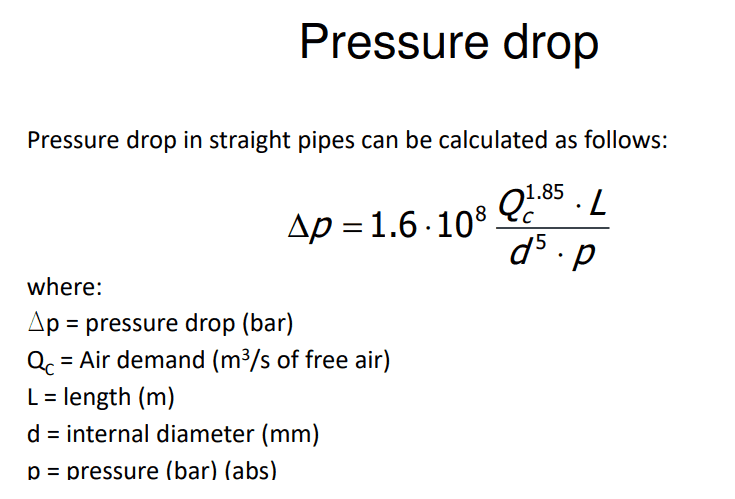
formula (1).png


but i seems that it worked only for the ring, and the branch #2 ( the branch in the middle), the solution given by the professor show different results for the other branch!( in each branch there is one valve and one reducer)
any help would be highly appreciated!
best regards
 
Engineering news on Phys.org
What? Only one compressor? You lucky person.

On these type of problems add the estimated/calculated flows to each pipe, and to the points of usage to the diagram. Then add the calculated pressure drop for each segment. It makes the problem much easier to understand, easier to communicate to others, and easier for somebody else to check your work. Also include pipe sizes, lengths, and units for all dimensions.

Some simplification is necessary in large complex systems. I once designed a heated water system with over 750 points of use, so have some experience at this.
 
  • Like
Likes Amaelle
Thank you jrmichler so let me write everything in detail
The candiate has to size the loop ring pipe and primary air receiver AS1 in a compressed air system given that
  • Standard conditions
  • Compression ratio 7
  • P1= 1bar we consider the temperature constant over the pipeline
  • so P1V1=P2V2 so P2=7 bar

1569399835869.png

AC= required compressed air
so the the volume of the AS1=12,28m3
my problem comes in the calculation of the pressure drop in the the first and last branch ( those values displayed in the image are those of my professor)
exercice.png


for the calcuculated diameter=sqrt((FR/AV)*4/pi)

the nominal and internal diameters have been taken from this table
1569401113959.png


I used this formula
1569401154192.png

to calculate the pressure drop in all branches but seem to work only for the main loop!
thanks!
 
Your chart does not clearly tell me what the pressure and flow are, and where. Each segment of pipe has a flow, so add the flows to the diagram. Each segment of pipe has a flow, a length, a diameter, and a pressure drop. Add the lengths and diameters to the diagram. Calculate the pressure at each junction, starting with the compressor, and add those numbers to the diagram. Show each point of use with a short arrow pointing away from the pipe, and add the flow at each of those arrows.

Then go through and check. Make sure that total usage flow equals compressor flow. Look at the pressure drops and see if anything does not make sense. This is called a sanity check, and is done without calculations. If you cannot find anything wrong, then it's time to recalculate the pressure drops using a Moody Diagram (search the term if you are not familiar with it).

Make sure that the finished diagram is clear and easy to read.
 
  • Like
Likes Amaelle
Thanks a lot for your long reply
I would be very grateful if you could show me some ressources where i can study the pressure drop in the pnemumatic conveying more in depth!
thanks a million!
 
An excellent book on compressed air systems is Compressed Air and Gas Data, edited by Charles W. Gibbs, and published by Ingersoll-Rand Company. I see that it is available used from Amazon. Highly recommended.

It's more than you need if you only need to size pipes and calculate pressure drops. For that, the Moody Diagram is enough. But for understanding complete systems, it is possibly the best source available.
 
  • Informative
Likes Amaelle
thanks!
 

Similar threads

  • · Replies 31 ·
2
Replies
31
Views
4K
  • · Replies 5 ·
Replies
5
Views
2K
  • · Replies 2 ·
Replies
2
Views
2K
  • · Replies 11 ·
Replies
11
Views
2K
Replies
1
Views
4K
Replies
4
Views
2K
Replies
13
Views
4K
  • · Replies 5 ·
Replies
5
Views
3K
  • · Replies 4 ·
Replies
4
Views
3K